
A printing-plant contractor inserts a USB stick into the engineering workstation that is allowed to download to the press PLCs. Those PLCs have no USB ports. Which threat remains?
Select an answer to reveal the explanation.
Short Explanation
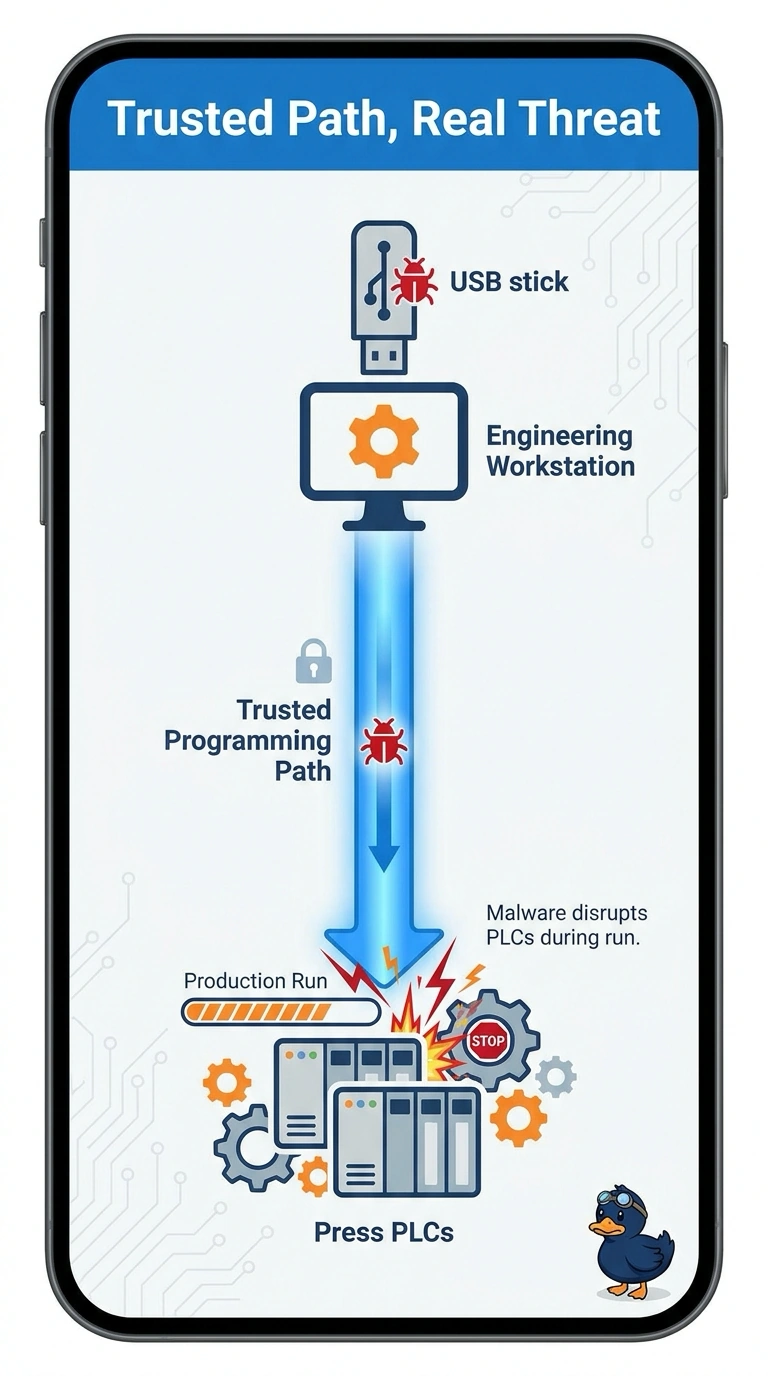
The office that already holds a key to the press is the door that matters. You can compromise the engineering workstation from a USB stick and ride that trusted path into the PLCs. No USB port on the controller does not close the path.
Full Explanation
The engineering workstation is allowed to download to the press PLCs, so it is already inside the trust of the cell. Malware that runs there, introduced from the contractor USB stick, can use that programming path to change logic, lock the station, or disrupt the presses during the run. The PLCs do not need USB ports of their own for that path to exist. Immunity based on the missing PLC port looks at the wrong device. The initial media hits the workstation, and the workstation is the programmer. Treating the loss as only the stick itself ignores what the stick can execute on a machine that already speaks to the controllers. Removable-media malware is not confined to file servers. Engineering workstations are ordinary computing hosts plus a path into the process, which is why this class of incident shows up in plants and not only in office shares. Exam caveat: the stick might also be a file the contractor meant to copy. The threat judgment starts from the workstation that can program PLCs, then you confirm whether the media was authorized. Operational check: see whether that workstation still allows removable media, and tie any programming session from it to a named person and a ticket.