
A substation permits or denies only TCP port 102 between protection panels and assumes that filter covers IEC 61850 trip messages carried by GOOSE. The relays use native Ethernet GOOSE. Which statement is correct?
Select an answer to reveal the explanation.
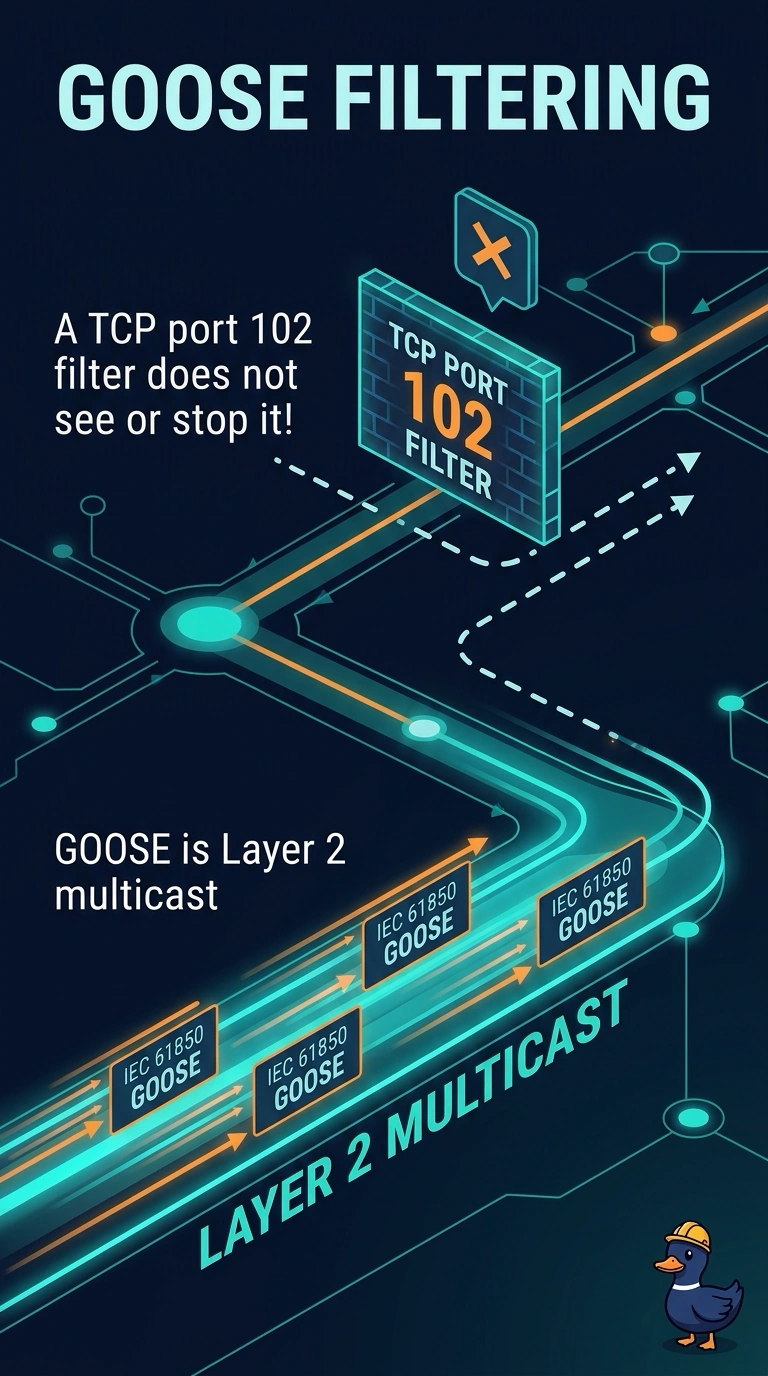
Short Explanation
GOOSE trips are shouts across the local room, not letters mailed through TCP port 102. You can filter that port all day and still miss the multicast the relays send at Layer 2. The trap is treating MMS and GOOSE as one and the same session.
Full Explanation
IEC 61850 MMS uses TCP port 102, the ISO-TSAP port, for client and server exchanges. GOOSE is a different service: it is Layer 2 multicast on the protection LAN, and it never becomes a TCP session. An access list that only permits or denies TCP 102 does not see GOOSE frames and cannot stop a trip those relays send to each other. An IP rule matching TCP 102 does not match native Ethernet GOOSE. Routable GOOSE is a separate IEC 61850 profile using IP and UDP. Putting GOOSE inside the MMS TCP session is the mix-up. Closing or opening port 102 changes MMS reachability and leaves GOOSE untouched. GOOSE is not OPC UA, and it is not unicast on TCP port 4840. That port is the usual OPC UA binary port, a different protocol in a different industry pattern. A login banner on a relay is a management notice. It does not confine Ethernet multicast, and GOOSE will still be forwarded on the protection VLAN according to the switch, not according to the banner text. Exam caveat: a TCP 102 filter is still worth having for MMS. The limit is that it is not a GOOSE control, even though both services belong to the same IEC 61850 family. Operational check: a capture on the protection LAN during a test trip should show GOOSE as Ethernet multicast with no TCP header, while an MMS client shows TCP port 102.