
A bottling line uses PROFINET cyclic input-output between a PLC and its drives. An engineer wants to route that cyclic traffic across the plant WAN to a distant cabinet. Which statement is correct?
Select an answer to reveal the explanation.
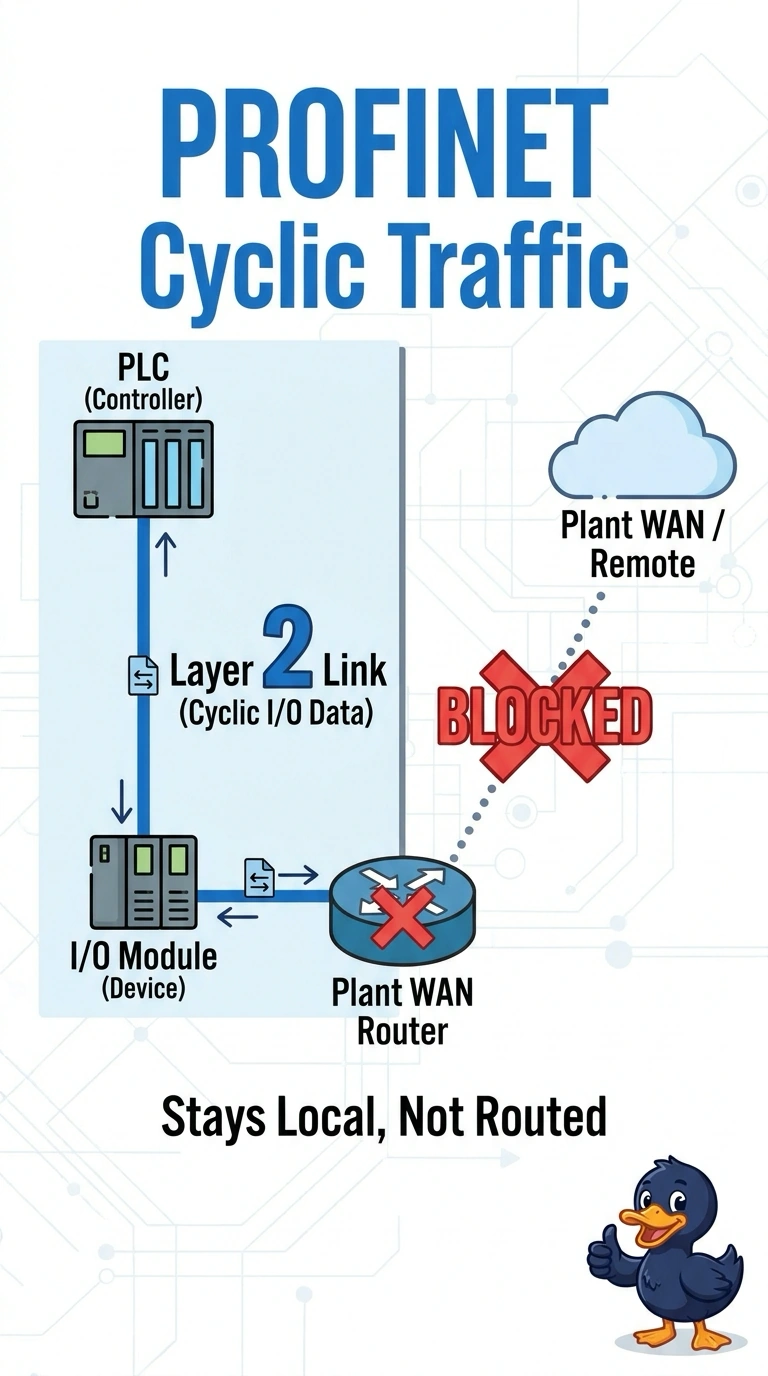
Short Explanation
Cyclic PROFINET between a PLC and its drives is a shout across one room, not a letter you can drop in a distant mailbox. You cannot treat that cyclic input-output as ordinary TCP and route it across the plant WAN. A substation multicast or a telemetry broker does not turn it into a routed stream.
Full Explanation
PROFINET cyclic input-output, the real-time exchange between a PLC and its drives, is Layer 2 Ethernet. It is not an IP conversation a router forwards across a WAN the way it forwards web traffic. The correct statement is that this cyclic traffic is not meant to be routed to a distant cabinet. Calling it ordinary TCP invents a transport the cyclic frames do not use, so a router will not carry them as if they were browsing sessions. GOOSE is also Layer 2 multicast, used for fast peer messages such as trips inside a substation. Converting a bottling line to GOOSE would not create a routed WAN path, and it would misuse a protection mechanism on a packaging line. MQTT on port 1883 is a publish-subscribe telemetry channel. It is not a required replacement before a drive can move, and it does not turn an existing cyclic PROFINET relationship into a routed one. Exam caveat: PROFINET can carry some engineering and diagnostic traffic over IP. That channel is not the cyclic input-output this engineer wants to stretch across the WAN. Operational check: the drive cabinet should stay on the same Layer 2 cell as the PLC, and a route map toward the WAN should not be the design for that cyclic exchange.