
A gas-plant lead writes down what the site actually does today, then writes a separate description of the outcomes the board wants within two years. In the NIST Cybersecurity Framework, what are those two descriptions?
Select an answer to reveal the explanation.
Short Explanation
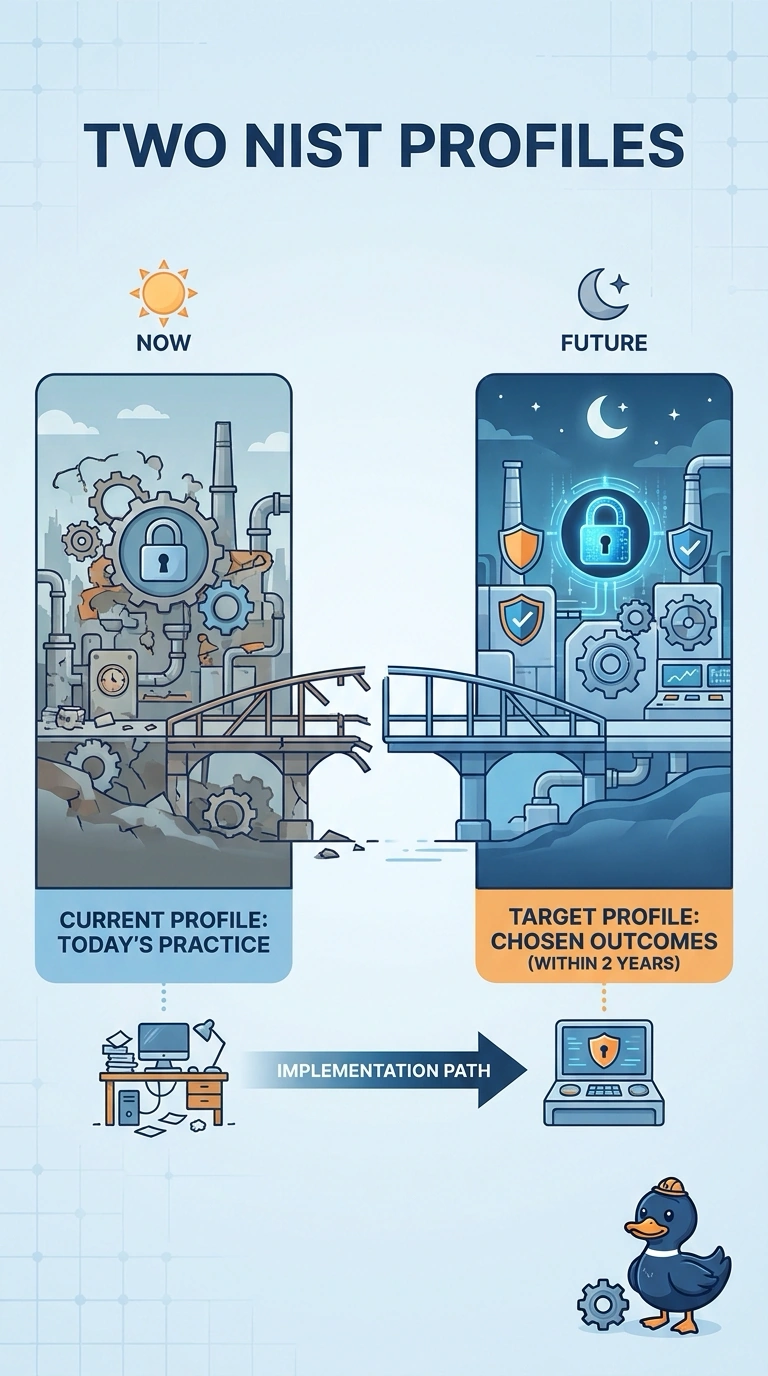
You describe the plant’s present outcomes with a Current Profile and the outcomes it has chosen to reach with a Target Profile. You are documenting outcomes, not a purchase order disguised as a framework. Purdue levels and CSF tier names do not replace that profile pair.
Full Explanation
NIST CSF uses a Current Profile to describe the cybersecurity outcomes the organization achieves now and a Target Profile to describe the outcomes it has chosen to aim for. The gas plant’s separate descriptions—today’s practice and the board’s desired state within two years—are those profiles. Profiles describe outcomes; the CSF specifies cybersecurity outcomes rather than mandating a particular vendor product. The organization can document its selected implementations when planning how to meet those outcomes. CSF Tiers are Partial, Risk Informed, Repeatable, and Adaptive. They describe how systematically the organization manages risk; they are four tiers, not a pair of scores, and cannot substitute for the Current and Target Profiles. Purdue levels place functions in the plant, from the process up through the enterprise, but do not record a two-year cybersecurity outcome statement. IEC 62443 security levels express how capable an attacker a zone is meant to resist. Calling today’s state SL1 and a post-budget state SL4 mixes security levels with a spending plan and does not describe the profiles the lead wrote. Exam caveat: a plant can have a Target Profile while sitting at a modest tier; the profile pair does not itself become a tier score. Practical check: the Current Profile should cite practices already in place at the gas plant, while the Target Profile should list the selected outcomes it aims to achieve.