
A cement plant calls the kiln network an air gap because no permanent route exists to the office. Technicians carry the engineering laptop from the office into the kiln cabinet several times a week. Which judgment fits?
Select an answer to reveal the explanation.
Short Explanation
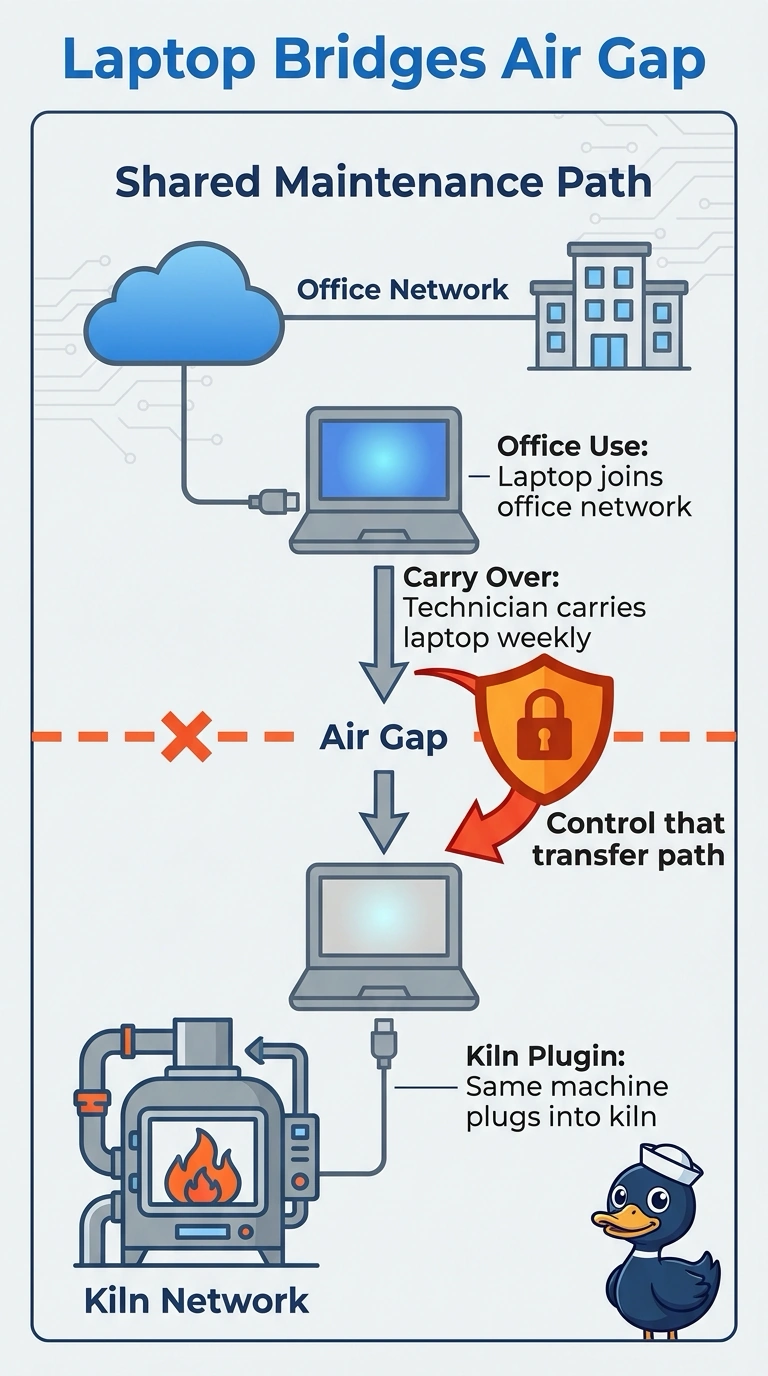
An air gap with a weekly laptop commute is a moat the crew rows across themselves. You do not have isolation while that machine lives in the office and then plugs into the kiln. The trap is counting only permanent routes and ignoring the device that walks.
Full Explanation
An air gap is a claim that nothing carries data between the kiln network and the office. A permanent route is one way to fail that claim. Air-gapped networks can still face carried-media and laptop threats. Record physical network isolation separately from the risks of approved transfers. The engineering laptop is another: it joins the office, then it is cabled into the kiln cabinet several times a week, so files, credentials, and malware can cross with it. The label is not the control. Absence of a router entry does not restore the gap while that commute continues. Patching the laptop on an office calendar may reduce one class of bugs on that PC. It does not make the machine a one-way or a contained transfer, and it does not undo the plug-in to the kiln. A login banner in the cabinet is a notice. It does not record where the laptop has been or stop it from bridging the two networks. Exam caveat: a laptop that never leaves the kiln, or a managed transfer that stays inside a defined procedure, is a different practice from the commute in this stem. The judgment here is about the walking machine. Operational check: look for that laptop's MAC on the kiln switch and on the office network in the same week, which is enough to retire the air-gap label.