
At a rail signaling shop, a contractor copies a diagram from an infected USB stick onto the engineering workstation that programs the wayside PLCs. Which threat does that create?
Select an answer to reveal the explanation.
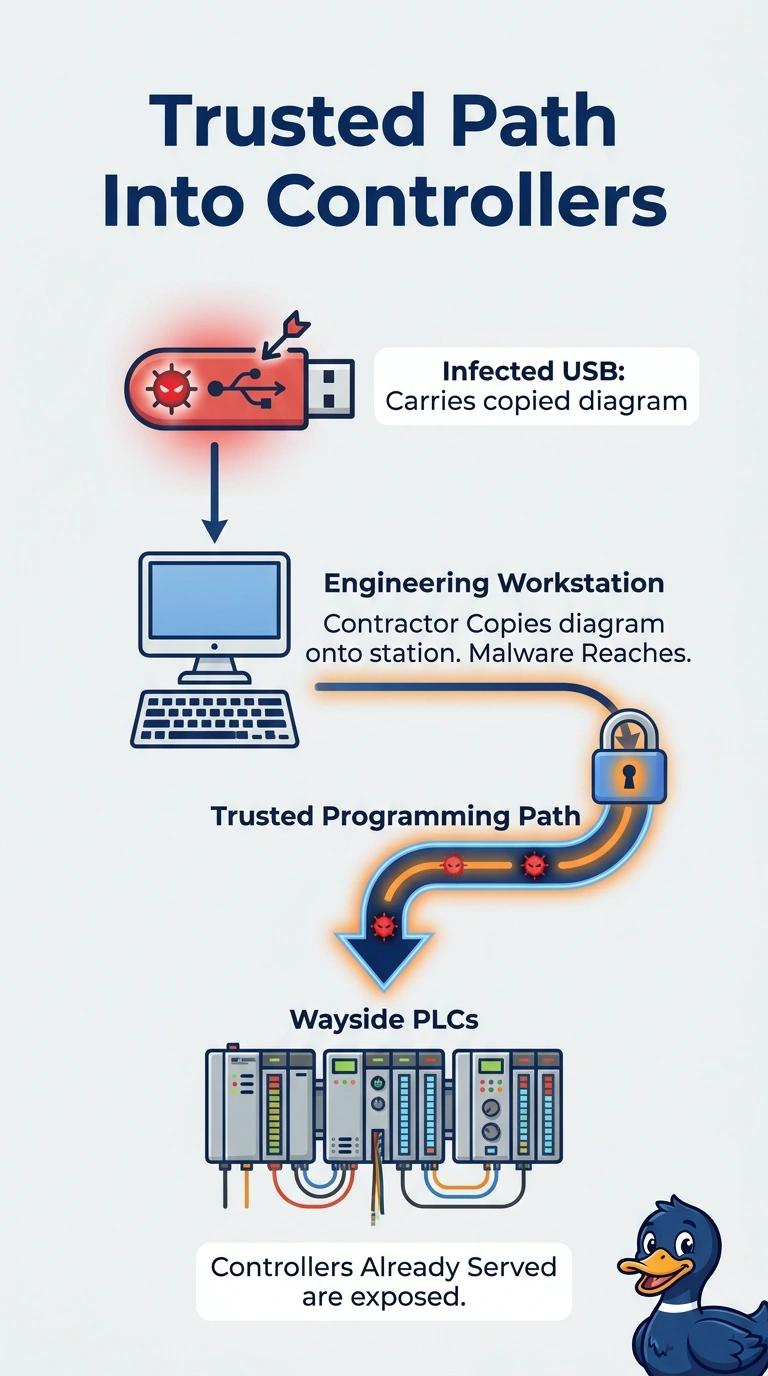
Short Explanation
The engineering workstation is the trusted toolbox for those wayside controllers, so a dirty USB stick is a tool dropped in that box. You should treat malware there as a path toward the PLCs the workstation is allowed to program. The trap is calling it a printer problem because the file was only a diagram.
Full Explanation
Engineering workstations sit inside the trust boundary that wayside PLCs accept for programming. Malware that arrives on a USB stick, even when the visible file is only a diagram, lands on a host that can open those programming sessions. The threat is that path: the workstation can be used to change or disrupt the controllers it is already allowed to reach. Limiting the damage to office printers ignores where this workstation sits. A copy onto a programming station is not a print-spool problem. Requiring the diagram to be a phishing message misses the initial access. The stick is already in the station, and no one had to click an email. Controllers do not drop sessions because they failed to start on the public internet. They often trust the engineering station precisely because it is local and familiar, which is why this infection matters. Exam caveat: inserting the stick does not by itself prove logic on a PLC has already changed. The threat created is the capability on a trusted programming host. Operational check: identify whether that workstation can still open a programming session to the wayside PLCs, and treat that reachability as the exposure until the station is known to be clean.