
Malware is found on a paper-mill engineering station after a technician plugged in a USB drive that had been used on a home PC. No email was opened on that station. Forensic evidence links execution of the malware to files on that USB drive. Which threat path does this show?
Select an answer to reveal the explanation.
Short Explanation
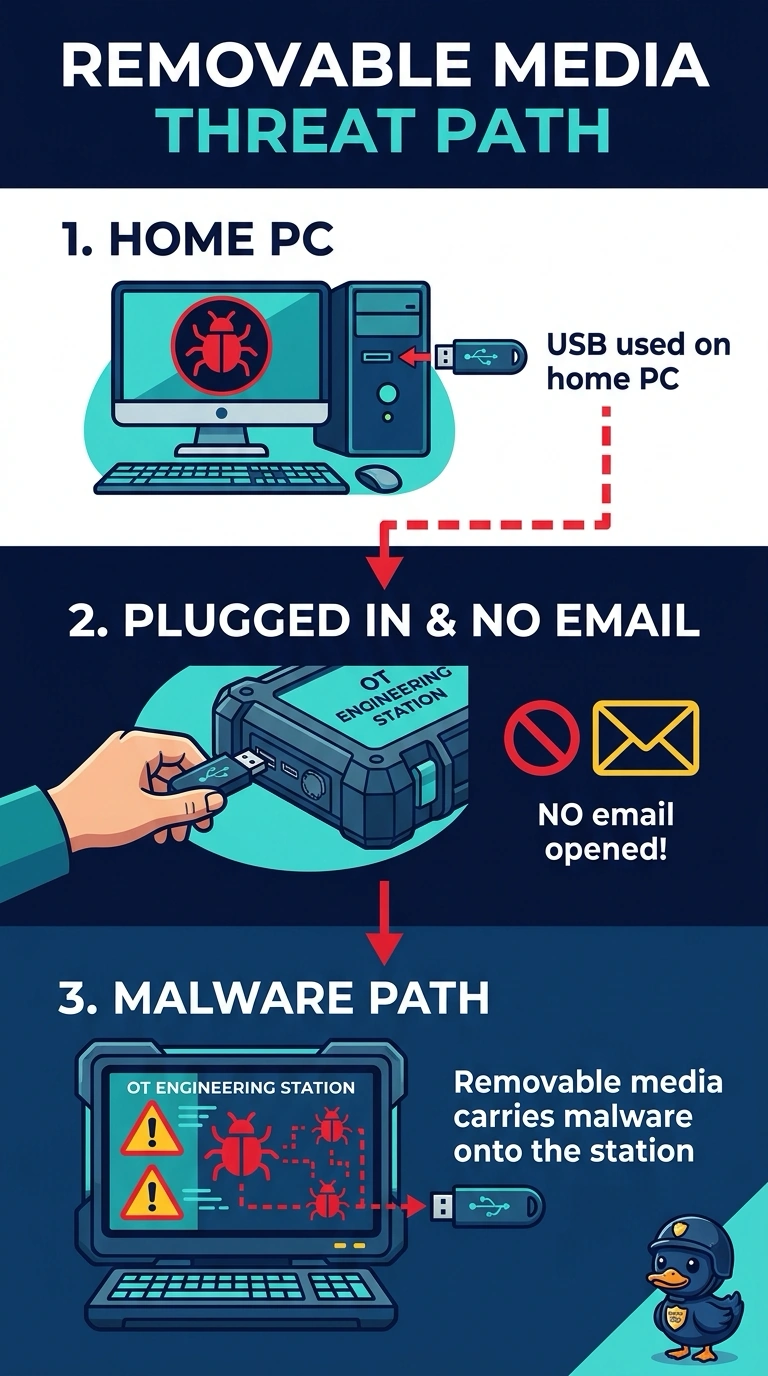
A USB stick is a pocket suitcase, and someone carried it past the mail room into the engineering station. You are looking at removable media as the path, on a station that never opened an email. A failed sensor and a tampered controller image are different events from that plug-in.
Full Explanation
Engineering stations often have no reason to receive mail, and they still get infected when someone plugs in a drive. The timeline here is a USB stick that had been on a home PC, then malware on the paper-mill station, with no email opened. The threat path is removable media crossing into OT. Phishing is a different initial-access path. Requiring a phishing message, and treating the USB insert as a coincidence, ignores the action that actually happened and invents a mail delivery the station did not have. A failed process sensor is a device fault. It does not explain malware on a workstation, and the claim that USB malware can only encrypt a corporate file server is too narrow. The station in the mill is a computer, and removable media can execute there. Supply-chain firmware is a tampered image that arrives inside a controller or a drive from the vendor path. A USB insert on an engineering station is not that event, and calling them the same hides where the response should start, which is the station and the drive. Exam caveat: the USB event shows the path onto the station. It does not by itself prove the PLC logic changed. Check the controllers the station can program before you declare a process impact. Operational check: Assess process impact with operations before isolating the engineering station, and preserve the drive and relevant evidence.