
A substation must send a protection trip between relays in the same bay with minimal delay, and a gateway must read measurements from those relays. Which IEC 61850 split fits?
Select an answer to reveal the explanation.
Short Explanation
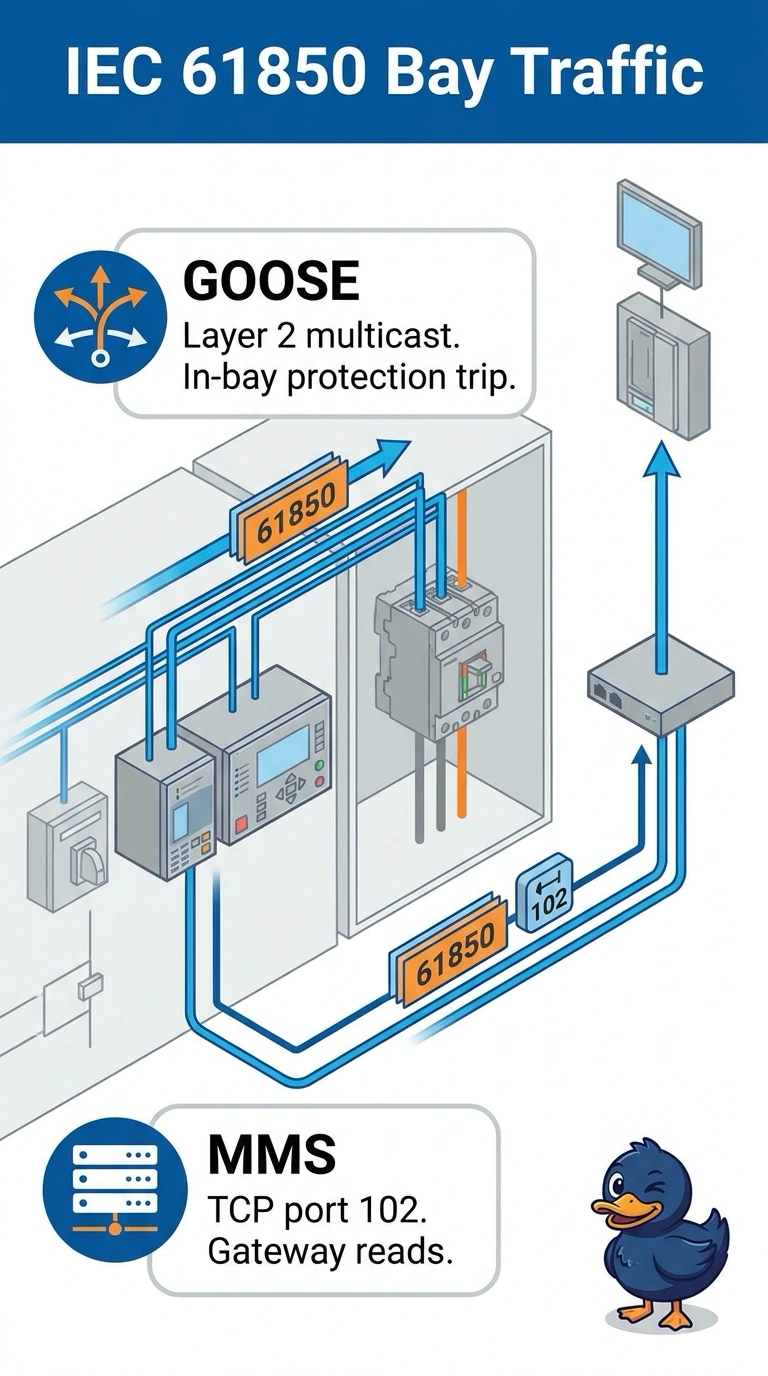
A protection trip is a shout across the relay room, not a letter you mail and wait on. You use GOOSE for that in-bay shout and MMS when the gateway needs a client read on TCP port 102. The trap is choosing a handy routable poll because it is easier to draw.
Full Explanation
IEC 61850 splits fast peer-to-peer protection from client-server monitoring. GOOSE is Layer 2 multicast used so relays in the same bay can publish a trip without waiting for a routed request and reply. MMS is the client-server profile a gateway uses to read measurements, and it rides TCP port 102. The bay needs both, aimed at those two jobs. Anonymous MQTT on TCP 1883 is a publish model often left open, and it is telemetry-style messaging rather than an in-bay protection trip. EtherNet/IP explicit messaging on TCP 44818 is a factory CIP session, not the substation mechanism for a protection trip between relays. Modbus TCP on port 502 is a poll of coils and registers with no protection semantics and no authentication in the classic form. A register poll is the wrong shape for a trip that has to win immediately inside the bay. Exam caveat: this stem is an in-bay trip plus a gateway read. A client poll, including an IEC 61850 client read, does not become the trip just because both ideas sit under one standard name. Operational check: the trip should appear as GOOSE multicast on the station bus, and the gateway sessions to the relays should be TCP port 102 rather than a Modbus or MQTT connection.