
In the Purdue model, where does a substation protective relay belong when it trips a breaker using current-transformer measurements?
Select an answer to reveal the explanation.
Short Explanation
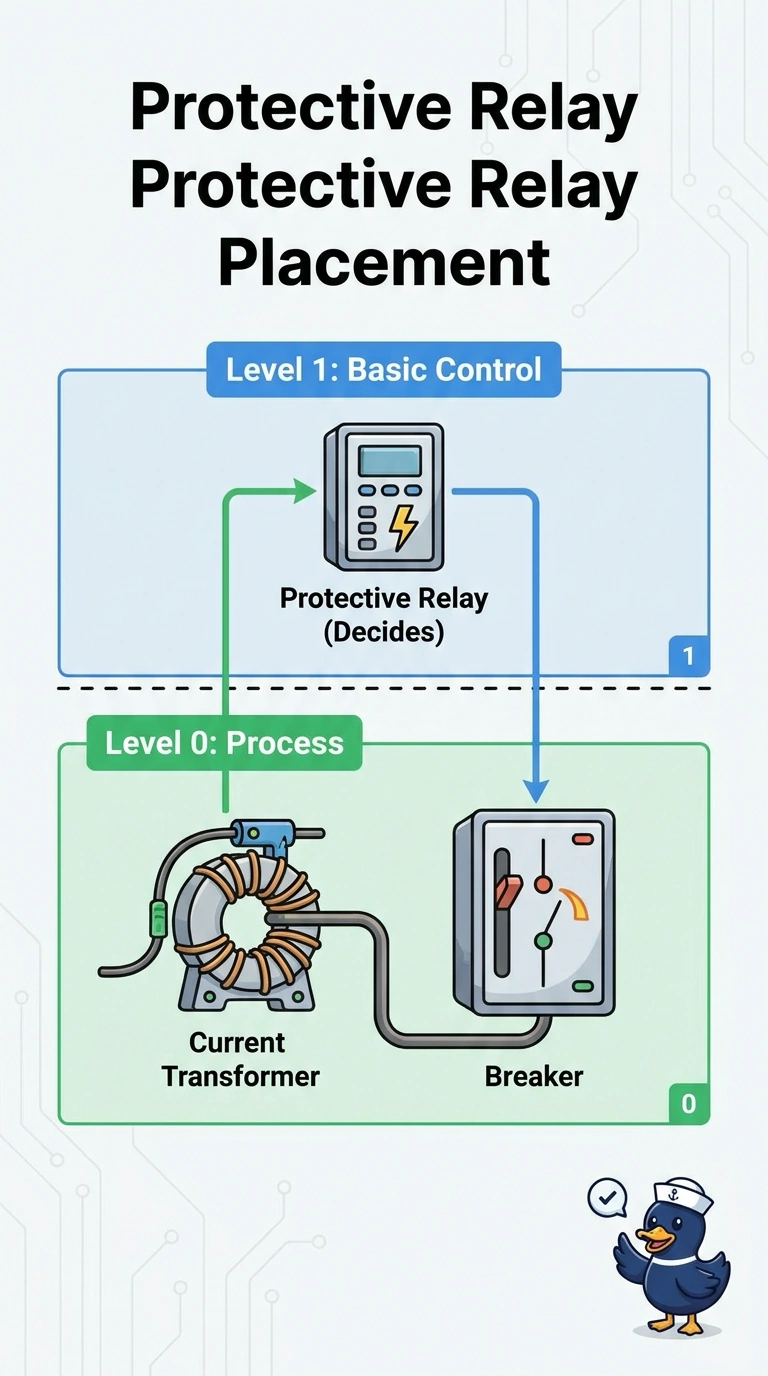
The breaker and the current transformer are the machinery, and the relay is the crew member who decides to trip. You place that relay at Level 1 with basic control, while the yard equipment stays at Level 0. Billing systems and the buffer between the office and the yard are different floors.
Full Explanation
The Purdue model separates the process from the devices that control it. Level 0 is the physical process: here the breaker and the current transformer. Level 1 is basic control, where a device reads those measurements and acts. A protective relay that trips the breaker from current-transformer input is that control device, so it belongs at Level 1. Grouping the relay at Level 0 with the breaker and the transformer erases the line between equipment and the logic that commands it. The transformer does not decide to trip. The relay does. Level 4 is the enterprise layer, where billing and customer systems live. Those servers account for energy. They do not execute a yard trip. The industrial DMZ is a buffer for services that must be shared across the operations and enterprise boundary, such as a remote-access broker. A protective relay stays in the substation control network, not in that buffer. Exam caveat: a relay with an engineering port is still a Level 1 control device. The port is a reason to control who can reach it, not a reason to renumber the relay into the enterprise or the DMZ. Operational check: on the substation drawing, the current transformer and the breaker sit at the process, the relay sits with basic control, and no route places that relay in the billing subnet or the DMZ.