
Relays in one substation must exchange peer-to-peer breaker trips. The designer wants those trips carried as EtherNet/IP explicit messaging on TCP port 44818. Which correction fits?
Select an answer to reveal the explanation.
Short Explanation
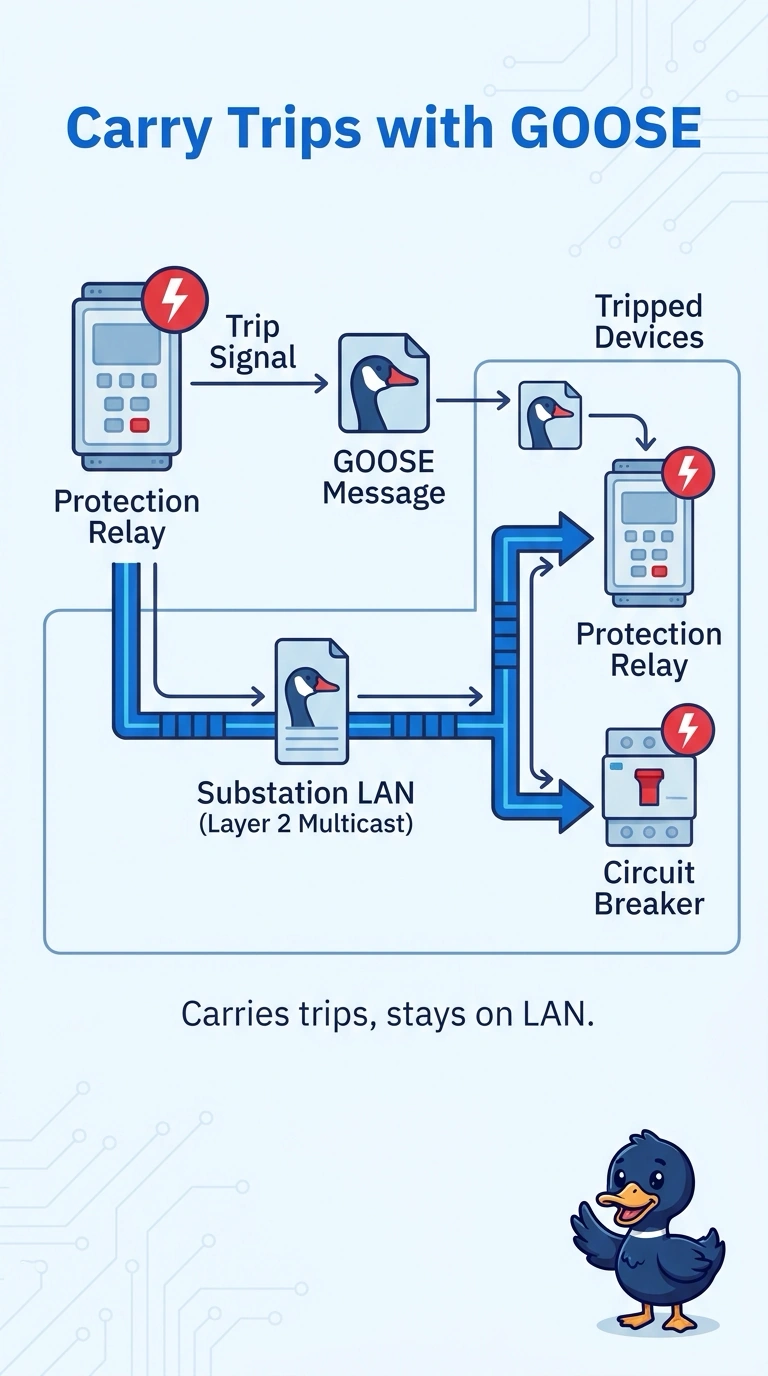
A breaker trip inside one yard is a shout across the room, not a letter mailed through a router. You want GOOSE, a Layer 2 multicast that stays on the substation LAN. EtherNet/IP explicit messaging, a cloud queue, and classic Modbus are the wrong voice for that trip.
Full Explanation
IEC 61850 GOOSE carries peer-to-peer protection messages, including trips, as Layer 2 multicast on the substation LAN. Relays in one yard that must trip one another are the case GOOSE is built for. EtherNet/IP explicit messaging on TCP port 44818 is a CIP session model used on industrial Ethernet for request and reply, not the substation protection multicast. Keeping that transport because it sounds like a control protocol puts the trips on the wrong design. MQTT is a publish-and-subscribe telemetry transport. An anonymous broker, and any cloud queue in front of it, adds delay and a third party. A trip is not a telemetry sample that can wait in a queue, and MQTT is not the protection scheme for these relays. Classic Modbus TCP on port 502 does not sign frames. Assuming it signs each trip invents a security service classic Modbus does not have, and Modbus is not the peer-to-peer protection method for a substation yard. Exam caveat: this correction is for trips between relays inside one substation. A wide-area scheme between two yards is a different design problem, and it still does not turn EtherNet/IP explicit messaging into GOOSE. Operational check: the protection drawing should show GOOSE on the substation LAN between the relays, and a capture on that LAN should show the multicast trips rather than TCP 44818 sessions.