
A building-automation vendor tells a hospital that the NIST Cybersecurity Framework requires buying that vendor's firewall. Which correction is sound?
Select an answer to reveal the explanation.
Short Explanation
A cookbook can tell you to lock the kitchen without naming the brand of lock. You can follow the NIST Cybersecurity Framework and still choose the products yourself. Tiers are not shelf tags, and a law about essential entities is not a product order either.
Full Explanation
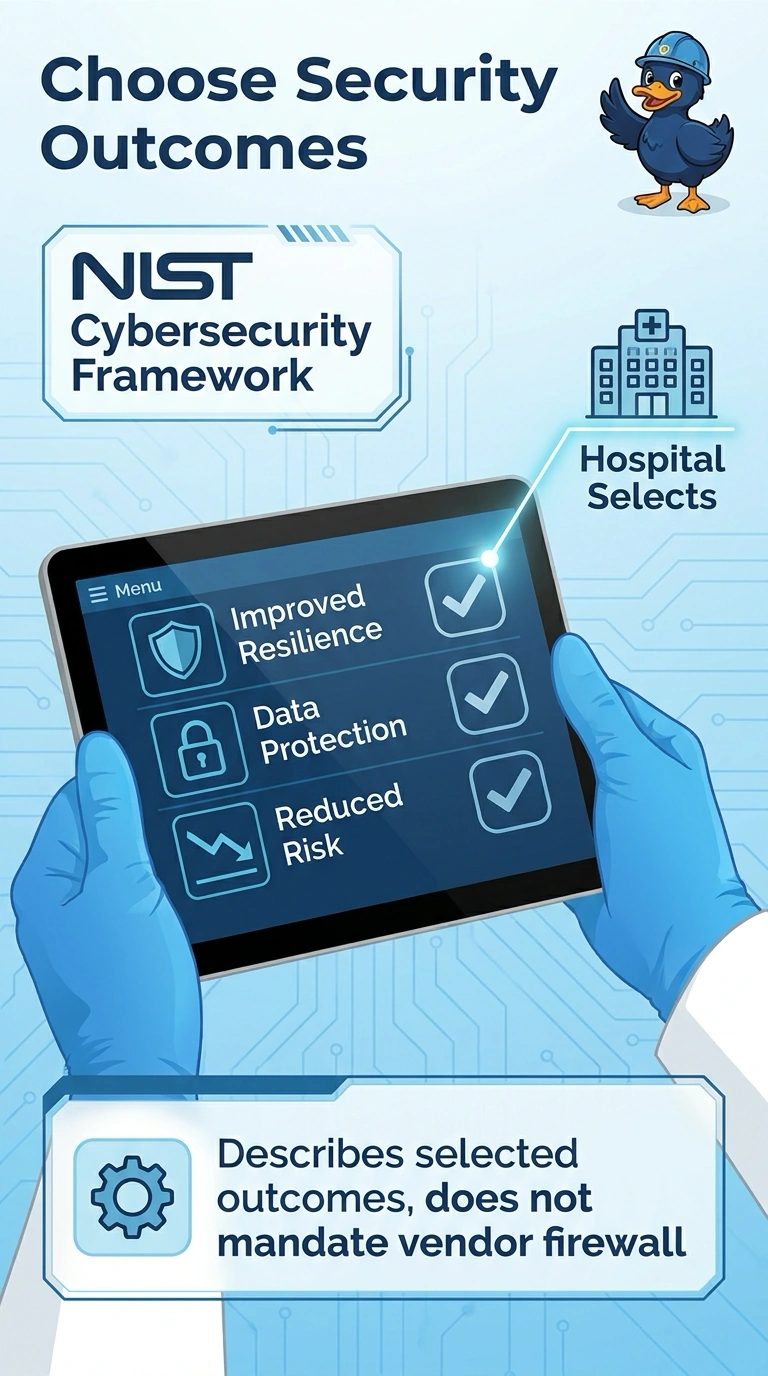
The NIST Cybersecurity Framework organizes outcomes. The functions are Govern, Identify, Protect, Detect, Respond, and Recover. An organization writes profiles for where it is and where it wants to be, and it chooses how to meet those outcomes. Nothing in that model requires a named vendor's firewall. The hospital can use the framework and select products on its own. Calling CSF Tiers appliance models misreads Partial, Risk Informed, Repeatable, and Adaptive. Those tiers describe how rigorously the organization manages cybersecurity risk, not a hardware lineup. NIS2 is a legal directive for essential and important entities. It is not a protocol, it did not replace the CSF, and it does not name a firewall model. Treating the CSF functions as product SKUs, with Govern as the SKU for a firewall, turns a set of outcomes into a catalog. Govern covers how risk decisions, policy, and oversight are run. It is not a box. Exam caveat: a firewall can be one way a hospital implements Protect or a conduit between zones. The purchase is the hospital's design choice. The framework does not become compliant or noncompliant based on that brand. CSF specifies cybersecurity outcomes rather than mandating a particular vendor product. The organization can document its selected implementations when planning how to meet those outcomes.