
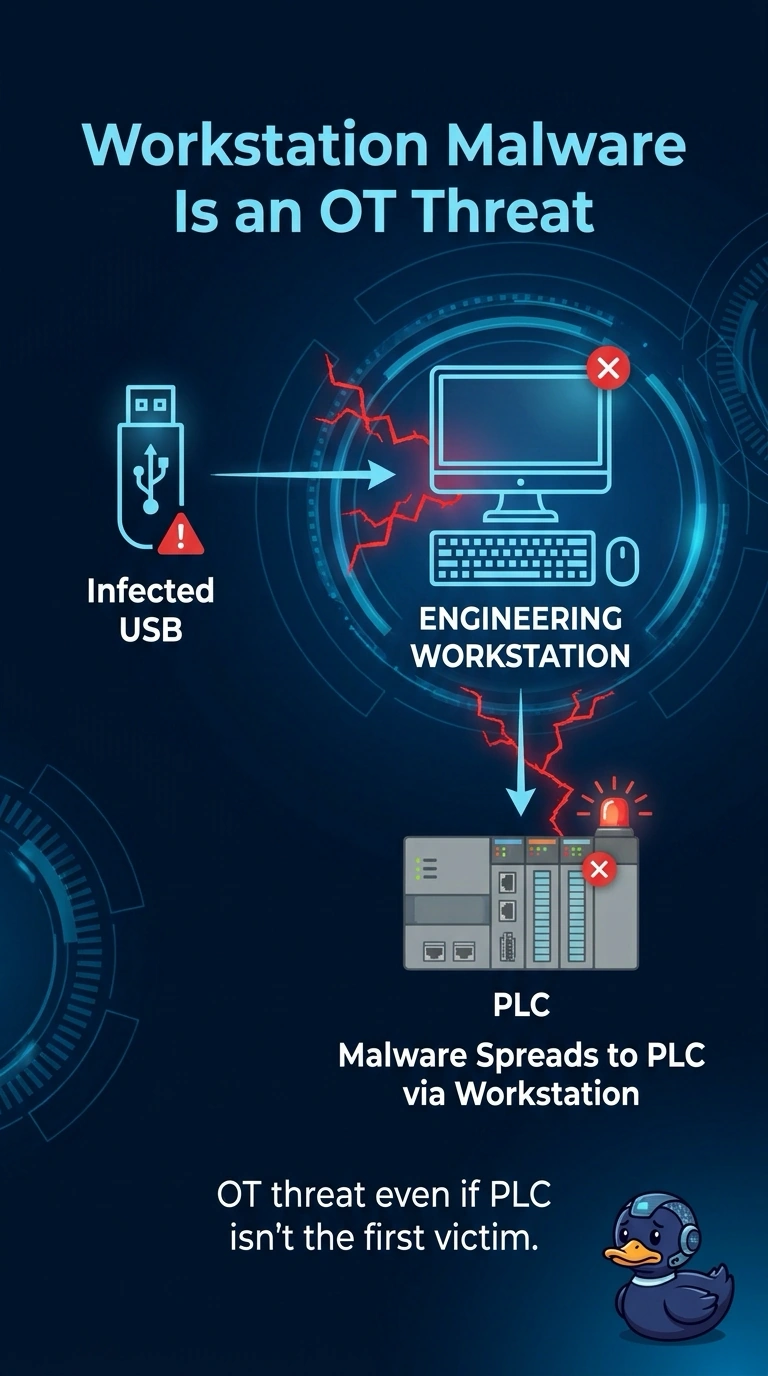
A printing-plant engineering workstation was infected from a USB stick a contractor left in the keyboard. The press PLC image was not the first file damaged. Which threat lesson fits?
Select an answer to reveal the explanation.
Short Explanation
A USB stick left in an engineering keyboard is a toolbox someone else packed. Malware that lands on that workstation can reach the press because the station is where logic is written. You should not file this as an office paperwork issue when the PLC image was not the first file touched.
Full Explanation
The engineering workstation is an OT asset because it holds projects and can download logic to the press. Malware that arrives on a USB stick at that keyboard is already inside the path used to change the controller, even if the first damaged files were not the PLC image. The lesson is that the workstation infection is an operational threat on its own. Waiting for the PLC image to be encrypted before calling it OT repeats a file-server view of ransomware and misses the station's role. A PLC does not reliably refuse a project just because the sending host is compromised. Classic programming paths authenticate weakly or not at all, so a compromised station is often trusted by the controller. Calling the event a confidentiality loss for office documents ignores where the host sits. Documents may be exposed, and the larger issue is control of the press logic. Exam caveat: not every file on a USB stick is malware, and the plant still treats an unknown stick in this keyboard as hostile until it is checked. This stem is that case, not a claim the PLC was already rewritten. Operational check: isolate the workstation from the press VLAN, preserve its logs, and confirm no unexpected download reached the PLC before the station returns to service.