
A discrete assembly cell uses EtherNet/IP between controllers and drives. Which description matches that protocol?
Select an answer to reveal the explanation.
Short Explanation
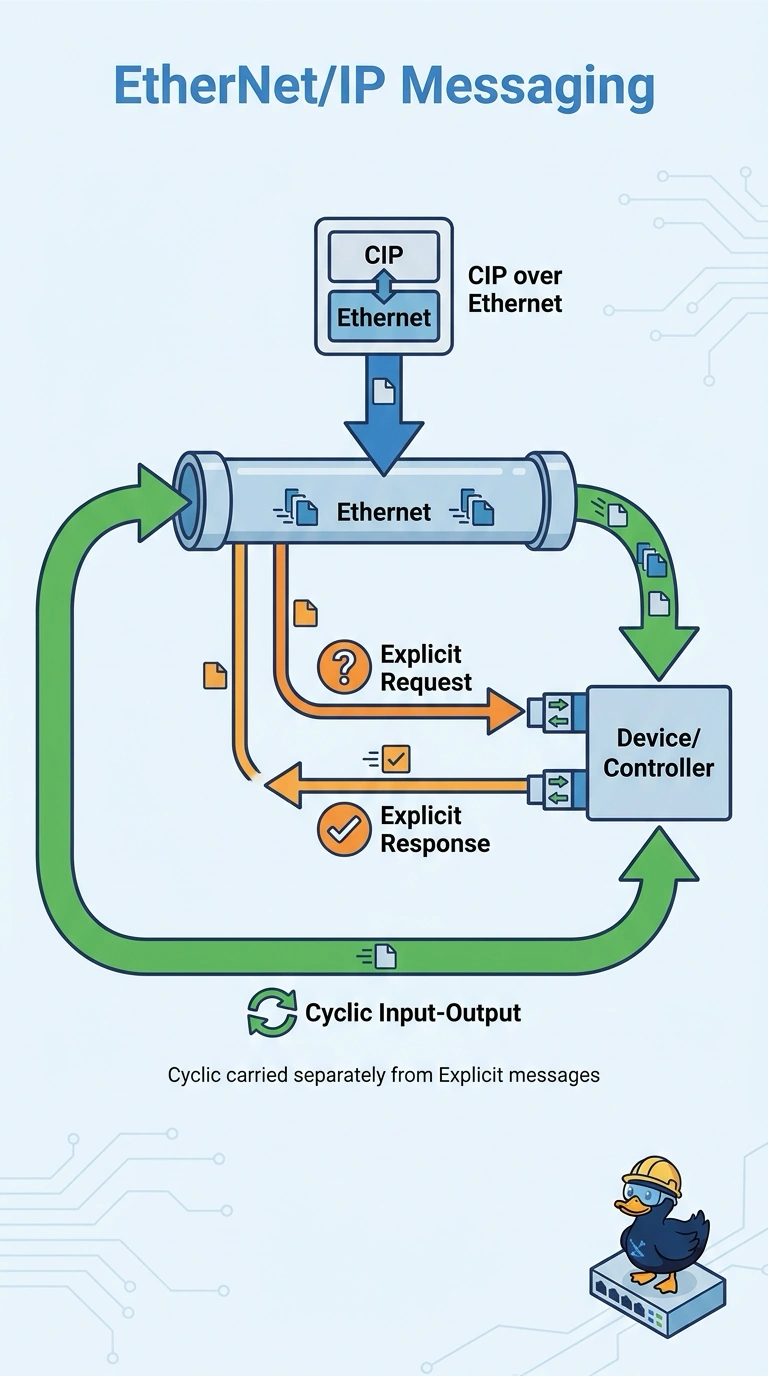
EtherNet/IP is the industrial conversation that rides ordinary Ethernet, with a fast repeating I/O stream and a separate request-response stream for configuration and data. You are not looking at a substation trip multicast, and you are not looking at a telemetry broker.
Full Explanation
EtherNet/IP carries the Common Industrial Protocol over Ethernet. In a discrete cell it connects controllers and drives. Cyclic input-output, often called implicit messaging, is separate from explicit request-response messaging used for configuration and on-demand reads. IANA registers EtherNet/IP I/O on UDP port 2222 and EtherNet/IP messaging on TCP port 44818. That split is the characteristic the stem is pointing at. A Layer 2 protection multicast used for a fast trip between relays is GOOSE, an IEC 61850 mechanism, not CIP. A broker that clients publish and subscribe to, typically on TCP 1883, is MQTT. EtherNet/IP is not a broker in the middle of the cell. A serial-only fieldbus description does not fit a protocol whose name and deployment are Ethernet. The cell's twisted-pair Ethernet is a normal place to find it. Exam caveat: classic CIP is not automatically authenticated. CIP Security is a newer profile. Do not tell the plant that EtherNet/IP on 44818 is encrypted just because it is IP. Operational check: on a capture at the cell uplink, cyclic I/O appears as UDP 2222 and explicit sessions as TCP 44818 between the controller and the drives, and an unexpected explicit peer is worth a ticket.