
A steel mill keeps a site historian that collects tag history from several mill cells for the on-site operations crew. In the Purdue model, where does that historian belong?
Select an answer to reveal the explanation.
Short Explanation
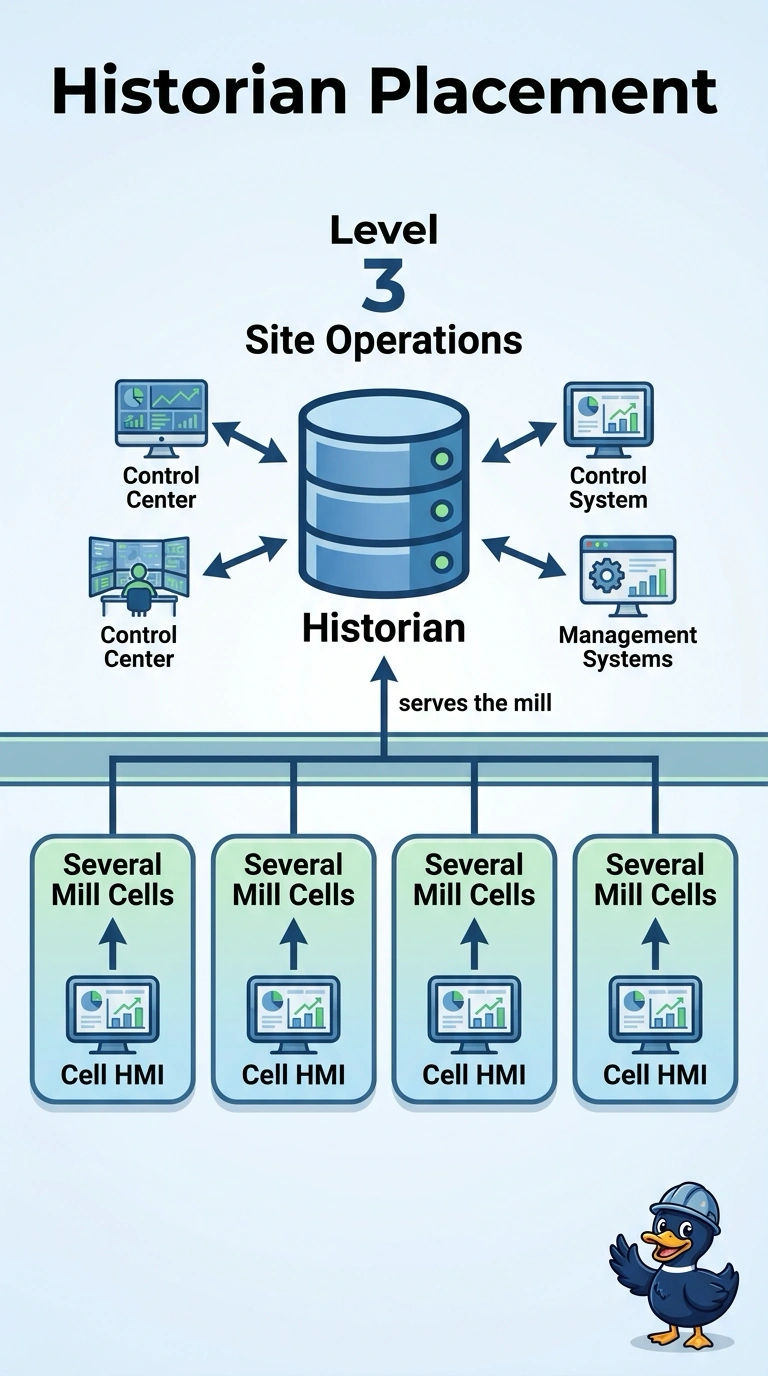
Think of the site historian as the mill’s filing room for the shift, not the corporate accounting floor or the lobby between buildings. You place this collector at Level 3 with the site operations systems; PLCs at Level 1 handle basic control, while the historian serves the crew across several cells.
Full Explanation
The Purdue model places functions in layers. Level 3 is site operations, where systems such as a historian collect tag history for the people who run the mill. Because this collector serves several cells and the on-site operations crew, you place it at Level 3, above the cell HMIs, rather than inside a single controller cabinet. Level 1 is basic control: PLCs and similar devices act on the process. Storing history does not make the historian a basic-control device, so placing it beside the PLCs would put a site database in the cell. Level 4 is the enterprise business layer, where systems such as ERP live. Trend reports may later serve business needs, but that does not make the historian used by the mill crew an ERP server. The industrial DMZ buffers services shared across the OT and IT boundary; the primary site historian used by operations belongs at Level 3, not automatically in that buffer. Exam caveat: a separate copy built for enterprise access may sit in the industrial DMZ, but that is not the site historian described here. Practical check: on the architecture drawing, place the site historian with Level 3 operations, the cells below it, and the enterprise above a boundary.