
A well-field design publishes tank levels to an MQTT broker and also wants the wellhead emergency shutdown to ride that same broker. Which decision fits?
Select an answer to reveal the explanation.
Short Explanation
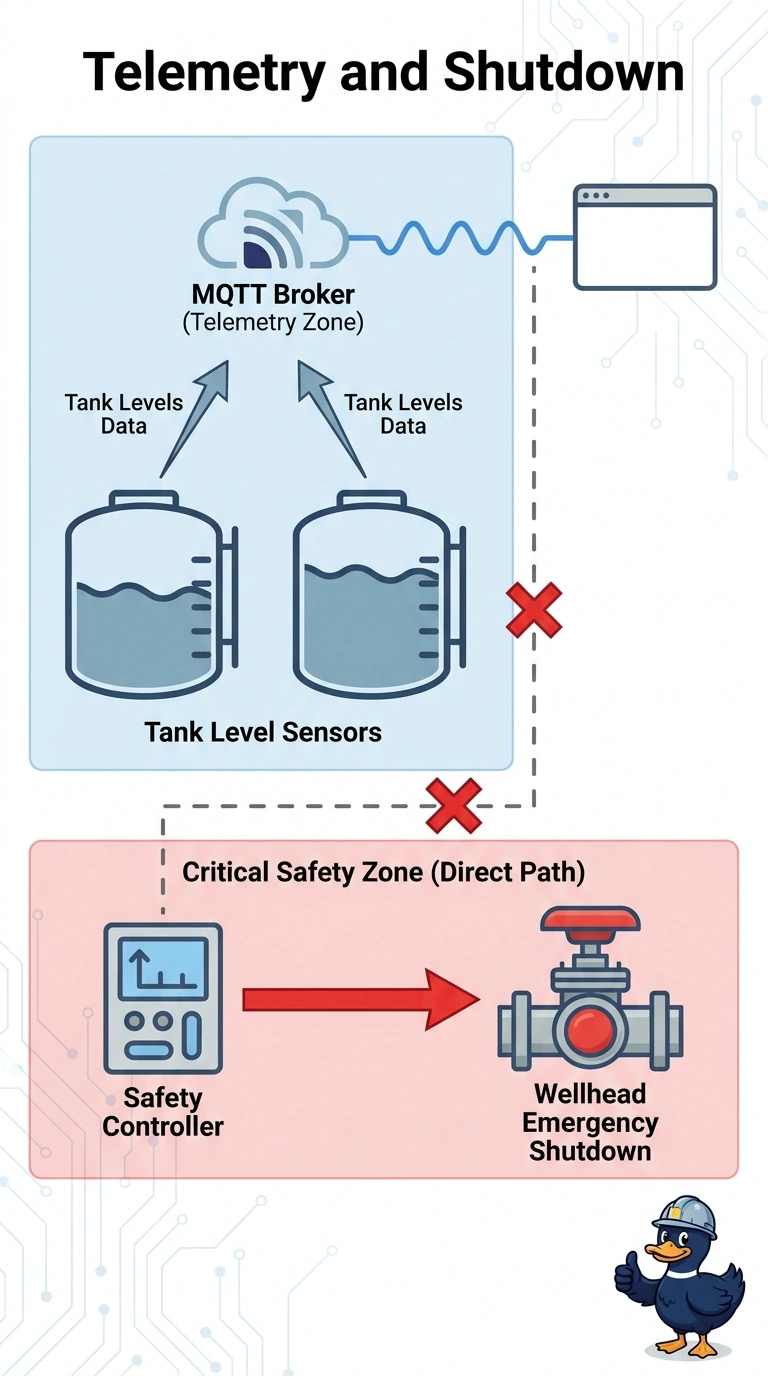
You can use MQTT as a telemetry channel for tank levels, but it is not the brake for a wellhead emergency shutdown. Keep the shutdown off the broker, even if a shared subscription would be convenient.
Full Explanation
MQTT is a publish-and-subscribe channel suited to telemetry such as tank levels, not a safety-trip medium. Keep the tank levels on the broker and the wellhead emergency shutdown off it, on the trip path used by the safety case. Taking the levels off MQTT just to route the shutdown through the broker reverses the appropriate split: the broker loses a suitable job and gains one it does not fit. Letting any anonymous client publish a shutdown removes authentication from the trip and creates an open command path; a lost account is not a reason to permit anonymous publishing. An anonymous broker, commonly cleartext on TCP 1883, is weak even for the levels and worse for a well trip. Putting both levels and shutdown on one broker would let field laptops subscribe to a shared path, but convenience does not provide the deterministic, dedicated behavior a shutdown needs. Exam caveat: using MQTT over TLS on TCP 8883 would encrypt the connection, but the shutdown would still depend on a broker; encryption can harden telemetry without turning the broker into a safety trip. Operational check: confirm tank-level clients use the broker and that the wellhead trip remains on its dedicated path, with no broker publish in the safety diagram.