
Counsel tells a regional electricity distributor that NIS2 applies to it as an essential entity. A technician asks which industrial protocol NIS2 specifies for the substations. Which answer is accurate?
Select an answer to reveal the explanation.
Short Explanation
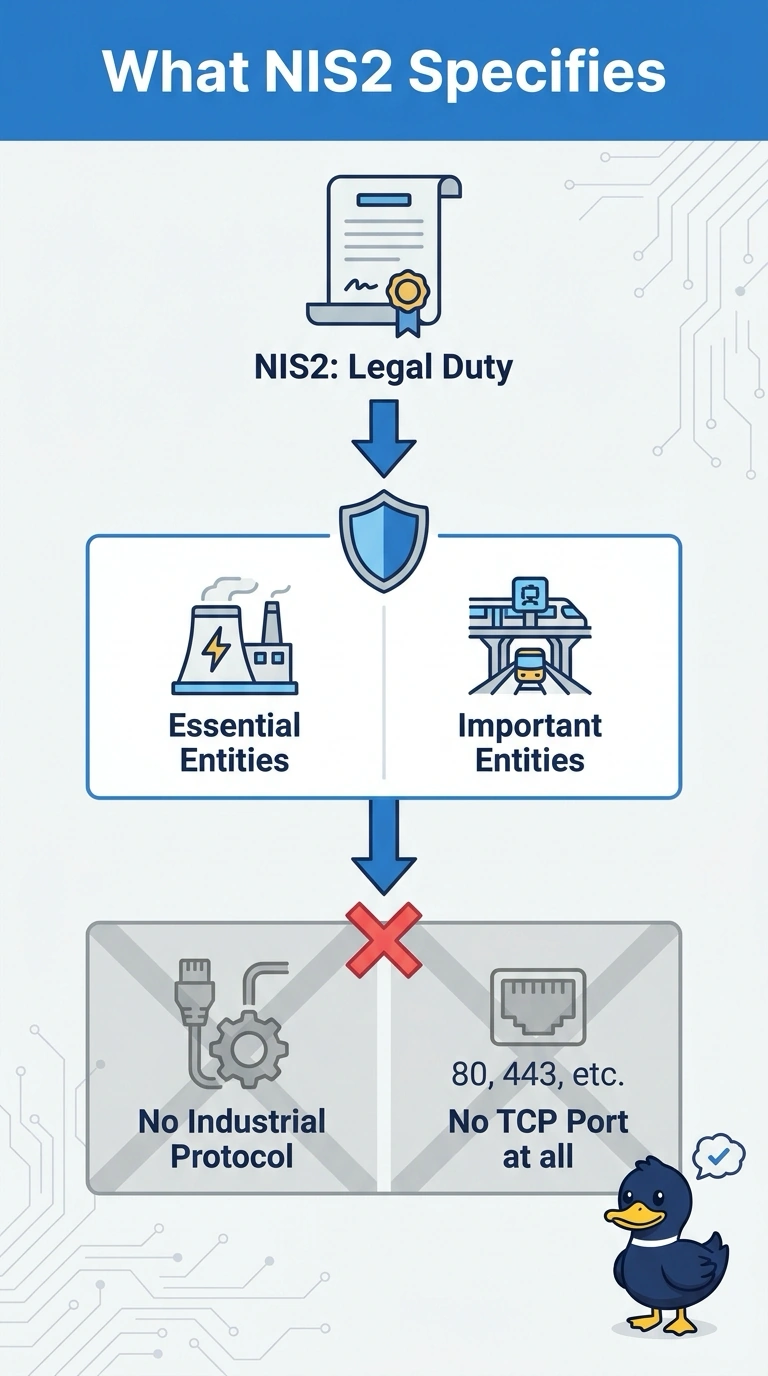
A statute can require a utility to manage risk without naming a port the way a protocol manual would. You can explain that NIS2 is law for essential and important entities, not an industrial protocol or a TCP service. The counsel label does not conceal a port inside the directive.
Full Explanation
NIS2 is a European legal directive that places cybersecurity duties on essential and important entities, including duties concerning how management oversees risk. Counsel has said this distributor is in scope as an essential entity. The directive does not specify an industrial protocol for substations or assign a TCP port, so the accurate answer is that it imposes legal duties but names no protocol or port. Modbus TCP is an industrial protocol that a plant may select, and port 502 is associated with it; neither is NIS2 under another name, and the directive does not fix substations on that port. IEC 62443 security levels are a standard’s targets for zones, not legal directives; SL4 is not NIS2 under a new label. NIST CSF tiers describe the maturity of an organization’s risk practice: Partial, Risk Informed, Repeatable, and Adaptive. There is no tier between Repeatable and Adaptive that the directive renamed. Exam caveat: NIS2 can oblige the distributor to manage risk and demonstrate that management, but it still does not select a substation protocol. Practical check: keep the legal scope statement separate from the protocol list in the design pack, and confirm that no port was added solely because counsel named NIS2.