
A water utility finds unfamiliar software on a laptop that was used to connect to the independent safety PLC, and the process PLC was not the target. Analysis identifies the software as a tool designed to alter that safety controller. Which threat does that finding represent?
Select an answer to reveal the explanation.
Short Explanation
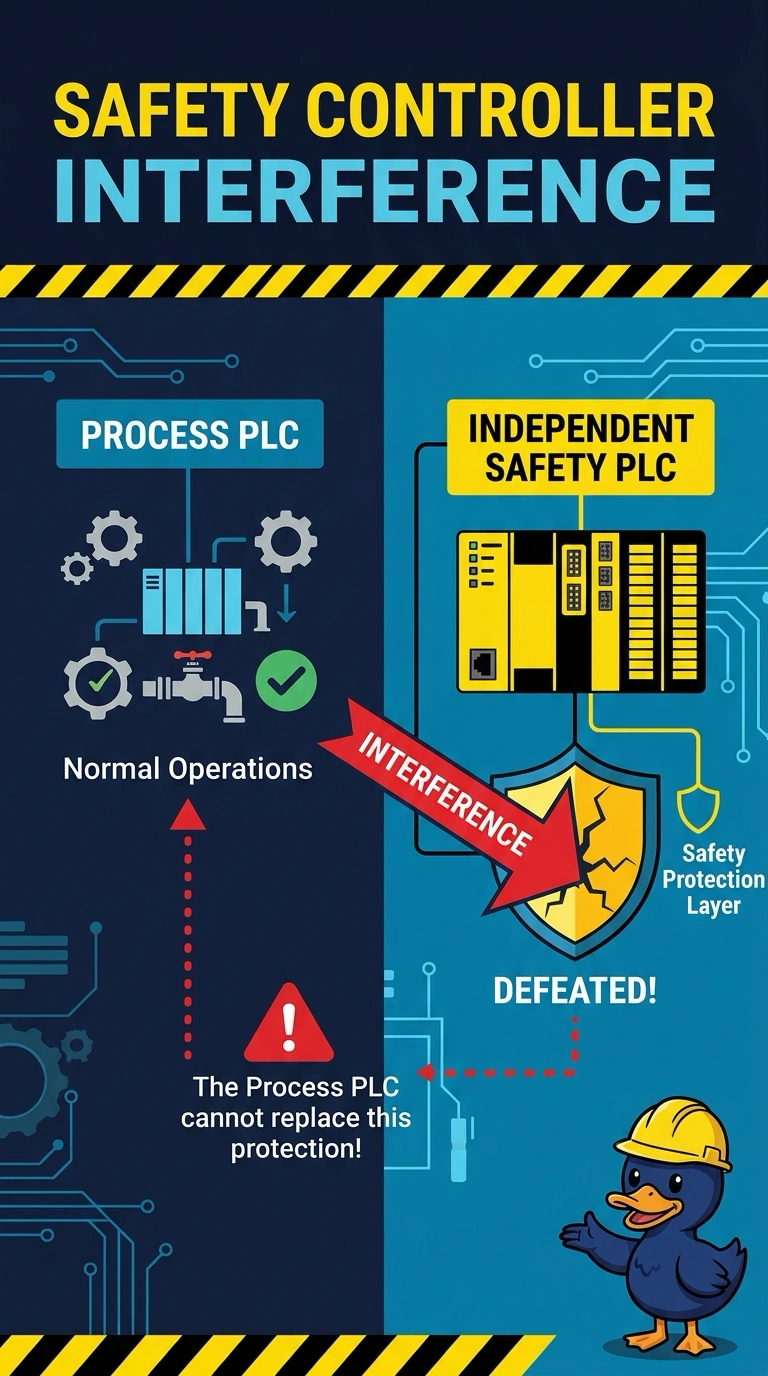
The safety PLC is the separate brake, not a spare copy of the process controller. You treat tooling aimed at that brake as an attack on a protection layer. Office ransomware is a different story, and a controller does not get a free pass because it is not a desktop PC.
Full Explanation
OT threats include attacks on safety systems, not only encryption of business files. An independent safety PLC exists so a dangerous process can still be driven to a safe state when basic control fails. Software on a laptop that was connected to that safety controller, with the process PLC left alone, points at the protection layer itself. That is the threat the finding represents. A normal interlock exchange is traffic between the two controllers as designed. It is not unfamiliar software staged on a laptop that was used to connect to the safety PLC. Limiting OT threats to ransomware on file servers misses safety-system and critical-infrastructure attacks, which matter even when no office share is encrypted. A safety controller can be a target without being a Windows desktop. Many are embedded or proprietary, and that does not make them irrelevant. Exam caveat: the laptop finding is a lead, not proof of a successful safety change. You still compare the safety program to the last approved copy before you declare impact. Operational check: Use the operations-approved incident procedure to contain the laptop and compare the safety program with the approved baseline, exporting the current safety program with the vendor procedure before the unit returns to service.