
In the Purdue Reference Model, where does the brewhouse HMI that operators use to start a mash belong?
Select an answer to reveal the explanation.
Short Explanation
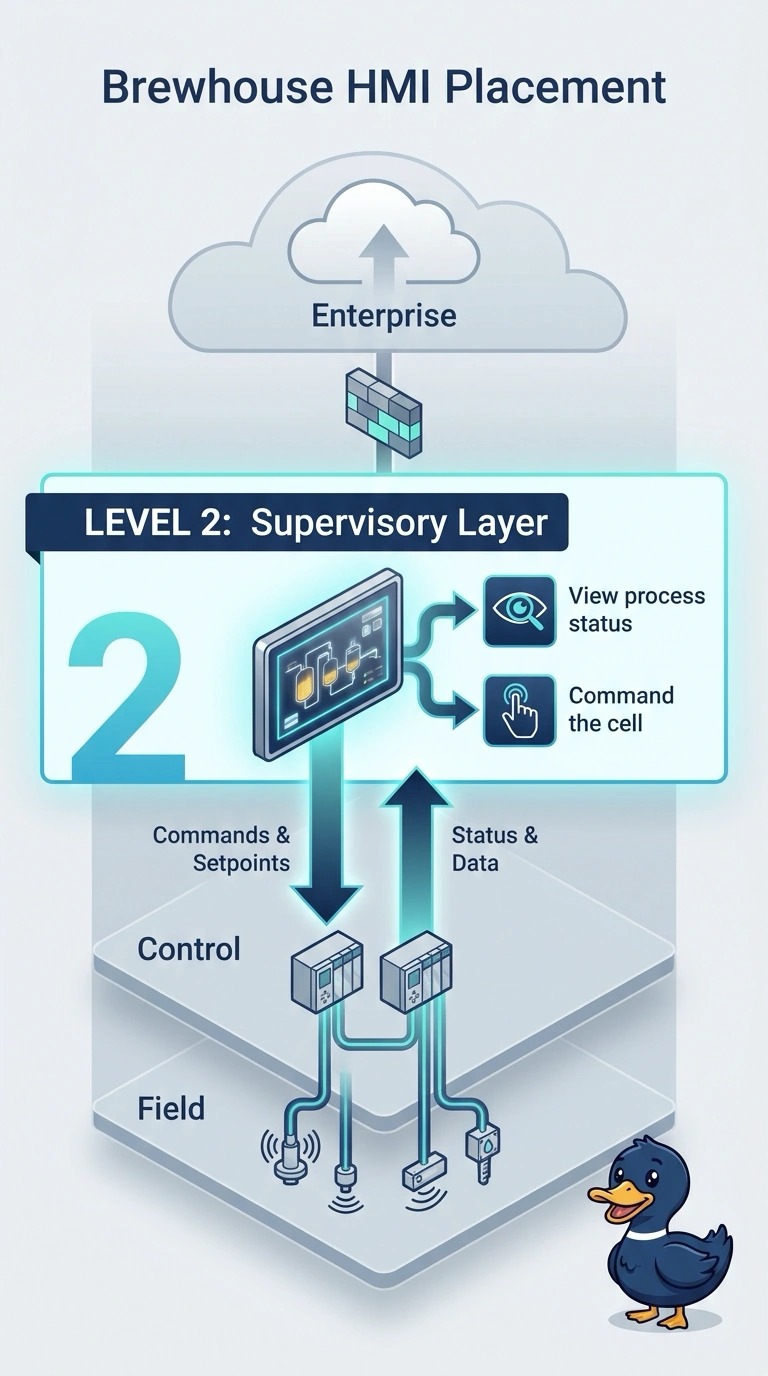
The HMI is the window and the buttons, not the mash tun and not the PLC that runs the interlocks. You put operator supervision at Level 2. Bolting the screen to the vessel does not drag it down into the process itself.
Full Explanation
Purdue Level 2 is area supervisory control: the HMIs and local operator stations people use to view the process and issue commands. A brewhouse HMI that starts a mash is that layer. The command goes to a controller. The HMI is not the controller. Level 0 is the physical process, vessels, sensors, and actuators, not a screen bolted nearby. Level 4 is enterprise business systems such as planning and finance. An operator display is not a business application just because a person uses it. Level 1 is basic control, the PLCs and similar devices that execute logic against the process. Displaying values does not move the HMI into Level 1, and starting a mash from the screen does not mean the screen is executing the interlock logic. Exam caveat: some compact panels combine a display and a small controller in one box. If the device actually executes the logic, classify the control function at Level 1 and do not pretend the whole box is only a screen. This stem describes the operator HMI. Operational check: on the architecture drawing, the brewhouse HMI sits with supervisory stations, above the PLC, and not in the ERP subnet.