
A plant's cybersecurity poster, printed for the 2018 framework, lists Identify, Protect, Detect, Respond, and Recover. Which function does NIST CSF 2.0 add that this poster omits?
Select an answer to reveal the explanation.
Short Explanation
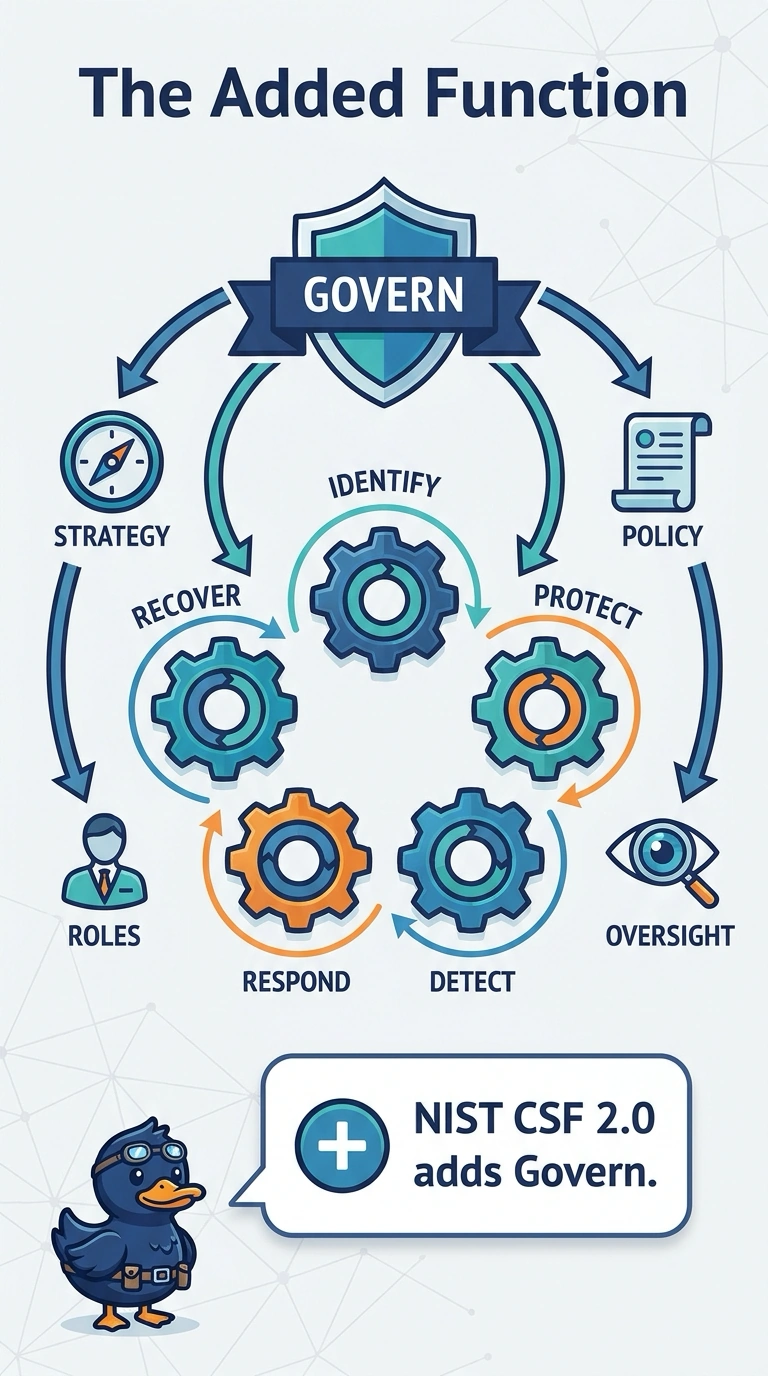
Use the five functions on your older poster as a helpful reminder: CSF 2.0 adds Govern for risk strategy, policy, roles, and oversight. Detect was already included, Encrypt is not a CSF function or a blanket TLS requirement, and NIS2 did not replace the framework.
Full Explanation
NIST CSF 2.0, published as CSWP 29 on 26 February 2024, organizes outcomes into six Functions: Govern, Identify, Protect, Detect, Respond, and Recover. Govern is the addition to the five-function core used before 2.0. It covers cybersecurity risk strategy, expectations, policy, roles, and oversight, and informs how the other five Functions are prioritized. A 2018 poster listing Identify, Protect, Detect, Respond, and Recover is therefore missing Govern. Detect was already one of the original five Functions, so CSF 2.0 did not introduce it and a poster listing it is not omitting it. Encrypt is not a CSF Function, and CSF 2.0 does not require every OT protocol to use TLS. NIS2 is a European directive with its own legal duties; it did not replace the CSF and is not a Function in the CSF Core. Exam caveat: CSF 2.0 does not prescribe which control an organization must buy; Govern directs the organization to set and oversee risk decisions, rather than specifying a product feature or Purdue level. Practical check: a plant claiming a CSF 2.0 profile should include Govern outcomes such as roles and policy, rather than listing only the five Functions shown on the older poster.