
A rural electric cooperative uses a field device at a distant feeder to report breaker status and analog values to the control center over a wide-area link. Which component is that device?
Select an answer to reveal the explanation.
Short Explanation
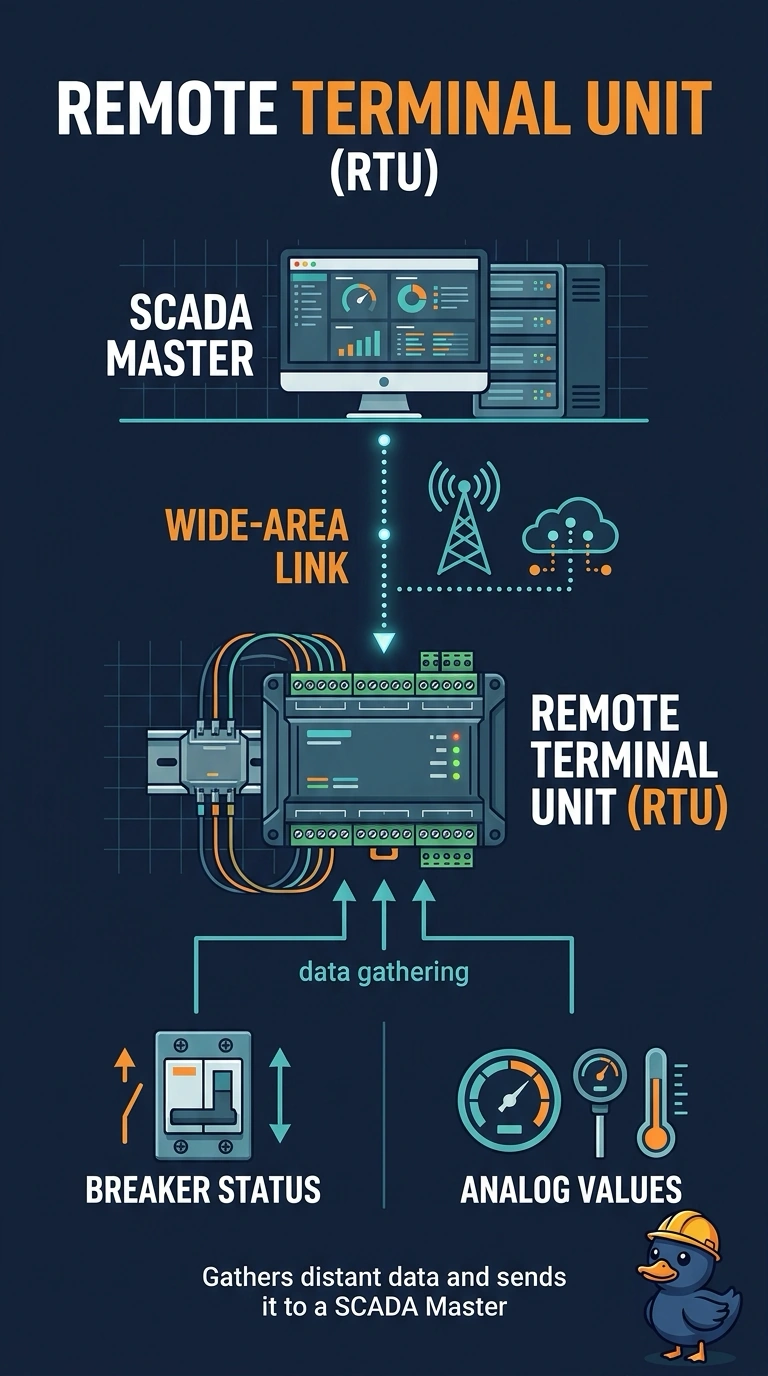
You can identify this field device by its job: it reports breaker status and measurements from the feeder to the control center. It is a remote terminal unit, the field end of a SCADA link. An HMI is the operator’s display, while a historian stores data rather than reporting it from the feeder.
Full Explanation
A remote terminal unit (RTU) is used where assets are spread out, such as feeders, pipelines, and pump stations. It gathers status and analog measurements, often buffers events, and communicates with a SCADA master over a wide-area link. The cooperative’s feeder device performs that job, so it is an RTU. An HMI is the operator’s view, usually at a console; handling breaker status does not make a field device an operator display. A distributed control system (DCS) is an integrated process-control system typical of a continuous plant, with controllers and operator stations designed as one system. A feeder’s location outside a substation fence does not make its reporting device a DCS. A historian stores time-series data after collection; reporting a live measurement from the feeder is telemetry, not archiving. Exam caveat: some modern feeder devices are intelligent electronic devices that use utility protocols and overlap the RTU role. Focus on the job—wide-area telemetry to a SCADA master—not the device’s label. For a practical check, confirm that the control-center point list identifies the feeder device as a polled or reporting outstation, and that local breaker interlocks have a defined home if a separate controller or relay performs them.