
In the Purdue Reference Model, where do the PLCs that run a dairy pasteurizer's interlocks belong?
Select an answer to reveal the explanation.
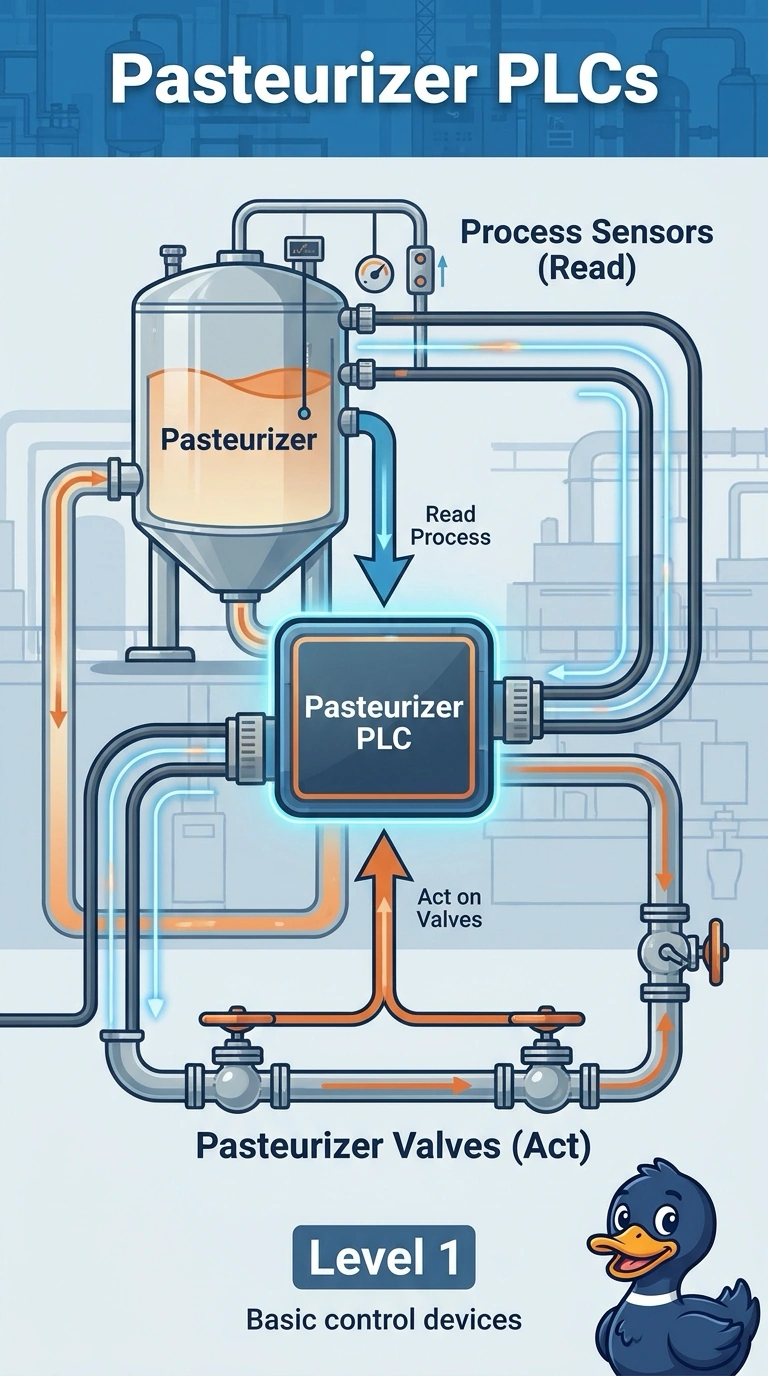
Short Explanation
The pasteurizer PLC is the crew standing at the valves, not the office that schedules next week's orders. You place that controller at Level 1, the basic control layer. The trap is parking every important box in the DMZ because the DMZ sounds safer.
Full Explanation
The Purdue model separates the plant by function. Level 0 is the physical process: sensors, actuators, and the product itself. Level 1 is basic control, where PLCs, RTUs, and similar devices run the logic that acts on that process. A pasteurizer's interlock PLC reads temperatures and commands valves, so it belongs at Level 1 even though the consequence of a mistake is serious. Level 4 is the enterprise business layer, where planning systems such as ERP live. Those servers schedule and account for production. They do not execute interlocks. The industrial DMZ is a buffer for services that must be shared across the OT/IT boundary, such as a remote-access broker or a replica historian. It is not the home of every controller, and putting the PLC there would pull basic control out of the cell. Level 2 is supervisory: HMIs and local operator stations. A PLC does not become Level 2 because someone wishes it showed graphics, and it is not Level 0 merely because it has no screen. Level 0 has no control logic. Exam caveat: a safety PLC is still a control device, but good design keeps the safety system independent from the basic process PLC. Independence is not a different Purdue level number by itself. Operational check: on the architecture drawing, the pasteurizer PLC should sit with the cell controllers, below the HMI, and not in the enterprise or DMZ subnet.