
Ransomware encrypts a regional electric utility's corporate file shares. Operators halt distribution switching as a precaution even though no relay was encrypted. Which lesson does that show?
Select an answer to reveal the explanation.
Short Explanation
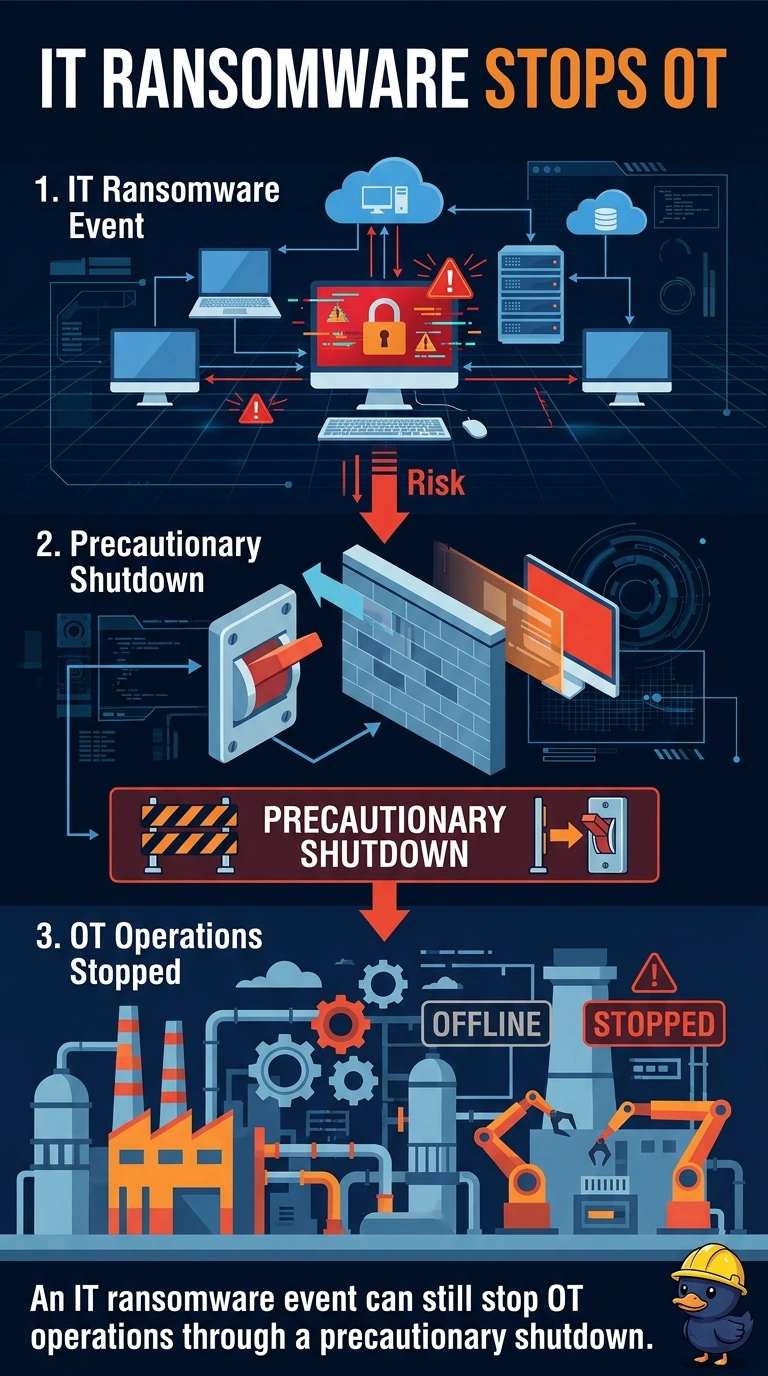
The lock on the office filing cabinet can still stop the plant, because people will not keep switching gear while they no longer trust the screens and the phones around it. You are looking at a business-system attack that forced an operational decision. Do not wait for a relay to be encrypted before you call it an OT problem.
Full Explanation
OT threat scenarios include ransomware that never touches a relay or a PLC and still stops the process. Here the encrypted systems are corporate file shares. Operators halt distribution switching because they cannot trust supporting IT, communications, or their own picture of the system, and they choose a controlled stop over an uncertain grid operation. The lesson is that an IT ransomware event can become an OT outage through that precautionary decision. Requiring the malware to rewrite logic on every relay before it 'counts' misses how real utility incidents have played out: the field devices stay intact while operations stop anyway. Relays do not 'drop encrypted sessions' in a way that isolates the control room from this decision. The halt is a human, safety-and-reliability choice, not a protocol feature. A vendor string inside the malware is not the test for whether a precautionary halt was rational. The operators already lost confidence in the IT services the operation depends on. Exam caveat: a precautionary shutdown is not automatic for every IT incident. It is a risk decision by operations. The exam point is that OT impact does not require the controller itself to be the encrypted host. Operational check: map which IT services the control room actually needs, and decide in advance which of those failures trigger a halt versus a degraded mode.