
A consultant groups a refinery's safety controllers apart from its basic process controllers because their security needs differ, then records the only paths allowed between those groups. Which framework idea is that?
Select an answer to reveal the explanation.
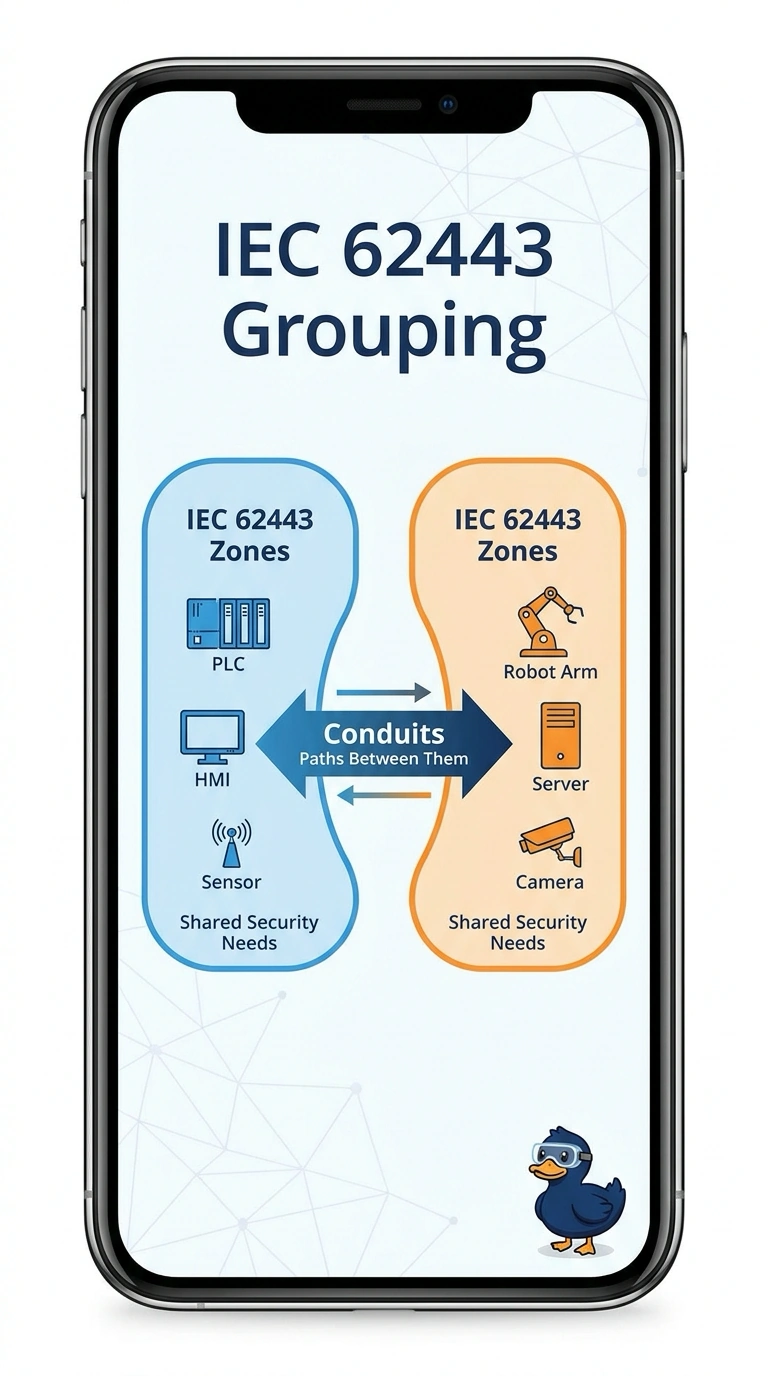
Short Explanation
You are watching someone sort the refinery into rooms that need the same locks, then write down which hallways are allowed. That is zones and conduits, and Purdue does not rename itself into a security level just because both ideas use numbers. Your layer diagram and your zone diagram answer different questions.
Full Explanation
IEC 62443 describes zones as groupings of assets that share the same security requirements, and conduits as the communications paths you explicitly allow between zones. Separating safety controllers from basic process controllers because their requirements differ, and writing down the only permitted paths, is that model. Purdue levels describe functional layers of a plant, from the process up through enterprise systems. They are not security levels SL1 through SL4, and renaming them that way mixes an architecture sketch with a 62443 target. NIST CSF Tiers, Partial through Adaptive, describe how rigorous an organization's risk governance and management are. They do not draw the refinery's allowed paths. NIS2 is a European legal directive that places duties on essential and important entities, including how they manage risk and report incidents. An entity label does not replace a zone design, and it is not the diagram the consultant just built. Exam caveat: a VLAN can implement part of a conduit, but a VLAN identifier is not itself a zone. The zone exists because the assets share requirements, not because a switch config used a number. Operational check: the zone list should name the safety group and the basic-control group separately, and each conduit should name the permitted protocol and direction rather than 'any' between them.