
A wastewater plant uses classic Modbus TCP between a lift-station PLC and the local HMI. Which exposure should the security review treat as inherent to that protocol?
Select an answer to reveal the explanation.
Short Explanation
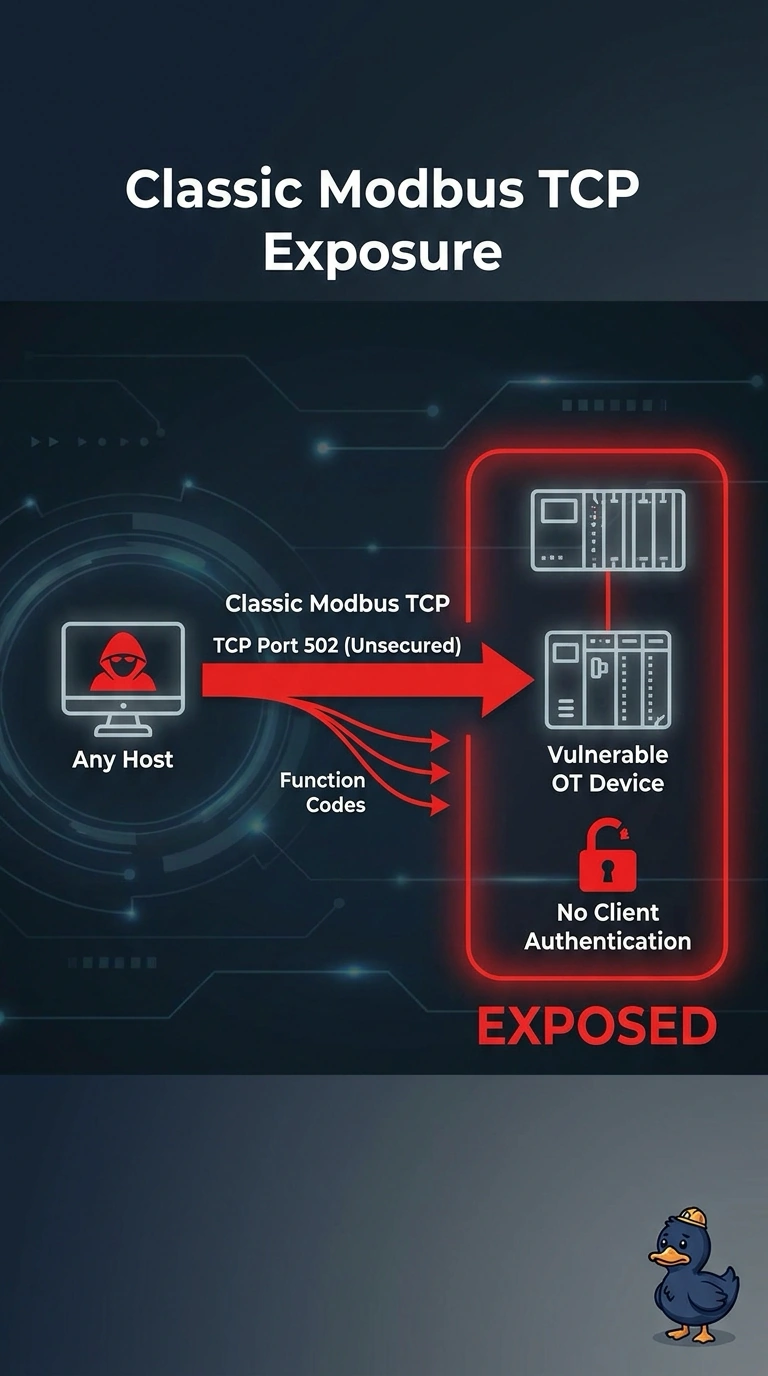
You can treat classic Modbus TCP as a conversation with no name check at the door. Any host that can reach TCP port 502 on the lift-station PLC can attempt function codes, because the protocol does not authenticate the client. Reachability is the key exposure to review.
Full Explanation
Classic Modbus TCP carries the Modbus application protocol over TCP port 502, and the classic protocol does not authenticate the client. Any host that can reach the PLC on that port can attempt the reads and writes allowed by its function codes; reachability is therefore the access control the review must address. Segment the network and allow only the HMI to reach the PLC, rather than relying on a protocol feature that classic Modbus TCP lacks. Per-frame device certificates are not required to read a coil or register in classic Modbus TCP, so that option describes a security mechanism the protocol does not provide. Modbus TCP uses routed IP, not Layer 2 alone, and can cross a routed boundary between panels unless filtering blocks it. A framework profile is an organizational document, not something the HMI must present during a Modbus session, so it does not govern whether the PLC accepts a connection. Exam caveat: do not infer that classic Modbus TCP is authenticated just because a network boundary or access rule restricts who can reach it; that is a separate control, not protocol authentication. Practical check: confirm the HMI uses TCP port 502, verify that only its address is permitted to reach the PLC, and test that a host elsewhere is denied.