
A printing-press OEM still supports a 12-year-old HMI operating system because the press software will not run on a current build. Compared with a typical office PC, which OT constraint is this?
Select an answer to reveal the explanation.
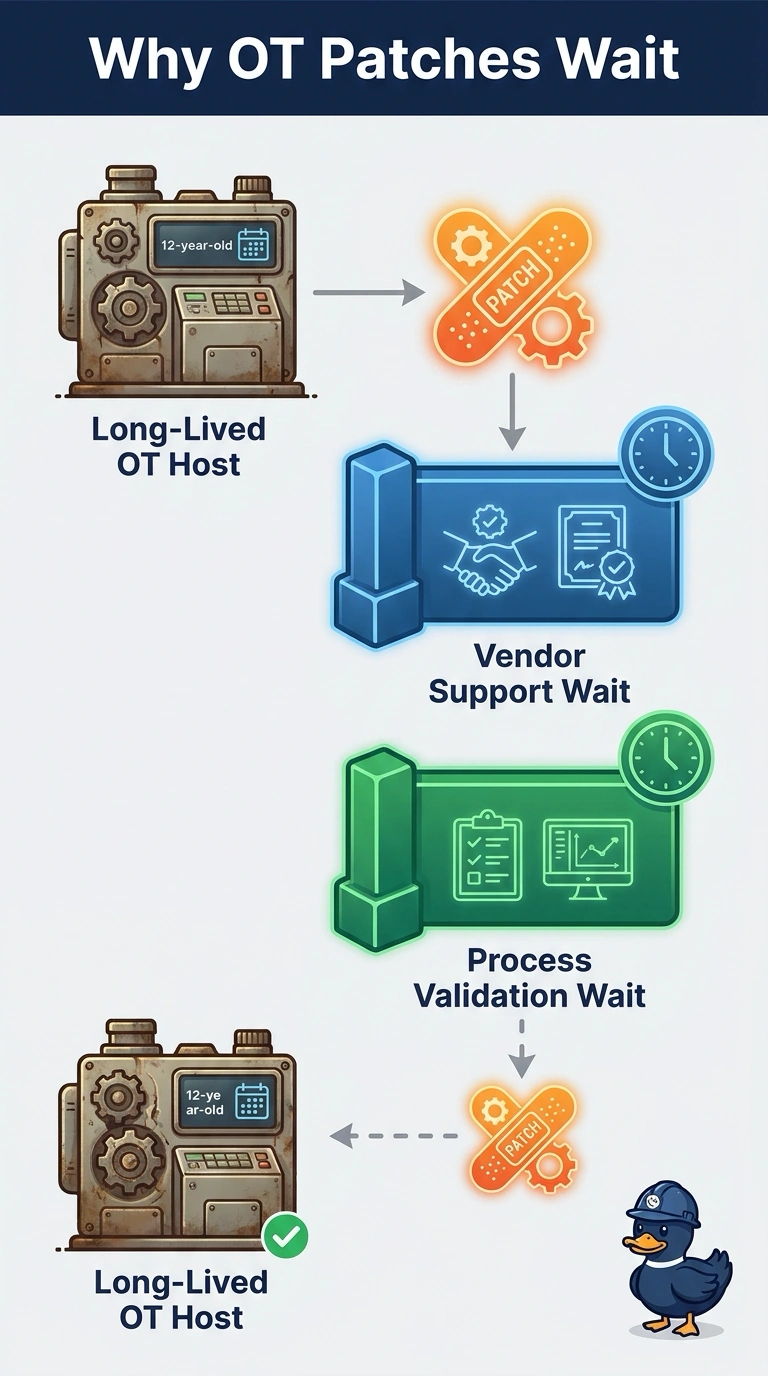
Short Explanation
An office PC is a rental you can swap. A press HMI is more like the frame of the machine: the validated software was built for it, and you do not replace the frame because a newer operating system exists. Your constraint is a long service life tied to the process, not a yearly refresh.
Full Explanation
OT hosts are often tied to a vendor's validated software, a specific driver set, and a process that was qualified on that build. A 12-year-old HMI operating system that the press software still requires is the long-lifecycle constraint: you cannot treat the refresh the way you treat an office PC, and patches exist only if that OEM still provides them for this build and the plant can prove the press still runs. Sharing one monthly reboot calendar with office PCs ignores the press. A reboot that is harmless for a spreadsheet can stop print. A yearly replacement cycle is an IT asset habit, not the constraint this OEM relationship shows. Confidentiality does not create a rule that the HMI must be patched before laptops. In OT the limiting factors are vendor support and a test on the real process, and confidentiality of a job ticket does not reorder that. Exam caveat: a long lifecycle is not an excuse to leave a reachable HMI unsegmented. You compensate with network controls and a plan for the day the OEM actually ships a tested image. The scenario age is this press, not a universal replacement year. Operational check: record the HMI build, the OEM support statement, and the last process test, and make sure the HMI's subnet is not a free path from the office LAN.