
An engineer approved to change one filler PLC at a beverage plant now wants to program every PLC on that line under the same approval. Which decision fits zero trust?
Select an answer to reveal the explanation.
Short Explanation
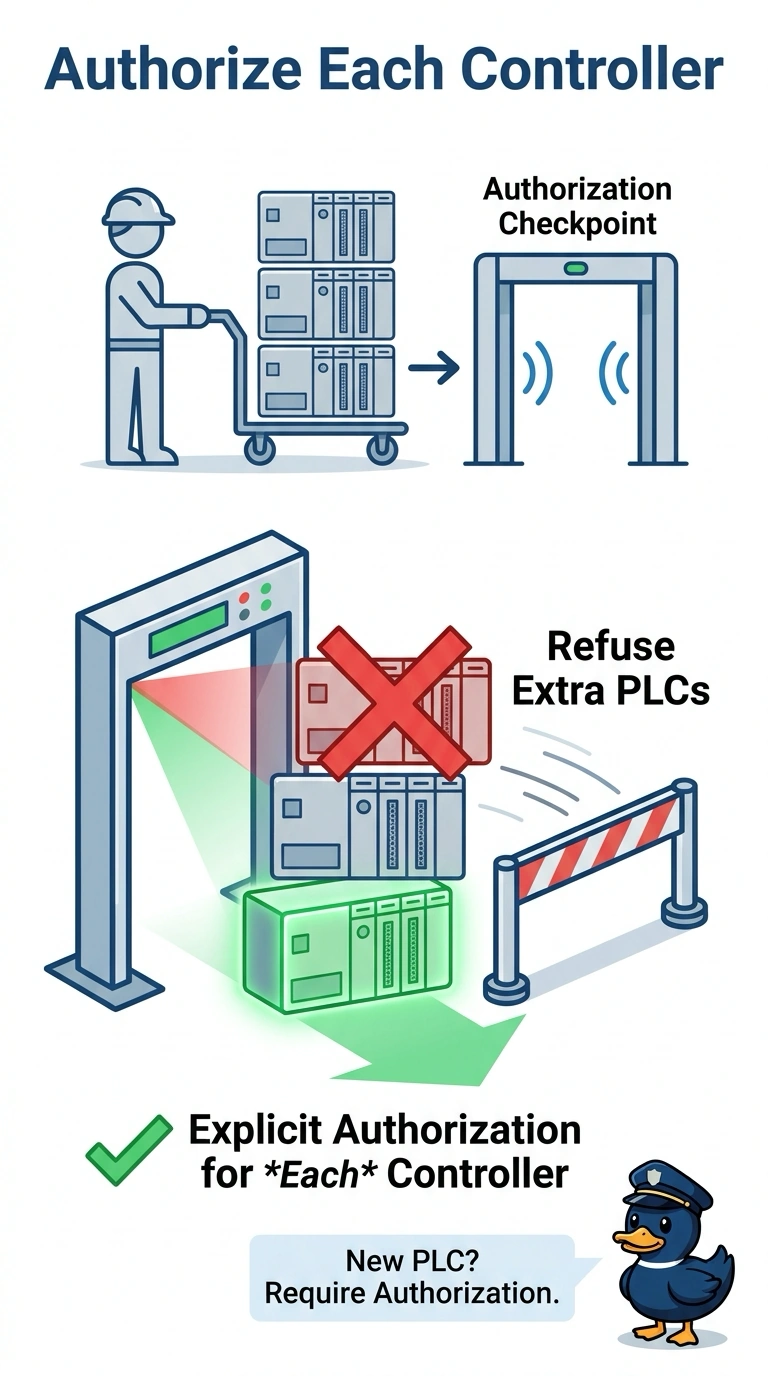
A key cut for one lock does not open the rest of the hallway. You keep this approval on the one filler PLC and you require a new explicit yes for each other controller. Standing in the control room is not that yes.
Full Explanation
Zero trust treats each asset as its own authorization decision. An approval that names one filler PLC lets that engineer change that PLC. It does not become a pass for every controller on the line. The fitting decision is to refuse the extra downloads until each additional PLC has its own explicit authorization. Being on the plant network is a location. Location is not an authorization to alter logic. A successful change on a different filler last month is history, and history is not a standing exception for today's line. Standing in the control room proves where a person is. It does not prove that this session may program every PLC. Least privilege sits in the same rule: the grant is as narrow as the work that was approved. The plant network, last month's filler, and a spot on the control-room floor each fail that test because none of them names the next PLC. Exam caveat: one change ticket can name several PLCs when each controller was written into that approval. This request tries to stretch a single-PLC approval to the whole line, which that ticket did not do. Operational check: review the approval record, confirm it names one filler, and deny a download to a second PLC from an account that holds only that grant.