
A packaging tech plugged a small switch into an HMI port on a Cisco IE switch. The port is err-disabled and the log names BPDU guard. Which recovery fits?
Select an answer to reveal the explanation.
Short Explanation
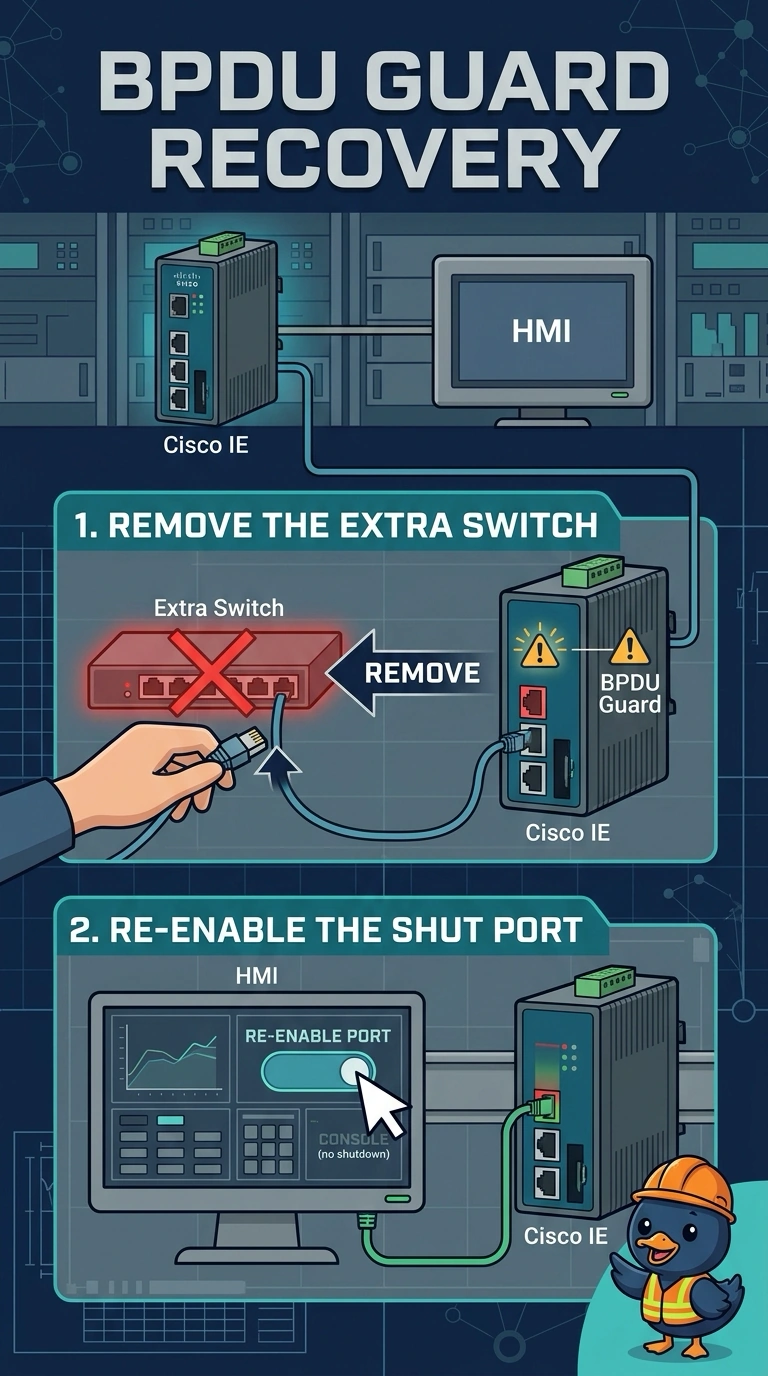
BPDU guard is a fire alarm for a second switch, not a MAC counter. You unplug that extra switch and only then bring the port back. Raising a MAC limit won’t help with a problem that was never port security.
Full Explanation
BPDU guard err-disables an access port when it receives a bridge protocol data unit (BPDU), which a switch sends. The small switch is the source, so remove it and then recover the err-disabled port to restore the HMI without teaching the cell to accept a rogue bridge. Raising the port-security maximum addresses a MAC-address limit; port security would name a port-security violation, not BPDU guard, and changing that maximum will not clear this state. Moving the HMI into the native VLAN does not turn off BPDU guard or prevent a switch from sending BPDUs. Deleting an access list is also ineffective: an ACL filters packets but is not the feature that err-disables a port because a BPDU arrived. The caveat is that err-disable recovery, if enabled, will shut the port again while the extra switch remains. Check the log reason, then run show interfaces status err-disabled after removing the small switch. Put before-and-after evidence in the work order, including the interface or account changed, the time, and the person who approved it. On the next shift, confirm the original symptom is gone and the change did not open a second path while closing the first. If the process is still inside a live batch, leave the controller running and finish only work that does not restart it. This sequence keeps a correct fix from becoming an unplanned outage.