
A flood-gate jump host cannot reach its identity service during a storm. One named engineer must view one gate HMI. Which path still fits zero trust?
Select an answer to reveal the explanation.
Short Explanation
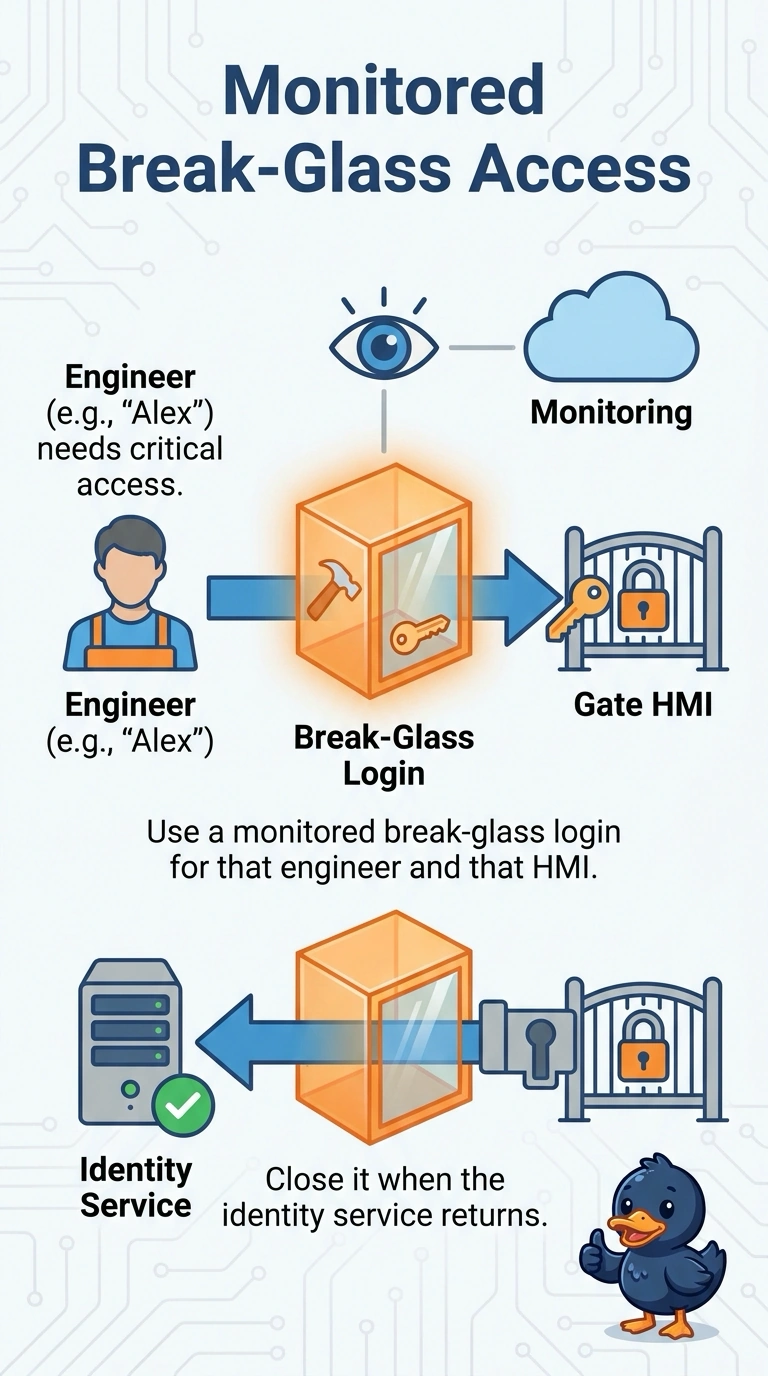
The gate still needs watching, and you can keep access limited while the identity service is down. Give the named engineer a monitored break-glass login for that one HMI, then close it when the service returns. Opening the HMI VLAN to the office network, sharing the administrator password over the radio, or bypassing the jump host gives access too broadly or without the needed monitoring.
Full Explanation
Zero trust still requires explicit authorization when the identity service is down. A monitored break-glass login issued to the named engineer, limited to the one gate HMI, and closed when the identity service returns preserves that authorization and records the storm access. Opening the HMI VLAN to every address in the plant office network replaces person-specific authorization with a network grant and lets every office host reach the HMI. Reading the administrator password over the radio creates a shared secret with no named user and no end tied to the service repair. Bypassing the jump host lets any laptop that can reach the control network connect directly to the gate HMI, removing the monitoring point and the limit to one HMI. Exam caveat: break-glass access should be agreed in advance, not created by disabling a firewall rule during the storm and forgetting to restore it. The login must be visibly in use and easy to close. Practical check: the session log should identify the engineer and the one HMI, an attempt to reach another HMI should fail, and the break-glass login should be disabled once the identity service answers again.