
A stamping-plant vendor asks for the press PLC programming port to be published on the public internet so home support can connect directly. Which response matches the remote-access standard?
Select an answer to reveal the explanation.
Short Explanation
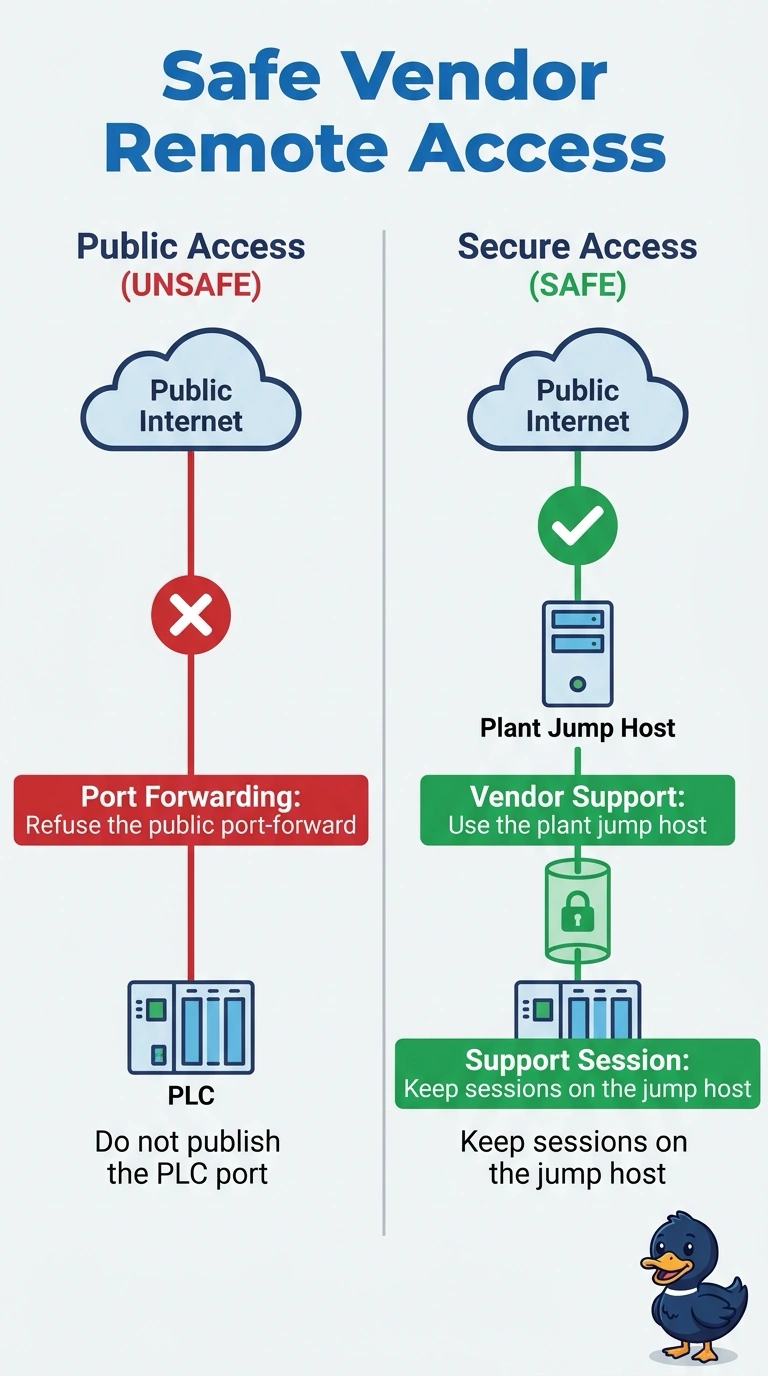
A programming port published to the public internet is a loading dock propped open onto the street. You refuse that forward and keep the vendor on the plant jump host. A long password sitting in a home browser does not make a direct hole into the press PLC acceptable.
Full Explanation
Remote access to a PLC programming service stays on a path the plant controls. Publishing that port on the public internet lets anyone who finds it attempt a session, and home support then depends on the PLC's own weak or missing authentication. The standard response is to refuse the port-forward and keep the vendor on the plant jump host, where the session can be approved, limited, and ended. A long password stored in a home browser still leaves the programming service on the internet, and the secret sits on a machine the plant does not manage. Rotating that password monthly while the port stays published manages a credential and does not remove the exposure. The service remains reachable from anywhere for the whole season. A standing any-to-any rule from the vendor office into the press VLAN is a permanent network trust, broader than a programming session, and it is not a substitute for a brokered login. Exam caveat: refusing this request does not mean the vendor can never work. A later, time-bounded session through the jump host is a different request from the one that publishes the PLC. Operational check: from an outside network, a connection to the programming port should fail, and a test vendor login should reach only the jump host.