
A glass-furnace PLC accepts a logic download from any host that can reach its programming port and has no user accounts of its own. Which control matches that limitation?
Select an answer to reveal the explanation.
Short Explanation
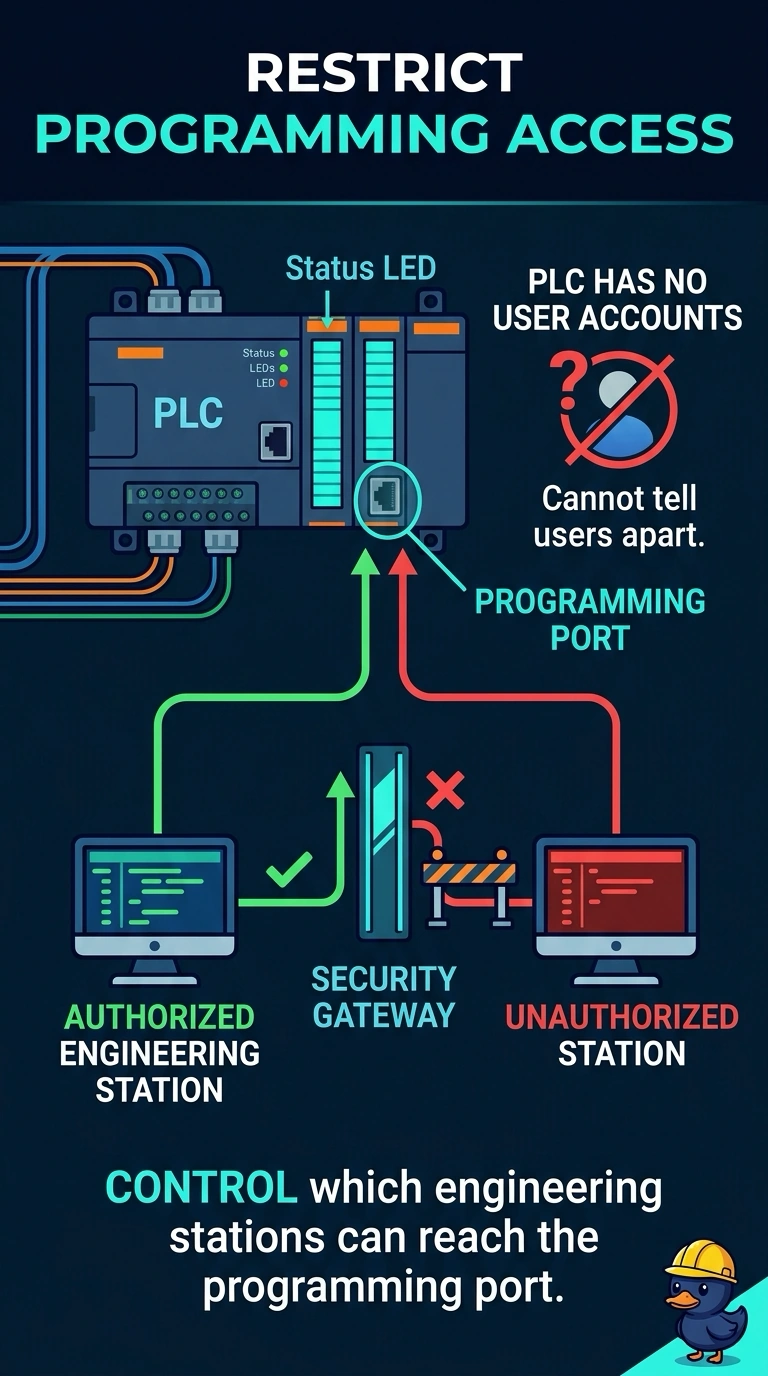
You can think of this PLC as having no front desk: anyone who can reach its programming port can download logic. Since it cannot distinguish users, put access control on the network path by allowing only approved engineering stations to reach that port, rather than sharing the programming laptop or relying on a password written on the cabinet.
Full Explanation
Access control has to live where the device can enforce it. This PLC has no user accounts, so it cannot tie a download to a person or refuse an operator who has the programming software. The practical control is to limit which engineering stations can reach the programming port, typically through a managed engineering workstation or an authenticated jump host, with cell switches and firewalls denying everyone else. Giving every furnace operator the programming laptop multiplies the people who can reach the port and violates least privilege. A longer password written on the cabinet remains a shared secret that the PLC cannot check; writing it down also removes even that weak secret’s secrecy, and it does not create user separation inside the controller. Disabling the event log, if the PLC has one, destroys evidence but does not prevent an unauthorized download. Exam caveat: network controls do not stop someone who plugs a laptop into a port beside the PLC, so physical access controls and port security are also needed. Practical check: a programming connection should fail from an operator HMI and a random cell port, succeed from the approved engineering station, and be logged at the jump host.