
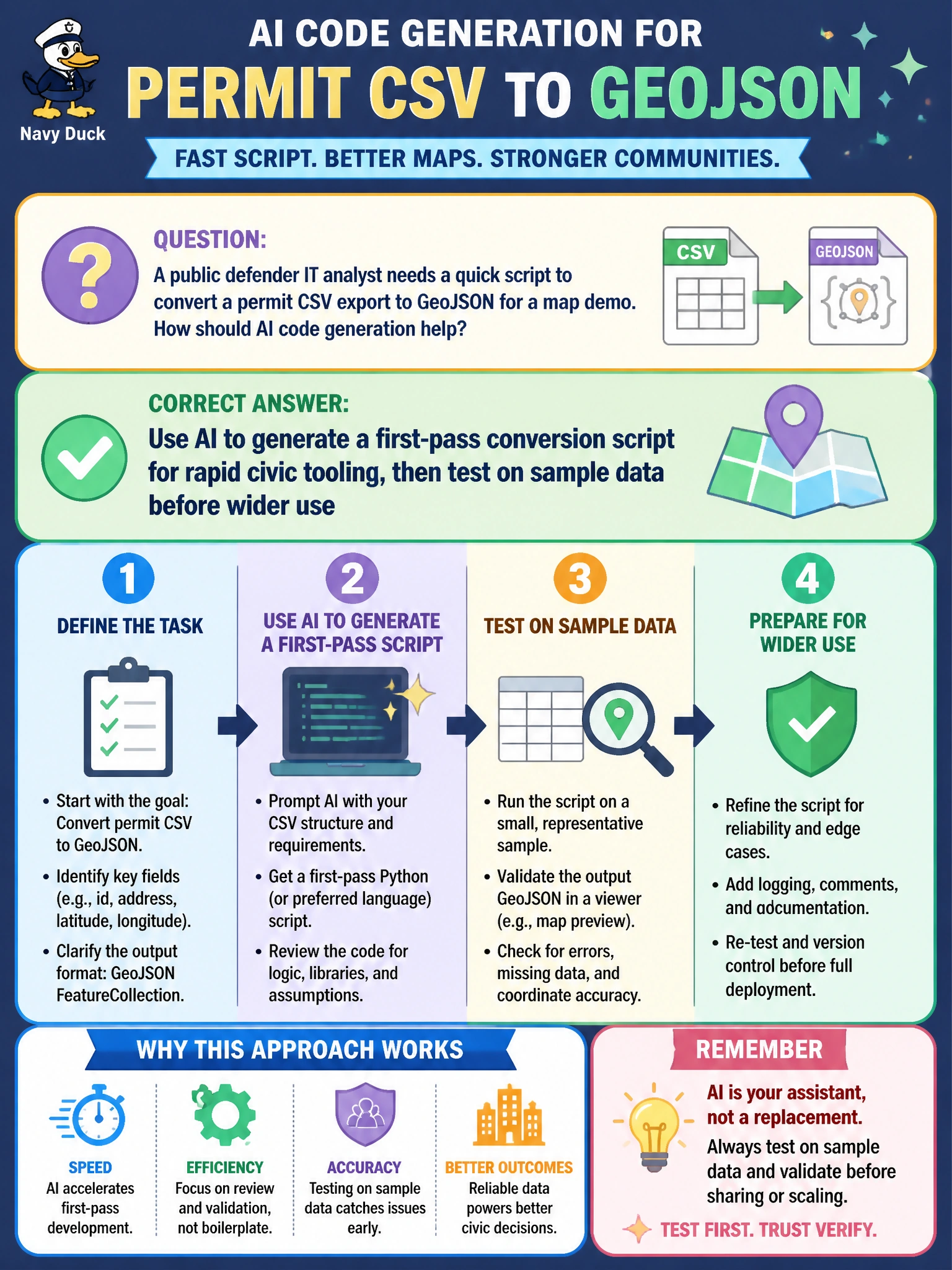
A public defender IT analyst needs a quick script to convert a permit CSV export to GeoJSON for a map demo. How should AI code generation help?
Select an answer to reveal the explanation.
Short Explanation
CSV to GeoJSON is a perfect rapid-tooling ask. Let AI sketch the script, run it on a sample file, and only then trust it near anything important—production GIS is not a scratchpad.
Full Explanation
AI code generation helps a public defender IT analyst by producing a first-pass script that converts a permit CSV export to GeoJSON for a map demo, then testing that script on sample data before wider use. Format conversion is classic rapid civic tooling: small scope, clear input/output, high value for a demo. The correct pattern is generate, test on samples, then expand—never treat the first draft as safe near production GIS or sensitive case stores.
Refusing all scripting and requiring a six-month vendor RFP before any conversion fails by proportionality; tiny one-off converters do not always warrant full procurement cycles when internal rapid tooling with review is available. Uploading the full client case file database into a public model to “improve” the script fails on confidentiality—public defender case data must not be pasted into public generative services. Running untested generated code directly against the production GIS database fails because unvalidated SQL/scripts can corrupt layers, leak credentials, or overwhelm production systems.
Exam caveat: sample-data success does not guarantee the production CSV schema matches; column renames and encoding issues often appear only on real extracts. Also scrub any residual PII from demo GeoJSON before sharing maps broadly.
Operational check: generate the converter, run it on a redacted sample CSV, validate GeoJSON geometry and properties, confirm no case database was exposed to public models, and only then consider a controlled run against a non-production GIS endpoint.