
A homeless-services continuum uses AI to prototype a shelter vacancy board. What sequencing reflects responsible SDLC practice?
Select an answer to reveal the explanation.
Short Explanation
AI prototypes move fast—accessibility review should move with them. Check the draft experience before you pour concrete on a full build, and never treat demo inventory as live beds.
Full Explanation
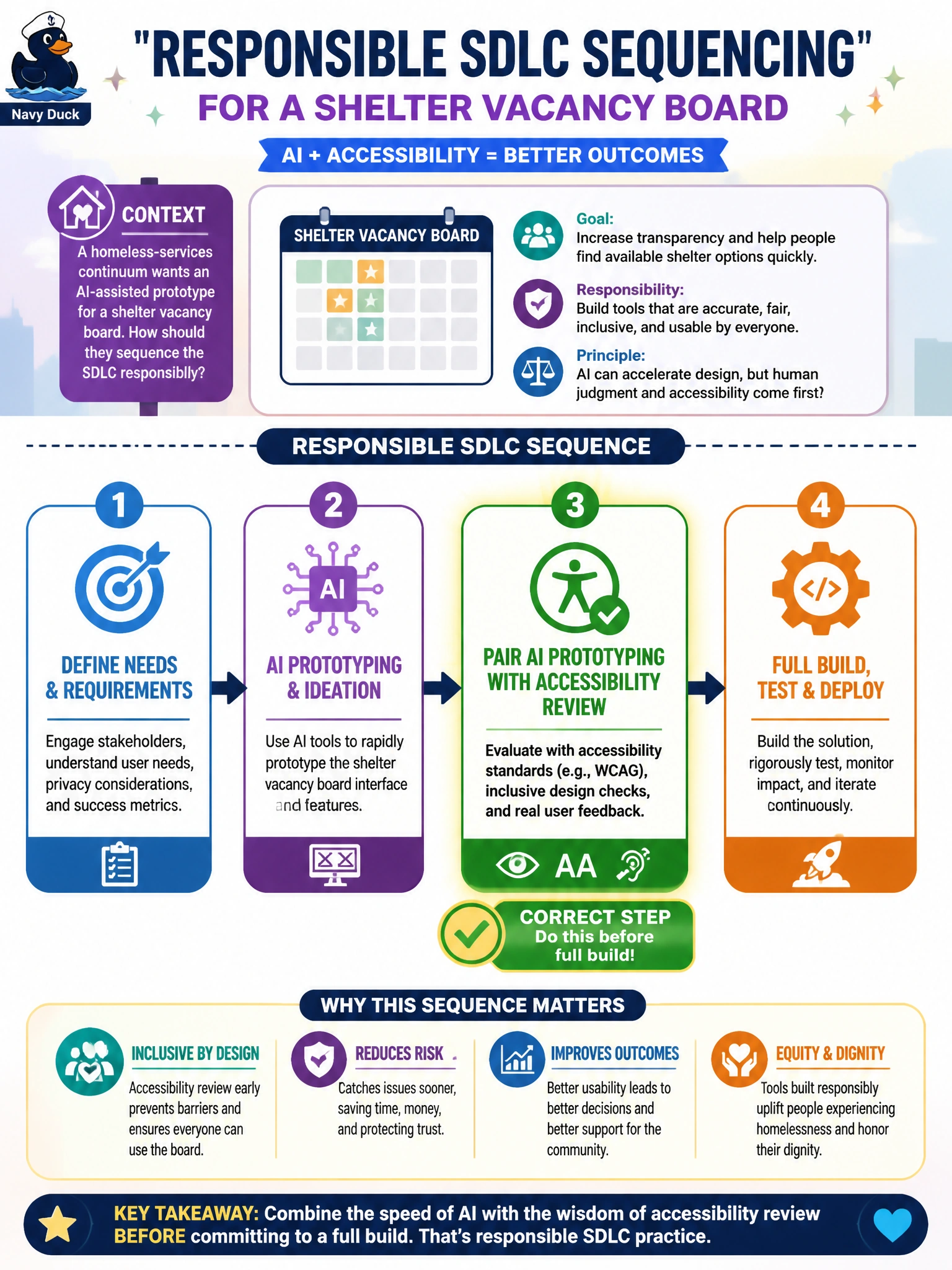
Responsible SDLC sequencing for a homeless-services continuum prototyping a shelter vacancy board pairs AI prototyping with accessibility review before committing to a full build. Speed from generative prototypes is valuable only if early experiences are checked for keyboard access, screen-reader labels, contrast, and comprehensible vacancy status language. The correct sequence validates the prototype with accessibility and human design review, keeps hardcoded demo inventory out of production, and only then invests in full build.
Skipping accessibility until after a year in production fails because shelter seekers who need accessible interfaces are harmed immediately; retrofits cost more than early review. Building only from AI prototypes with no human design review fails by concept: generative layouts can look complete while encoding confusing status semantics or exclusionary flows. Shipping the prototype’s hardcoded demo data as live shelter inventory fails operationally and ethically—demo beds are not real vacancies and can misdirect people in crisis.
Exam caveat: accessibility review must include mobile and low-bandwidth scenarios common for people seeking shelter, not only desktop WCAG checklists in an office. Also verify that vacancy meaning (hold, available, restricted) is unambiguous.
Operational check: run the AI prototype through accessibility and service-design review, replace demo inventory with a safe data contract before any production path, and gate full-build funding on documented remediation of critical access and data-integrity findings.