
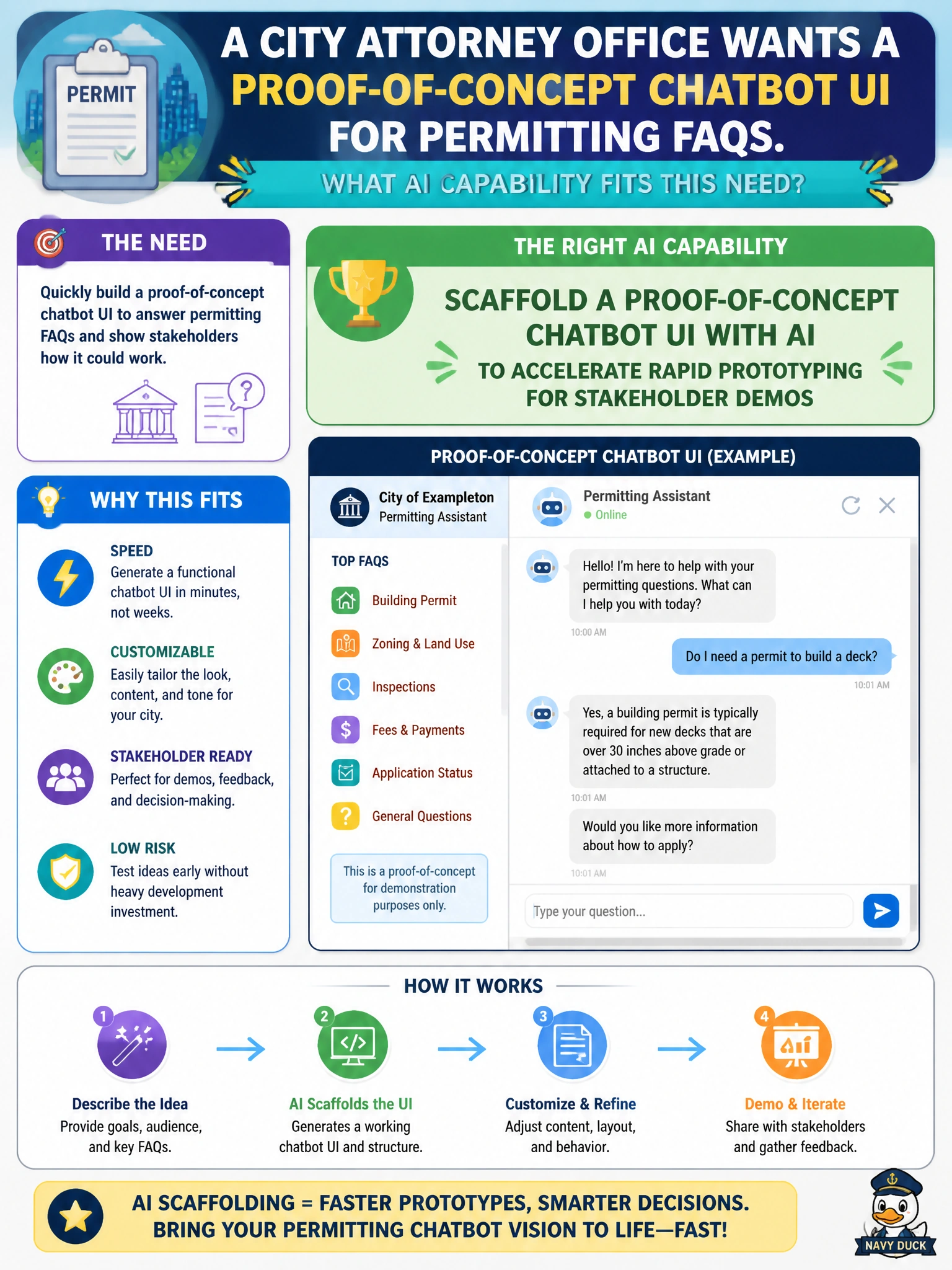
A city attorney office wants a proof-of-concept chatbot UI for permitting FAQs. What AI capability fits this need?
Select an answer to reveal the explanation.
Short Explanation
Need a clickable FAQ bot for a stakeholder room by Thursday? AI scaffolding gets a POC UI on the table fast—just keep confidential legal advice out of the unauthenticated demo.
Full Explanation
AI fits a city attorney office need for a proof-of-concept chatbot UI by scaffolding a rapid prototype for permitting FAQ demos to stakeholders. Scaffolding HTML/component stubs and conversational shells gets a clickable experience in front of attorneys and permitting staff quickly so they can judge scope, tone, and workflow before any platform rewrite. The correct capability is speed-to-feedback on a disposable POC—not production legal advice delivery and not a mandate to finish multi-year architecture first.
Mandating a full multi-year platform rewrite before any FAQ UI can be shown fails because POC demos exist precisely to inform whether a larger investment is justified. Prohibiting UI scaffolding because AI cannot generate HTML or component stubs fails by concept: modern assistants routinely generate UI stubs suitable for early demos. Putting live confidential legal advice behind an unauthenticated prototype fails on ethics and security—unauthenticated POCs must not expose privileged counsel or confidential client matters.
Exam caveat: stakeholders may mistake a polished POC for a production-ready advisor; facilitators should label the demo clearly and disable any path that looks like individualized legal advice. Use only public permitting FAQ content in the prototype corpus.
Operational check: scaffold the chatbot UI with AI, load only approved public FAQ content, keep authentication and confidential advice out of the demo, watermark it as a prototype, and capture stakeholder feedback before any production build decision.