
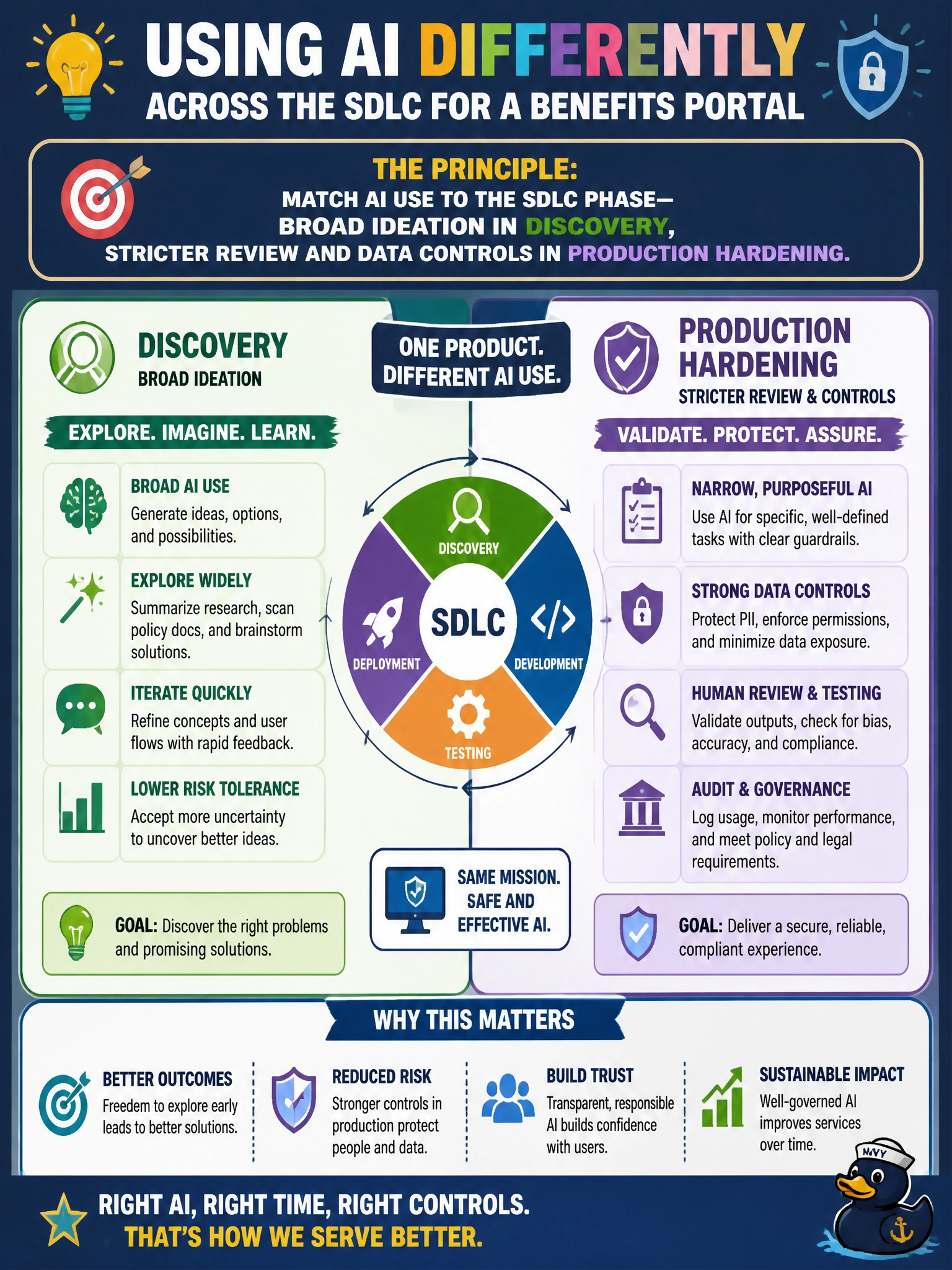
A social-services intake team uses AI differently in discovery than in production hardening for a benefits portal. What principle should guide that difference?
Select an answer to reveal the explanation.
Short Explanation
Discovery can brainstorm loosely; production hardening cannot. Dial AI assist to the phase—wild ideation early, tighter review and data guardrails when the portal gets real.
Full Explanation
A social-services intake team should match AI use to the SDLC phase: broad ideation in discovery, and stricter review and data controls during production hardening of a benefits portal. Early demos can tolerate loose brainstorming on synthetic examples; production hardening cannot tolerate paste-anything habits with real case data, weak logging, or unreviewed changes. The correct principle is phase-appropriate risk posture—same assistive technology, different guardrails as the portal approaches live benefits determinations.
Reusing unconstrained AI paste-anything habits from discovery demos in production fails because real resident PII, eligibility logic, and payment-adjacent workflows demand privacy, change control, and auditability. Forbidding AI entirely once discovery ends, even for documentation drafts, fails by overcorrection: controlled late-phase assists (release notes, test drafts, runbook language) remain valuable under review. Disabling all logging during production hardening to speed AI experiments fails by concept—hardening is when logging and monitoring matter most, not when they should be turned off for convenience.
Exam caveat: teams often blur “staging with production-like data” into production risk; phase matching includes data classification, not only calendar phase labels. Synthetic or properly minimized datasets should persist into late testing whenever possible.
Operational check: publish a short phase matrix for the benefits portal listing allowed AI uses, prohibited data classes, and required reviewers for discovery versus hardening; spot-check that production prompts never include live case PII and that logging remains enabled during late experiments.