
A county jail medical unit wants clearer communication after merges for a clinic scheduling tool. How can AI help late in the SDLC?
Select an answer to reveal the explanation.
Short Explanation
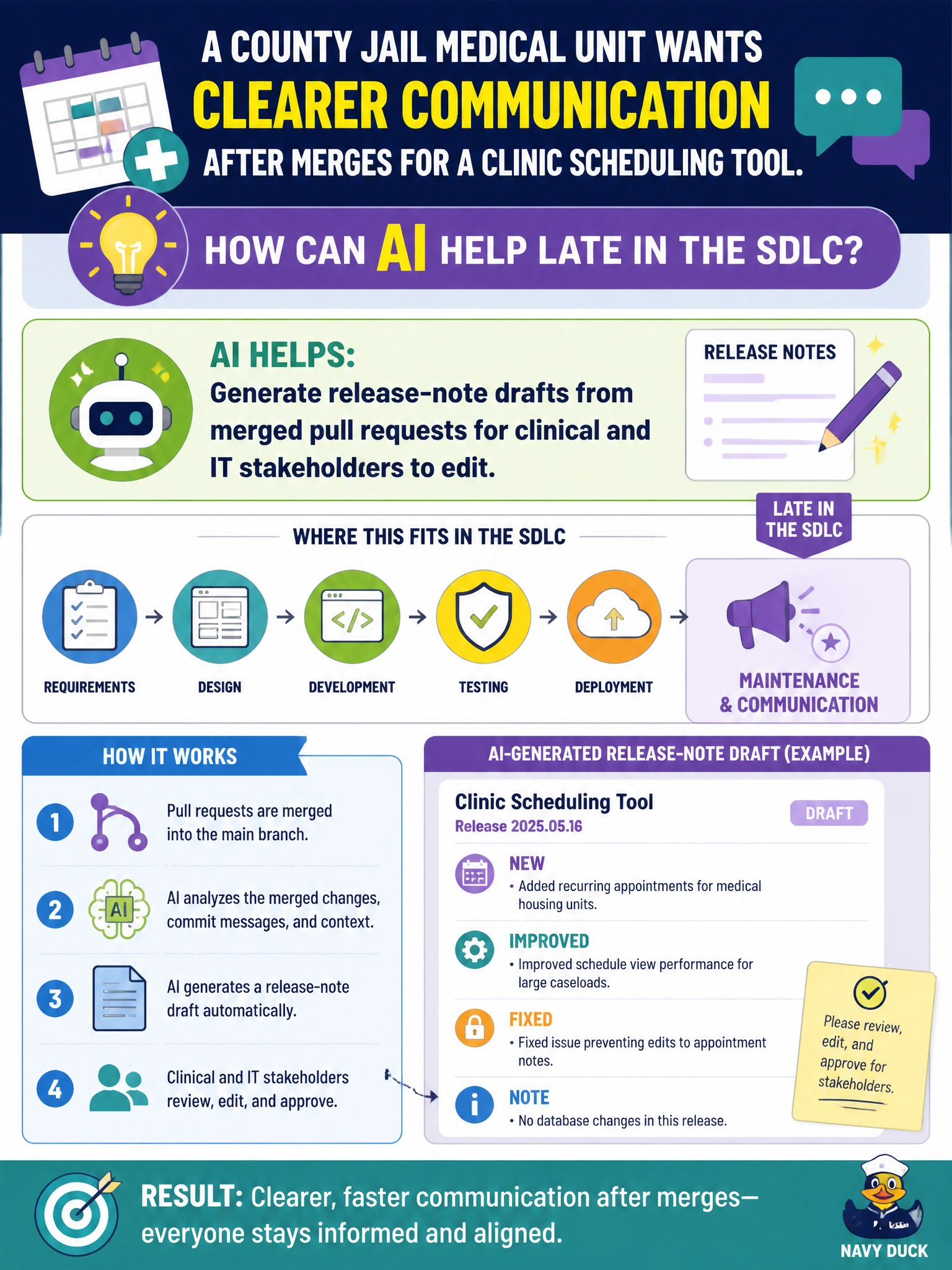
Merged PRs are noisy; release notes should not be. Let AI draft a human-readable summary from the merges, then clinicians and IT edit before anyone relies on it.
Full Explanation
Late in the SDLC, AI can help a county jail medical unit’s clinic scheduling tool by generating release-note drafts from merged pull requests for clinical and IT stakeholders to edit. Raw merges are noisy; readable release notes improve communication about what changed in scheduling, access, or downtime windows. The correct pattern is draft-then-edit: AI summarizes merged work, humans correct clinical meaning, and nothing that alters clinical protocols ships in the notes without clinician review.
Posting raw git diffs to the public without summarization or review fails because diffs are unreadable to clinicians and may expose internal paths or sensitive configuration details. Skipping release notes because medical staff never read change summaries fails by concept: if notes are unused, the fix is better communication design—not abandoning change communication for a clinic scheduling system. Having AI silently alter clinical protocols inside the notes without clinician review fails because release notes are not a back door to change care standards; protocol changes need clinical governance, not generative rewording.
Exam caveat: AI summaries can invent features that were only partially merged or mislabel bugfixes as enhancements. Editors must reconcile notes to the actual merge list and environment where the release will land.
Operational check: generate a release-note draft from the merged PR set, have IT verify technical accuracy, have clinical stakeholders edit patient-impact language, remove any unverified protocol changes, and publish the reviewed notes through the approved internal channel before go-live.