
A parking authority is releasing a resident chatbot and needs deployment hygiene. How can AI support the deployment phase?
Select an answer to reveal the explanation.
Short Explanation
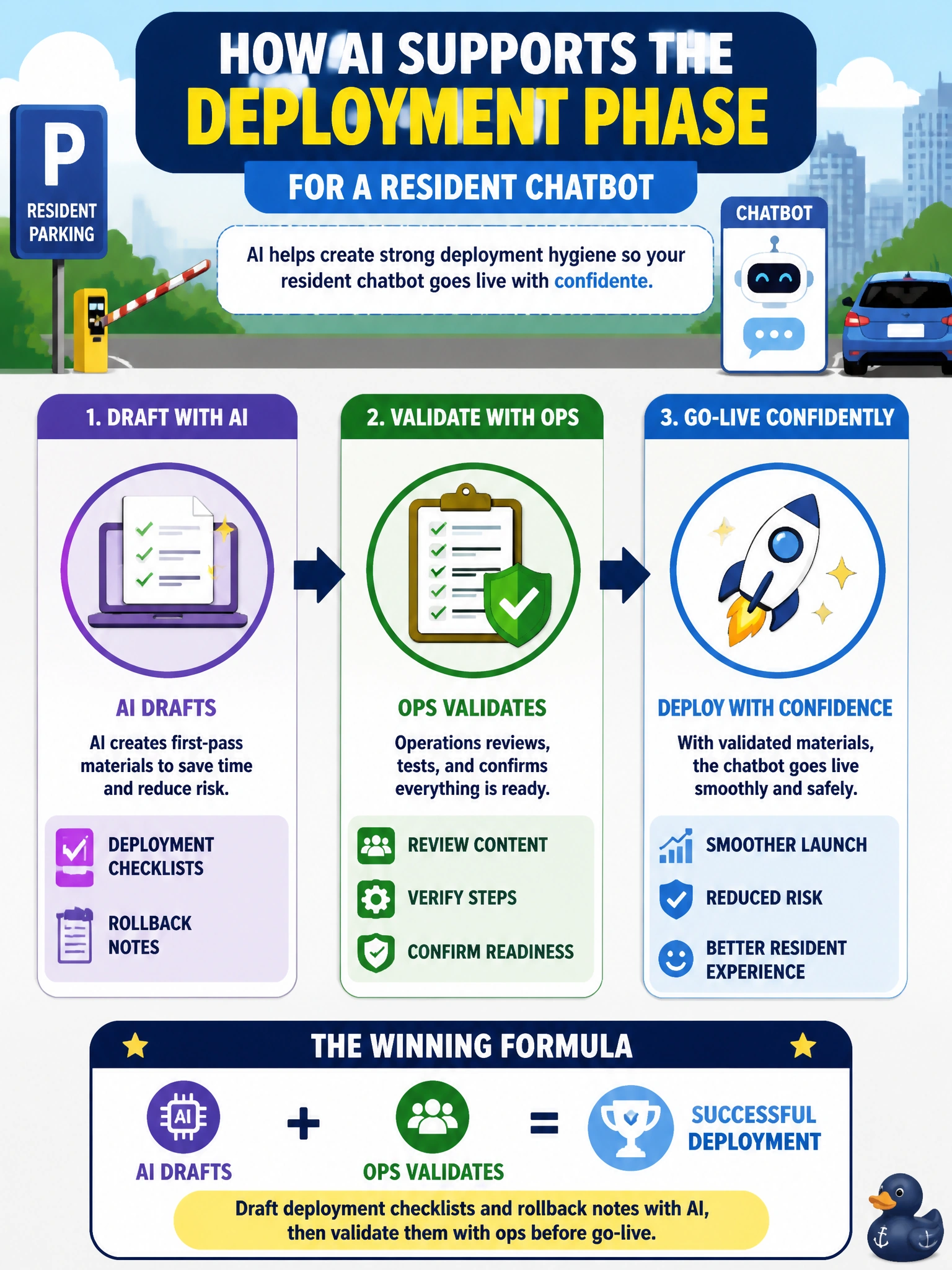
Go-live still needs a checklist. Let AI draft deployment and rollback notes, then ops signs off—because ‘the model said it would be fine’ is not a runbook.
Full Explanation
AI supports the deployment phase for a parking authority resident chatbot when it drafts deployment checklists and rollback notes that operations staff validate before go-live. Deployment hygiene is about controlled release: environment readiness, configuration checks, monitoring hooks, and a practiced rollback path if the chatbot misroutes tickets or fails authentication. The correct assist accelerates documentation of those steps without pretending generative text replaces ops judgment or that AI-built apps never fail.
Ignoring rollback planning because AI-generated apps never fail fails by concept—every release can fail, and civic chatbots that break create resident service outages. Deploying Friday night with no checklist to maximize surprise fails because change windows without readiness checks amplify incident cost when fewer staff are available. Storing production secrets in the public chatbot prompt for convenience fails on security: secrets belong in managed secret stores, not prompts, logs, or public conversational contexts.
Exam caveat: AI-drafted checklists often miss agency-specific dependencies such as payment gateway cutovers, ADA statement pages, or after-hours escalation contacts. Ops validation must add those local items before treating the checklist as authoritative.
Operational check: generate draft go-live and rollback notes with AI, walk them with ops and the service owner, confirm secret handling excludes prompts, schedule a non-surprise change window, and rehearse the rollback step in staging before production cutover.