
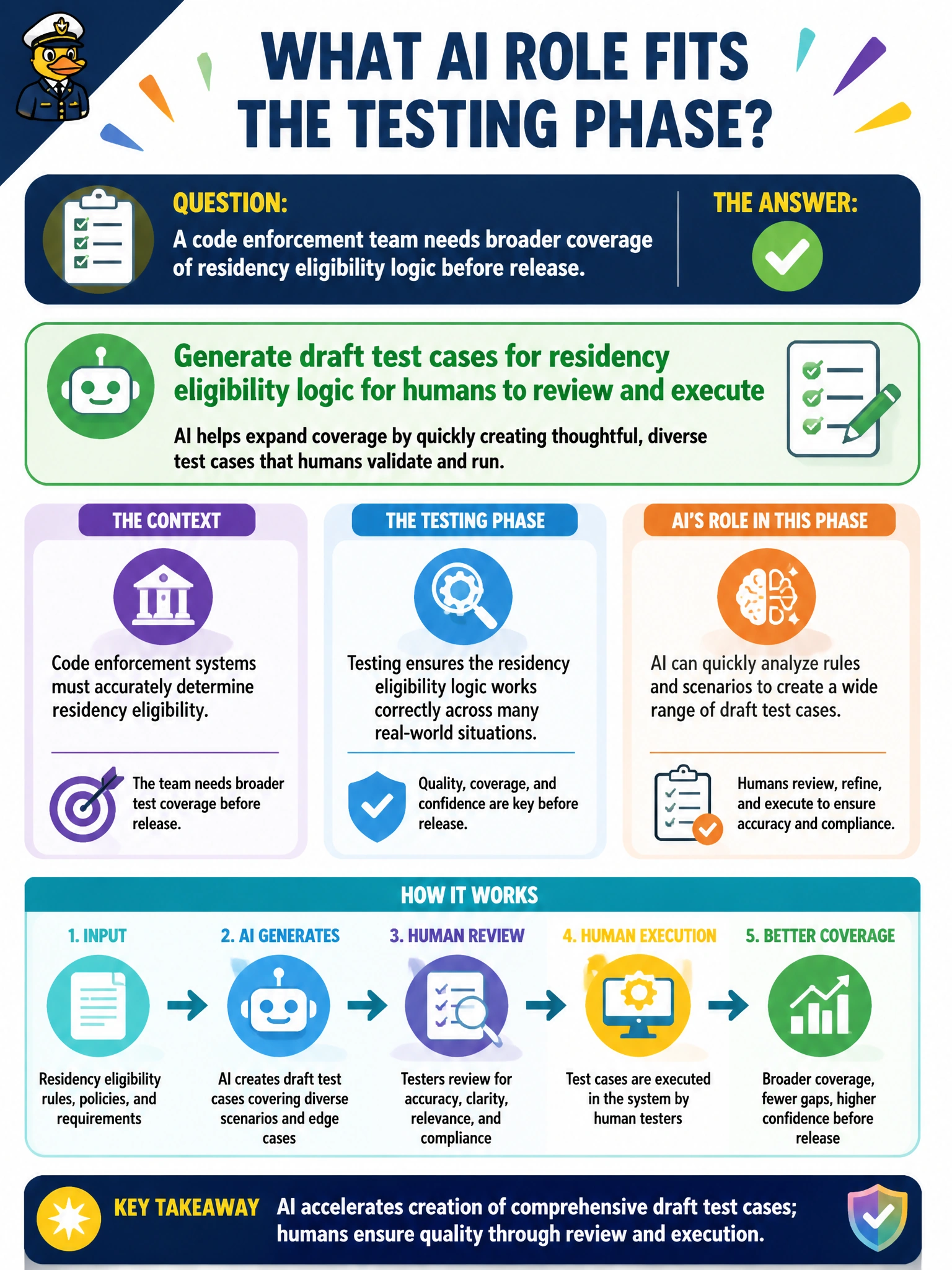
A code enforcement team needs broader coverage of residency eligibility logic before release. What AI role fits the testing phase?
Select an answer to reveal the explanation.
Short Explanation
Testing loves more cases than humans remember to write. Ask AI for draft residency eligibility tests, then humans pick the good ones and actually run them—chat praise is not a test result.
Full Explanation
In the testing phase, AI’s appropriate role for a code enforcement team is generating draft test cases for residency eligibility logic that humans review and execute. Models are useful at enumerating boundary conditions—expired IDs, multi-address households, temporary housing—that expand coverage beyond the cases staff remember to write. The correct pattern keeps humans responsible for selecting valid cases, running them, and interpreting failures; AI drafts candidates, it does not certify quality by opinion.
Declaring the system fully tested solely because AI said the code looks fine fails because static praise from a model is not an executed test result or coverage metric. Deleting all negative test cases to shorten the suite fails by concept: negative and edge cases are where residency eligibility bugs hide, and shrinking the suite for speed undercuts the testing phase’s purpose. Replacing production monitoring with a one-time AI chat about quality fails because testing and runtime observability are different controls; a pre-release chat cannot detect post-release regressions in live eligibility decisions.
Exam caveat: AI-generated cases may encode incorrect legal assumptions about residency unless reviewers align them to local ordinance and policy. Discard or rewrite cases that conflict with adopted rules even if they look sophisticated.
Operational check: collect AI-drafted cases, triage them against the eligibility policy matrix, execute the accepted set in the test environment, record pass/fail evidence, and retain negative cases that probe spoofed or incomplete residency proofs before release.