
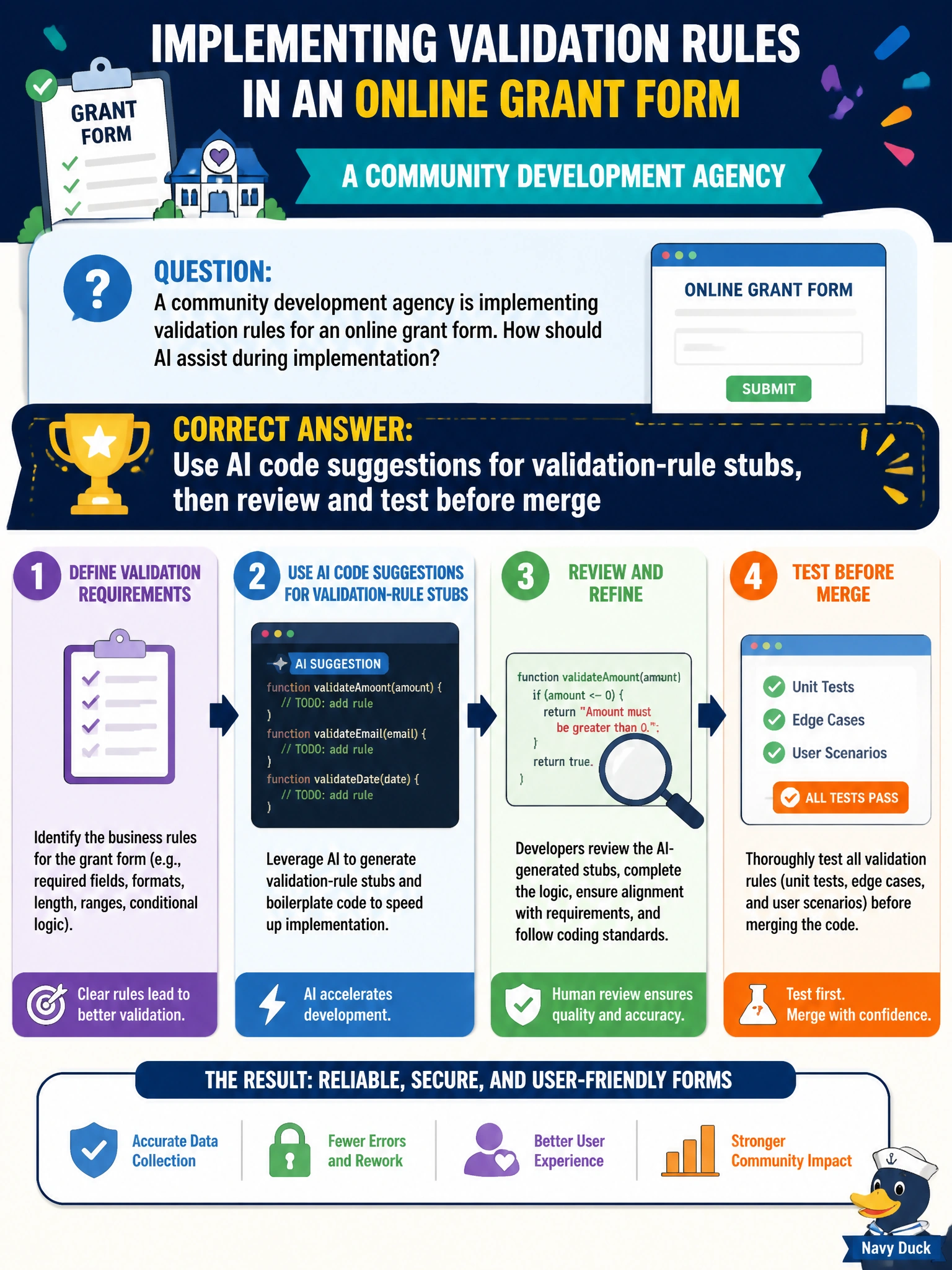
A community development agency is implementing validation rules for an online grant form. How should AI assist during implementation?
Select an answer to reveal the explanation.
Short Explanation
Implementation is where AI code assist shines—stub those validation rules, then review and test like any other teammate’s pull request. Unreviewed merges are still unreviewed merges.
Full Explanation
During implementation, AI assists a community development agency by suggesting validation-rule stubs for an online grant form that developers still review and test before merge. Code suggestions speed repetitive patterns—required fields, amount ranges, EIN format checks—while human review protects against insecure or incomplete validation. The correct SDLC habit is the same as for any teammate’s pull request: AI can draft, but merge gates remain review, tests, and controlled promotion.
Committing every AI suggestion to production without code review fails because generative code can include subtle logic gaps, injection risks, or incorrect eligibility rules that silently reject valid applicants. Disabling logging so AI-suggested code cannot be audited fails by concept: observability and auditability are implementation requirements for grant systems handling public funds, not optional friction. Asking AI to delete all server-side validation in favor of client-only checks fails because client checks are bypassable; municipal grant portals need authoritative server-side enforcement.
Exam caveat: passing unit tests on happy-path stubs does not prove edge-case eligibility rules match program policy. Pair code review with policy owner sign-off on validation semantics, not only syntax.
Operational check: accept AI stubs into a branch, run unit and integration tests including negative cases, require peer review, confirm server-side rules remain authoritative, and merge only after validation behavior matches the grant program’s published requirements.