
A port authority reviews AI prompts and outputs that might echo rare facility addresses from an analysis extract. What risk are they primarily mitigating?
Select an answer to reveal the explanation.
Short Explanation
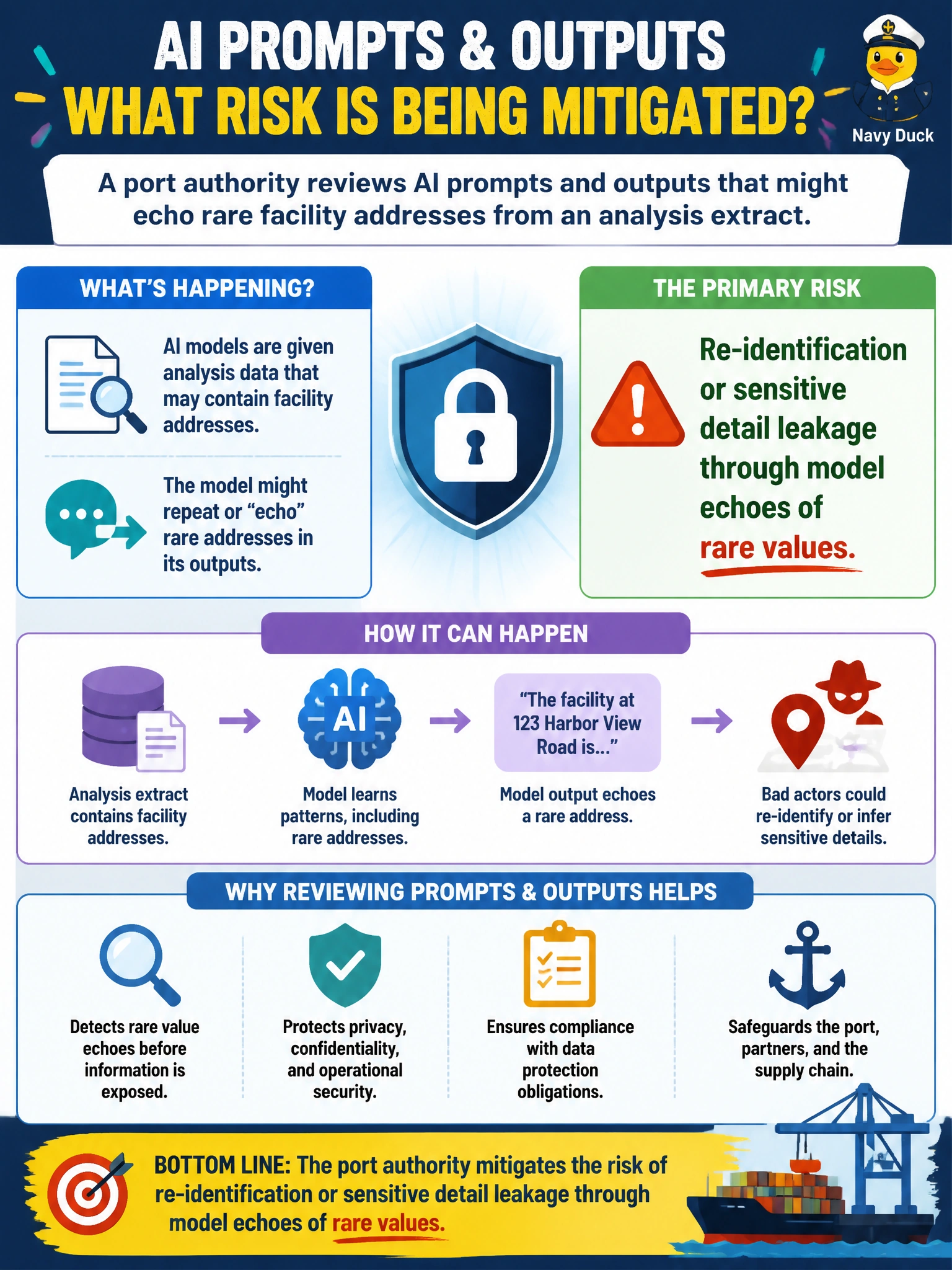
Rare addresses are fingerprints. If the model parrot them back, someone can re-identify a site or person even from a “de-identified” extract. Review prompts and outputs for those echoes before they leave the room.
Full Explanation
Reviewing AI prompts and outputs for echoes of rare facility addresses from an analysis extract primarily mitigates re-identification and sensitive-detail leakage: generative models can memorize or repeat uncommon values that act as fingerprints for sites or people. Port authorities handling logistics and critical-facility data correctly treat rare address echoes as a disclosure risk even when direct names were stripped. Output review is part of safe AI-assisted analysis, not a cosmetic branding exercise.
Token pricing for maritime APIs fails as the primary risk framing here—the scenario centers on leakage of rare values, not cost accounting. GPU thermal throttling in dock crane PLCs fails by category: operational OT thermals are unrelated to LLM prompt/output review for address echoes. Whether the chart color palette matches the port brand guide fails because branding is not a privacy or security control for re-identification.
Exam caveat: Quasi-identifiers combine—rare address plus uncommon cargo type plus timestamp can identify even without a name. De-identification of the extract does not eliminate echo risk in free-text model completions. Red-team prompts that ask for “examples from the data.”
Operational check: Scan prompts and completions for rare tokens from the extract, suppress or generalize addresses before prompting when possible, restrict who can export chat logs, and escalate any echoed critical-facility detail. Prefer aggregated geographies over exact addresses in AI-assisted analysis.