
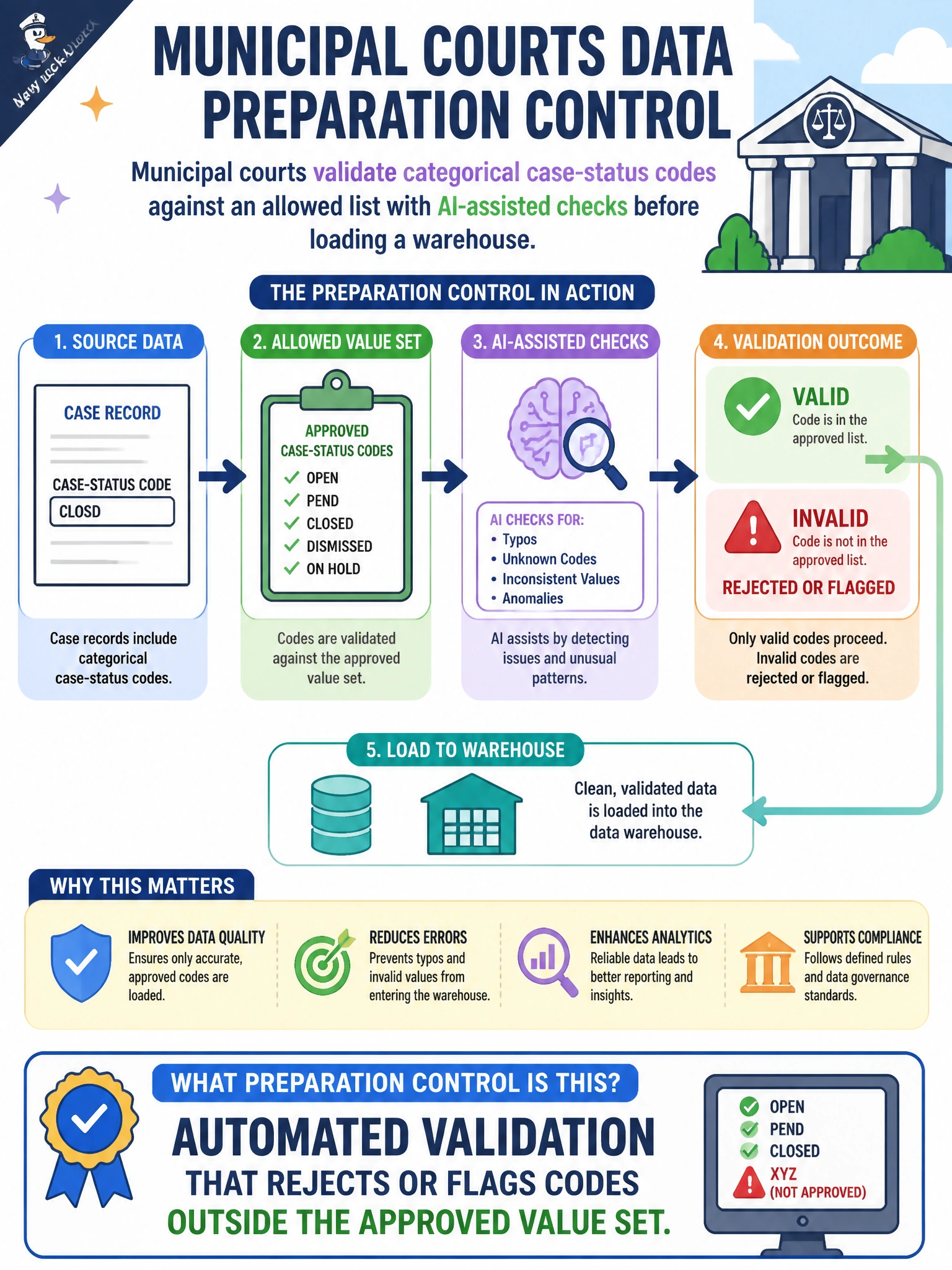
Municipal courts validate categorical case-status codes against an allowed list with AI-assisted checks before loading a warehouse. What preparation control is this?
Select an answer to reveal the explanation.
Short Explanation
Allowed-list checks are the bouncer at the data-warehouse door. If a case-status code is not on the list, flag it before it contaminates reporting. Validation beats inventing mystery codes on the fly.
Full Explanation
Validating categorical case-status codes against an allowed list with AI-assisted checks before a warehouse load is an automated domain-validation control in preparation: codes outside the approved value set are rejected or flagged so municipal courts reporting is not poisoned by typos, legacy synonyms, or free-text drift. The control protects schema integrity and downstream dashboards. AI may help classify borderline strings into known codes or exception queues, but inventing statuses is out of bounds.
Inventing new status codes whenever the model is unsure fails because unauthorized categories break longitudinal court metrics and statutory reporting maps. Dropping the code field entirely to speed the load fails by concept: case status is analytically essential; speed is not a reason to destroy meaning. Allowing free-text status values to bypass schema rules fails because uncontrolled text reintroduces the quality problem the allowed list exists to stop.
Exam caveat: Allowed lists must version with policy changes (new dispositions); a stale list will false-positive valid new codes. AI “nearest code” suggestions still need human approval when mapping legacy values.
Operational check: Maintain a governed status code list, run pre-load validation, route failures to a remediation queue, measure reject rates, and prohibit model-invented codes from entering the warehouse. Align BI measures to the same list used in validation.