
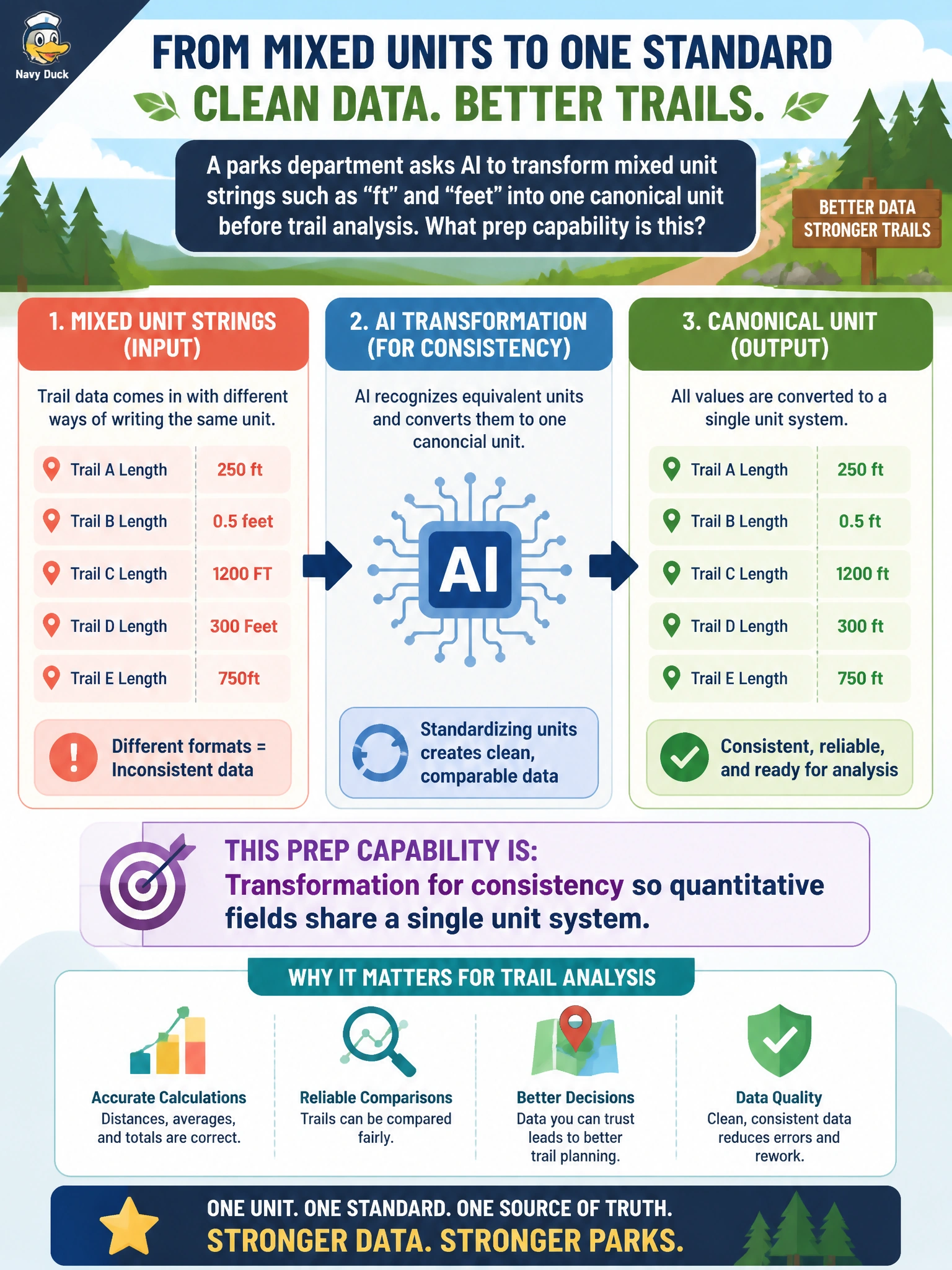
A parks department asks AI to transform mixed unit strings such as “ft” and “feet” into one canonical unit before trail analysis. What prep capability is this?
Select an answer to reveal the explanation.
Short Explanation
“ft” versus “feet” is the same length wearing different name tags. AI can help map those strings into one unit so trail stats add up. Consistency transforms beat poetic unit salad every time.
Full Explanation
Transforming mixed unit strings such as “ft” and “feet” into one canonical unit before trail analysis is a consistency transformation in data preparation: quantitative fields must share a unit system so parks analytics can aggregate distance, grade, or clearance correctly. AI can help map synonyms and abbreviations into a governed unit code, but the capability is standardization for trustworthy math—not abandoning measurement for adjectives or hiding conversion rules. Municipal asset and trail datasets routinely need this hygiene.
Replacing all measurements with qualitative adjectives only fails because trail planning and maintenance need quantitative totals and thresholds, not irreversible loss of numeric meaning. Using unit chaos to train a creative writing model fails by concept: prep exists to make analysis correct, not to preserve mess for generative aesthetics. Avoiding any documentation of the conversion rules fails because civic data pipelines require reproducible lineage; undocumented unit maps break audits and future loads.
Exam caveat: Unit canonicalization must include conversion factors (feet vs meters), not only string rename. Mixed imperial/metric legacy surveys are common in parks GIS—validate with known segment lengths.
Operational check: Build a unit synonym table, apply AI-assisted mapping into staging with explicit conversion factors, document rules in the data dictionary, spot-check totals against field sheets, and reject any prep design that drops numeric precision for adjectives or omits lineage.