
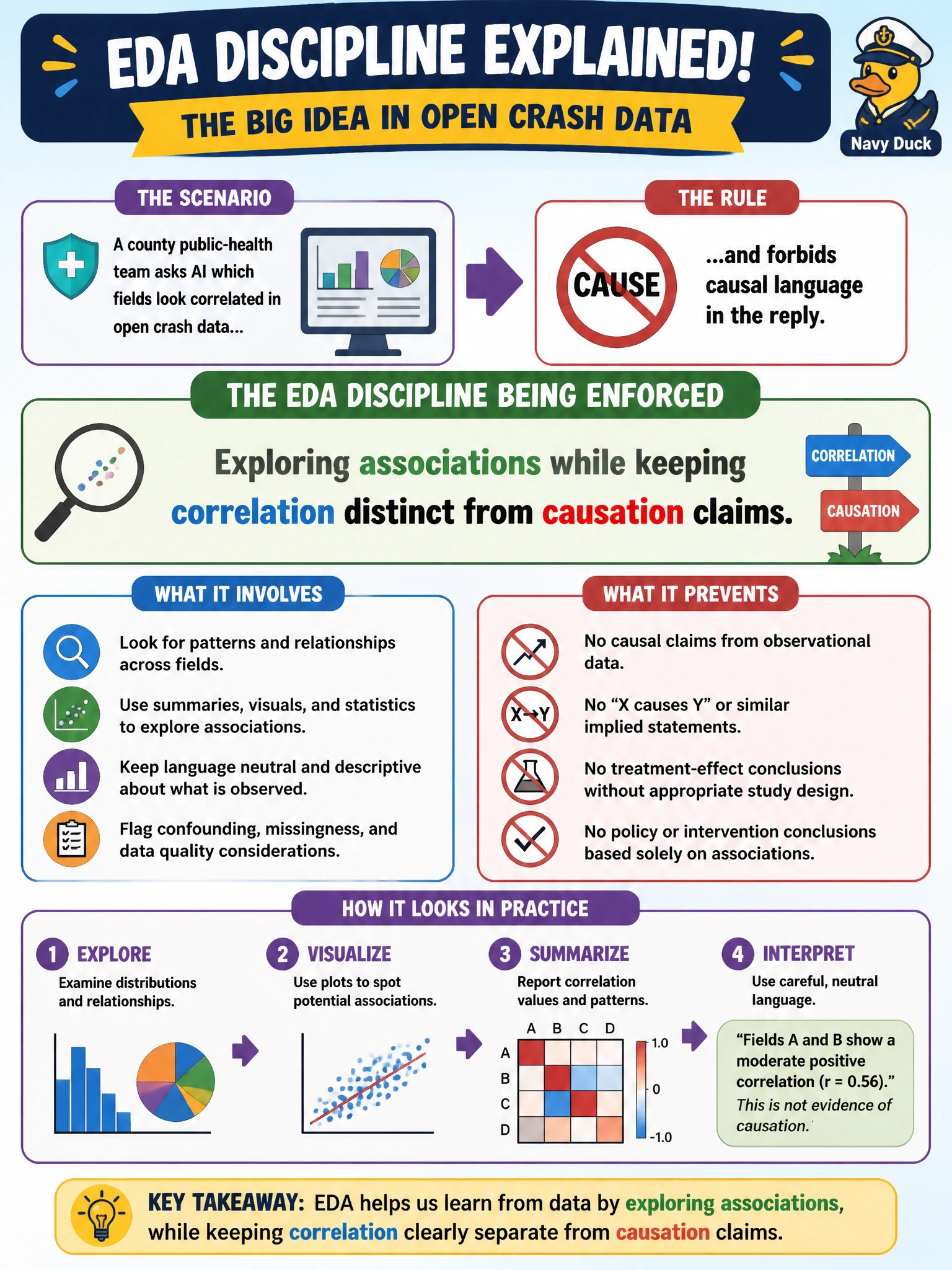
A county public-health team asks AI which fields look correlated in open crash data and forbids causal language in the reply. What EDA discipline is being enforced?
Select an answer to reveal the explanation.
Short Explanation
Correlation is “these dials move together,” not “this dial causes that one.” Asking the model for associated fields while banning causal wording keeps exploration honest. Nobody should write tickets or rewrite physics from a first-pass association list.
Full Explanation
Responsible exploratory analysis of open crash data requires distinguishing statistical association from causal inference. When a county public-health team asks AI which fields look correlated and forbids causal language in the reply, they are enforcing that EDA discipline: the model may surface candidate associations for human follow-up while being constrained not to claim that one field causes another. That control protects traffic-safety and health communications from overstated AI wording and keeps exploration intellectually honest.
Treating every correlation the model names as proven causation fails because association can reflect confounding, colliding, reporting bias, or shared time trends—classic failures when crash and health variables co-move. Skipping review of field definitions before modeling fails by concept: open crash schemas often encode severity, manner of collision, or impaired-status flags inconsistently across years; correlation lists without data-dictionary checks mislead. Using the correlation list as the sole basis for traffic citations fails because enforcement actions require lawful evidence and due process, not an EDA association spit out by a chat model.
Exam caveat: Banning causal verbs in the prompt is a useful guardrail but not a complete causal-inference program. Ecological correlations at county or corridor level still need epidemiologic and engineering review. Open data may omit vulnerable road-user nuance that changes interpretation.
Operational check: Prompt the assistant for associations only, with explicit “do not claim causation” instructions; have epidemiologists or traffic engineers validate field meanings; reproduce top correlations in audited code; and route any operational or messaging use through human review that separates hypothesis from intervention design. Never feed correlation dumps into citation workflows.