
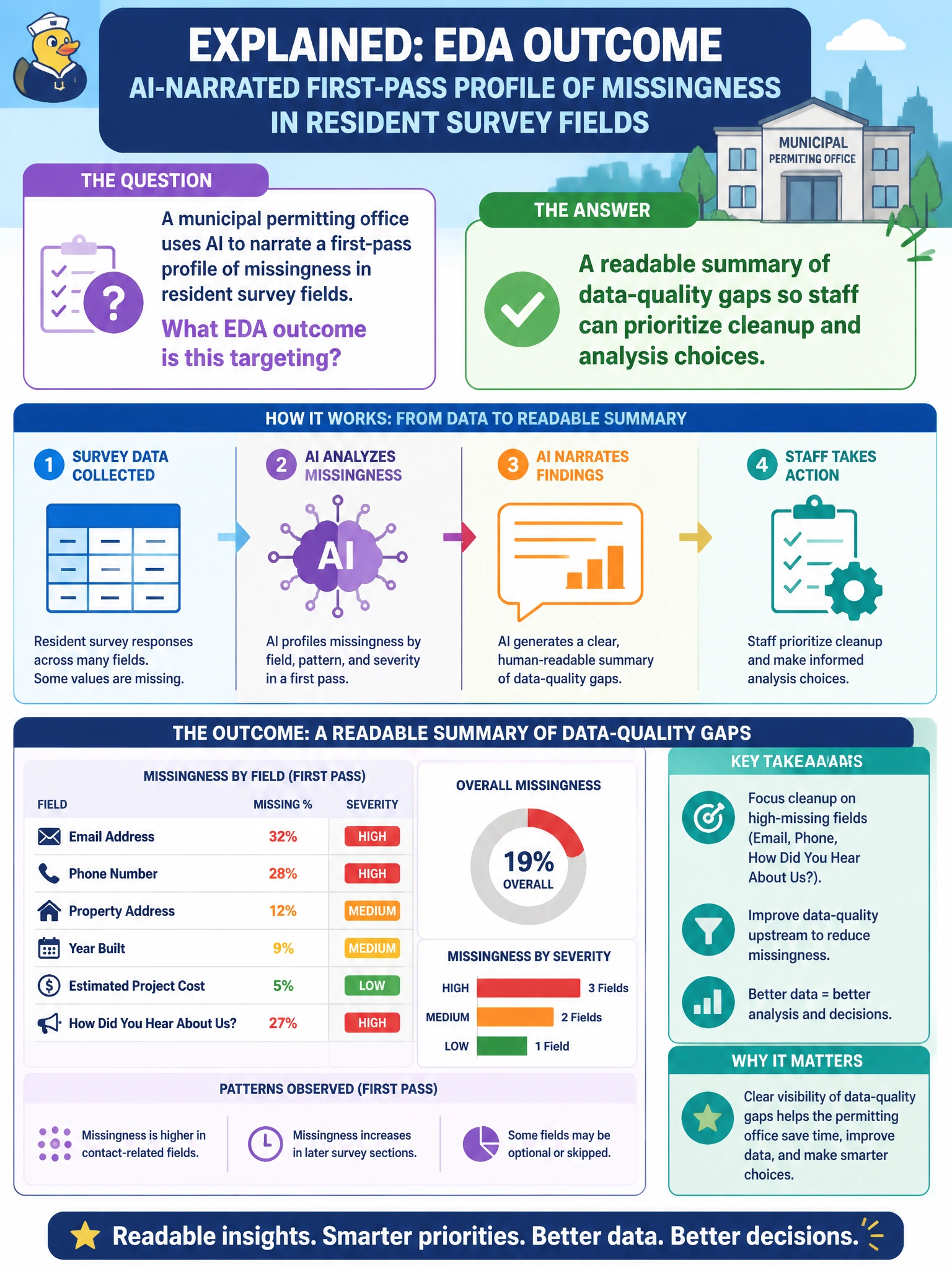
A municipal permitting office uses AI to narrate a first-pass profile of missingness in resident survey fields. What EDA outcome is this targeting?
Select an answer to reveal the explanation.
Short Explanation
A missingness profile gives you a readable map of where survey fields are blank, helping you prioritize cleanup and choose how to interpret results. You can use that EDA summary to guide decisions; it does not justify silently deleting records or assuming the gaps are harmless.
Full Explanation
An AI-narrated first-pass profile of resident survey fields is a data-quality EDA outcome: it gives you a readable map of where blanks concentrate so staff can prioritize cleanup, identify analysis limitations, or consider an imputation policy under governance. The value is understanding gaps before modeling or making public claims; nonresponse may correlate with language, housing tenure, or digital access. Automatic deletion of every incomplete survey without human review fails because missingness can be informative, legally constrained, or fixable through follow-up, and blanket deletion can bias permitting and equity analyses. A guarantee that missing fields are randomly distributed fails because municipal surveys may have systematic missingness; describing gaps does not prove they are missing completely at random (MCAR). Publishing incomplete rows unchanged as official open data fails because privacy, quality, or documentation standards may require suppression, disclosure of imputation, or field-level completeness notes; an EDA summary is not a release decision. Exam caveat: A missingness narrative is descriptive, not permission to invent values in sensitive fields or proof of survey representativeness; distinguish skip logic for some applicant types from true nonresponse. Practical check: On a governed extract, generate field-level counts, verify them against the survey platform export, classify gaps as skip logic, nonresponse, or pipeline drop, and document cleanup or limitations before modeling. Treat AI text as advisory and follow policy for retention and open-data decisions.