
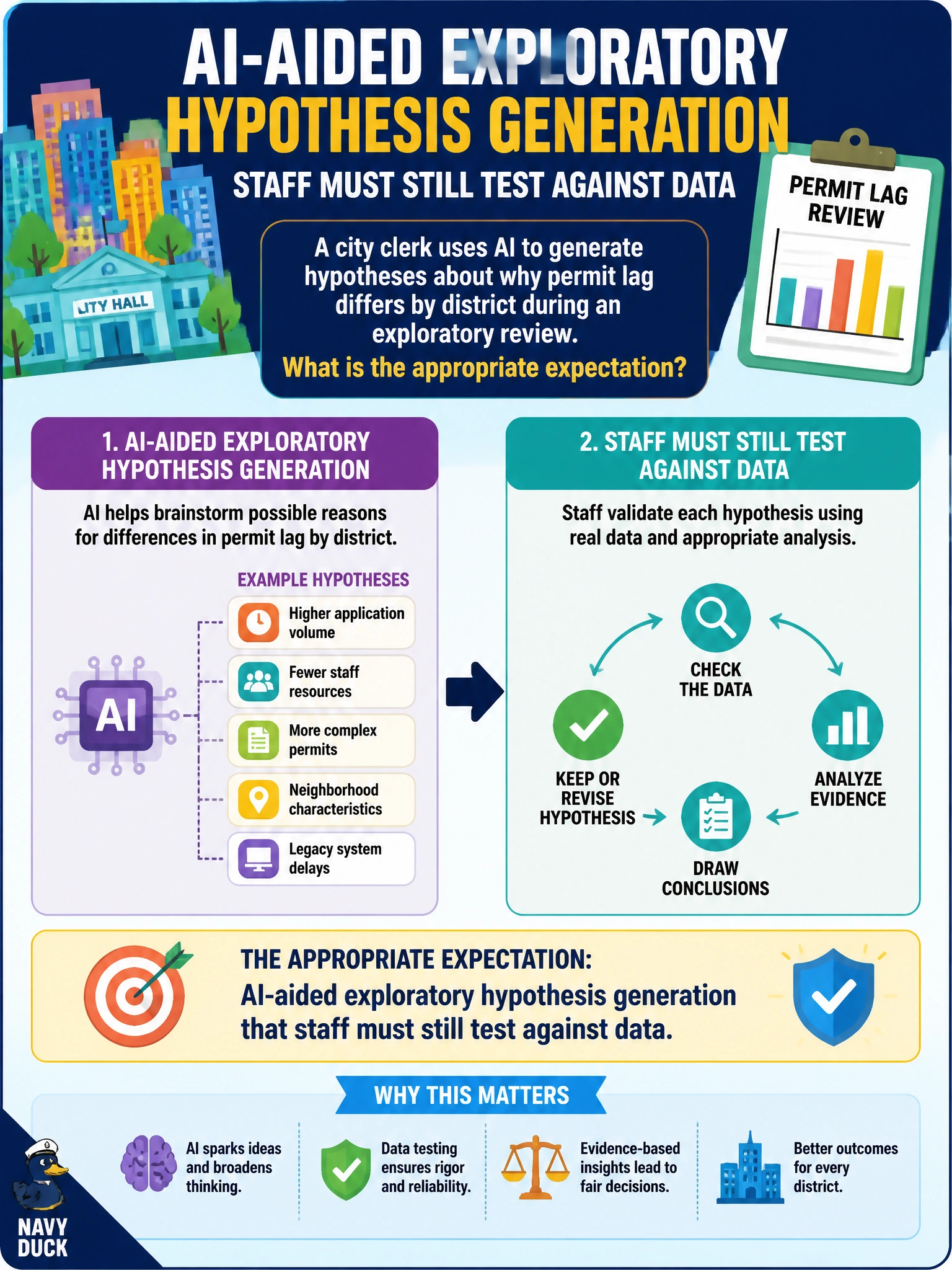
A city clerk uses AI to generate hypotheses about why permit lag differs by district during an exploratory review. What is the appropriate expectation?
Select an answer to reveal the explanation.
Short Explanation
Think of AI-generated hypotheses as starting points, not verdicts. You can use them to explore why permit lag differs by district, then test each idea against the actual permit data.
Full Explanation
AI-aided exploratory hypothesis generation is appropriate when you use it to suggest possible reasons permit lag differs by district, then test those ideas against data. Hypotheses are starting points for investigation, not automatic truths; AI can help you explore, but staff remain responsible for checking the evidence. Treating each AI hypothesis as true without checking source permits fails because a plausible explanation may not match the records. Treating hypotheses as a replacement for district demographic context fails because context is needed to assess differences fairly and interpret what the data show. Expecting the model to silently change historical permit timestamps confuses exploration with changing the system of record; hypothesis generation should not alter permit history. Exam caveat: exploratory hypotheses are not confirmed causes, so do not treat a model-generated explanation as proof. Practical check: record each hypothesis and test it against source permit data, consider relevant district demographic context, and verify that no historical timestamps were changed. Only ideas that survive those checks should inform further review.