
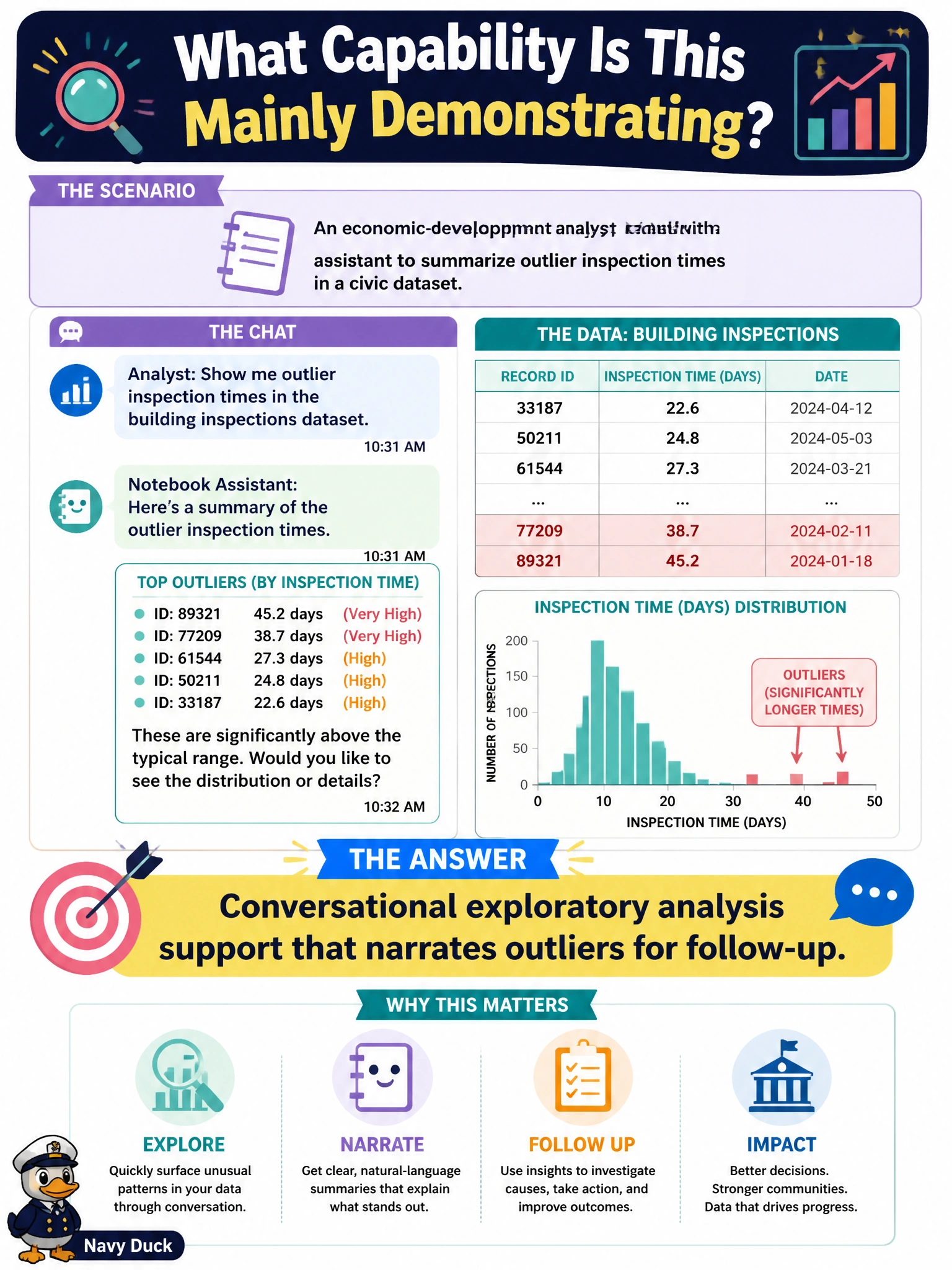
An economic-development analyst chats with a notebook assistant to summarize outlier inspection times in a civic dataset. What capability is this mainly demonstrating?
Select an answer to reveal the explanation.
Short Explanation
Chat-with-your-data is like asking a coworker, “What’s weird in these inspection times?” The assistant narrates outliers so the analyst can chase them down. It does not rewrite law, replace logged analytics, or magically classify every spike as a typo.
Full Explanation
When an economic-development analyst uses a notebook assistant to summarize outlier inspection times in a civic dataset, the capability on display is conversational exploratory analysis support: the model narrates unusual values, distributions, or candidate anomalies in plain language so the analyst can prioritize follow-up checks. That pattern is classic AI-assisted EDA—speed and readability of first-pass description—not replacement of logged analytics workflows or legal instruments. Municipal practitioners should treat the chat as a guided tour of the extract, then verify findings in reproducible code or BI.
Using AI to rewrite the city’s legal charter fails because charter and ordinance text are constitutional/local-law artifacts outside the scope of notebook EDA narration; conversational outlier summaries do not amend law. Replacing every statistical package with an unlogged chat transcript fails by concept: durable civic analysis needs reproducible methods, versioned notebooks or scripts, and auditability that ephemeral chat cannot provide. Guaranteeing that every outlier is a data-entry error fails because outliers may be true extreme events, special programs, or geocoding issues—AI narration proposes attention, not a certified root-cause label.
Exam caveat: Conversational EDA help can invent plausible-sounding summaries or miss stratified bias (for example, one district’s inspection clock definitions). Outlier talk is not automatic data cleansing. Keep PII and confidential business details out of unapproved assistants when inspection records are sensitive.
Operational check: Restrict the assistant to approved data scopes, ask for outlier summaries with explicit “correlation ≠ cause” and “verify in source” reminders, reproduce flagged inspection-time extremes in a logged notebook join to permit or facility IDs, and record human disposition (error, true extreme, needs field check) before any economic-development decision uses the finding.