
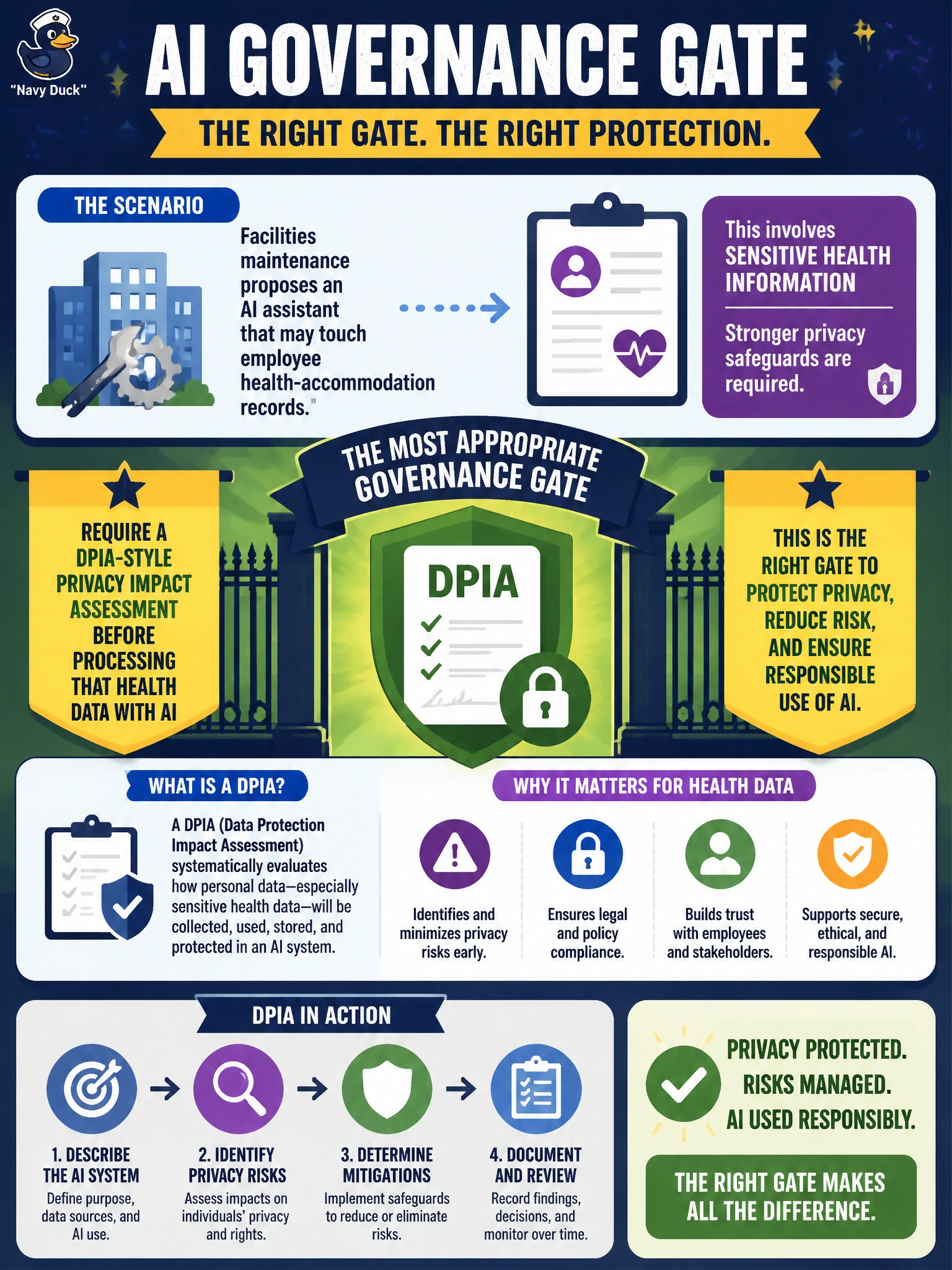
Facilities maintenance proposes an AI assistant that may touch employee health-accommodation records. What governance gate is most appropriate?
Select an answer to reveal the explanation.
Short Explanation
Health-accommodation data is not a casual demo dataset. Run a privacy impact-style review first so you know the risks, mitigations, and whether AI should touch it at all.
Full Explanation
When facilities maintenance proposes an AI assistant that may touch employee health-accommodation records, the most appropriate governance gate is to require a DPIA-style privacy impact assessment before processing that health data with AI. Health-accommodation information is sensitive; a privacy assessment documents necessity, proportionality, risks to employees, vendor processing, retention, access controls, and whether AI should process the data at all. That gate belongs before demos that ingest real accommodation fields into prompts or fine-tuning sets.
Launching immediately to gather real incidents as training data weaponizes employee health information as an experimental corpus and skips risk analysis. Relying solely on a marketing slide that says the vendor is trustworthy is not due diligence. Storing health fields in the prompt cache indefinitely without review creates an unassessed, persistent sensitive store outside normal HR and privacy controls.
Exam caveat: DPIA-style review is the privacy gate; security architecture and labor or HR policy review may still be required in parallel. Operational check: complete the privacy assessment, minimize health fields or exclude them if unnecessary for the assistant’s job, set retention on prompts and logs, restrict who can invoke health-scoped tools, and obtain formal approval before production use.