
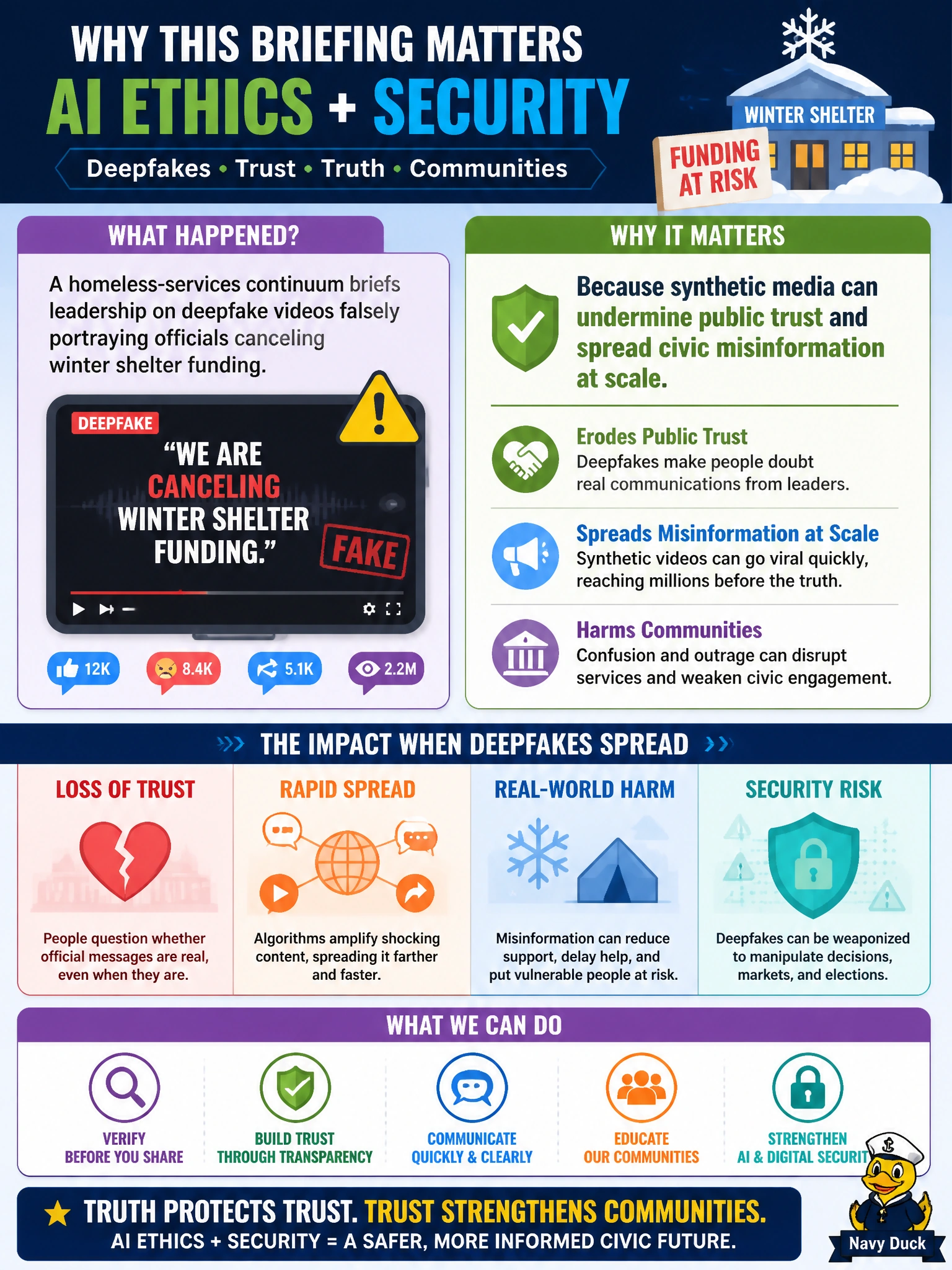
A homeless-services continuum briefs leadership on deepfake videos falsely portraying officials canceling winter shelter funding. Why is that briefing relevant to AI ethics and security?
Select an answer to reveal the explanation.
Short Explanation
A fake clip of a leader “canceling shelters” can panic a whole city overnight. Deepfakes are an AI misinformation problem that hits civic trust, not just movie magic.
Full Explanation
Briefing leadership on deepfake videos falsely portraying officials canceling winter shelter funding is relevant to AI ethics and security because synthetic media can undermine public trust and spread civic misinformation at scale. A forged clip can trigger panic, political pressure, and harmful resident decisions overnight—even when funding and shelter operations are unchanged. For a homeless-services continuum, that is not entertainment-industry trivia; it is an AI-enabled attack on civic trust and service continuity that ethics and security programs must anticipate.
Saying deepfakes only affect Hollywood studios, not civic trust, dismisses documented municipal and political misuse of synthetic media. Claiming winter shelter logistics are solved solely by buying more cots ignores the information environment that drives whether residents believe shelters exist and are funded. Asserting video codecs cannot be forged under any circumstances is technically and practically false in an era of generative video and voice cloning.
Exam caveat: relevance to AI ethics and security is about trust and misinformation harm, not a claim that every shelter capacity problem is a deepfake. Operational check: pre-draft verification and public-communications playbooks for viral synthetic videos, use authenticated channels for official funding statements, train leadership to respond quickly with factual corrections, and include a deepfake shelter-funding inject in tabletops.