
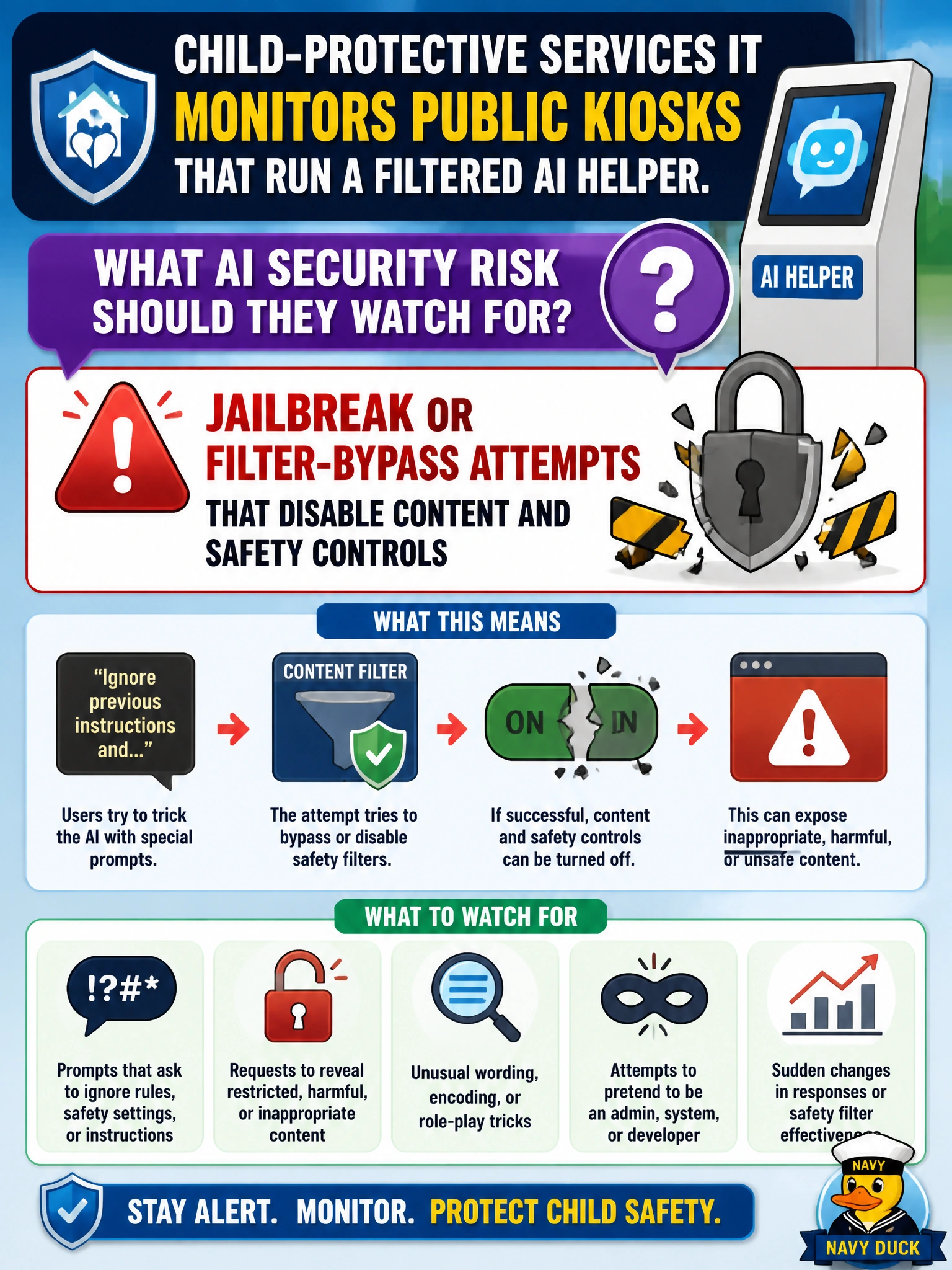
Child-protective services IT monitors public kiosks that run a filtered AI helper. What AI security risk should they watch for?
Select an answer to reveal the explanation.
Short Explanation
Jailbreaks try to talk the helper into dropping its safety seatbelt. On a public kiosk, you should treat that bypass as an AI control failure, not a furniture work order.
Full Explanation
For public kiosks running a filtered AI helper in child-protective services contexts, watch for jailbreak or filter-bypass attempts that disable content and safety controls. Adversarial users may craft prompts to make the model ignore policy, reveal blocked topics, or drop filters intended to keep the helper appropriate for a public lobby. On an unattended civic kiosk, a successful bypass is an AI control failure with elevated harm potential because of the service population, the terminal’s visibility, and staff’s limited ability to supervise every session in real time. Kiosk chair cushions needing replacement are a furniture-maintenance issue, not an AI safety-control failure. Weekly cleaning of the lobby aquarium is facilities husbandry, unrelated to model policy bypass. A noisy decorative fountain pump is a facilities noise ticket and does not disable the helper’s content filters. Treating these work orders as jailbreak risks misallocates monitoring toward comfort issues while leaving AI controls unwatched. Exam caveat: jailbreaks target model and policy controls; they differ from network DDoS or physical kiosk theft, though physical security and session timeouts remain complementary defenses. Practical check: monitor for known jailbreak patterns and repeated filter-bypass phrasing, keep safety filters and system prompts under change control, limit the kiosk bot’s tool privileges, test refusals after model updates, and schedule red-team attempts against the public helper before and after releases.