
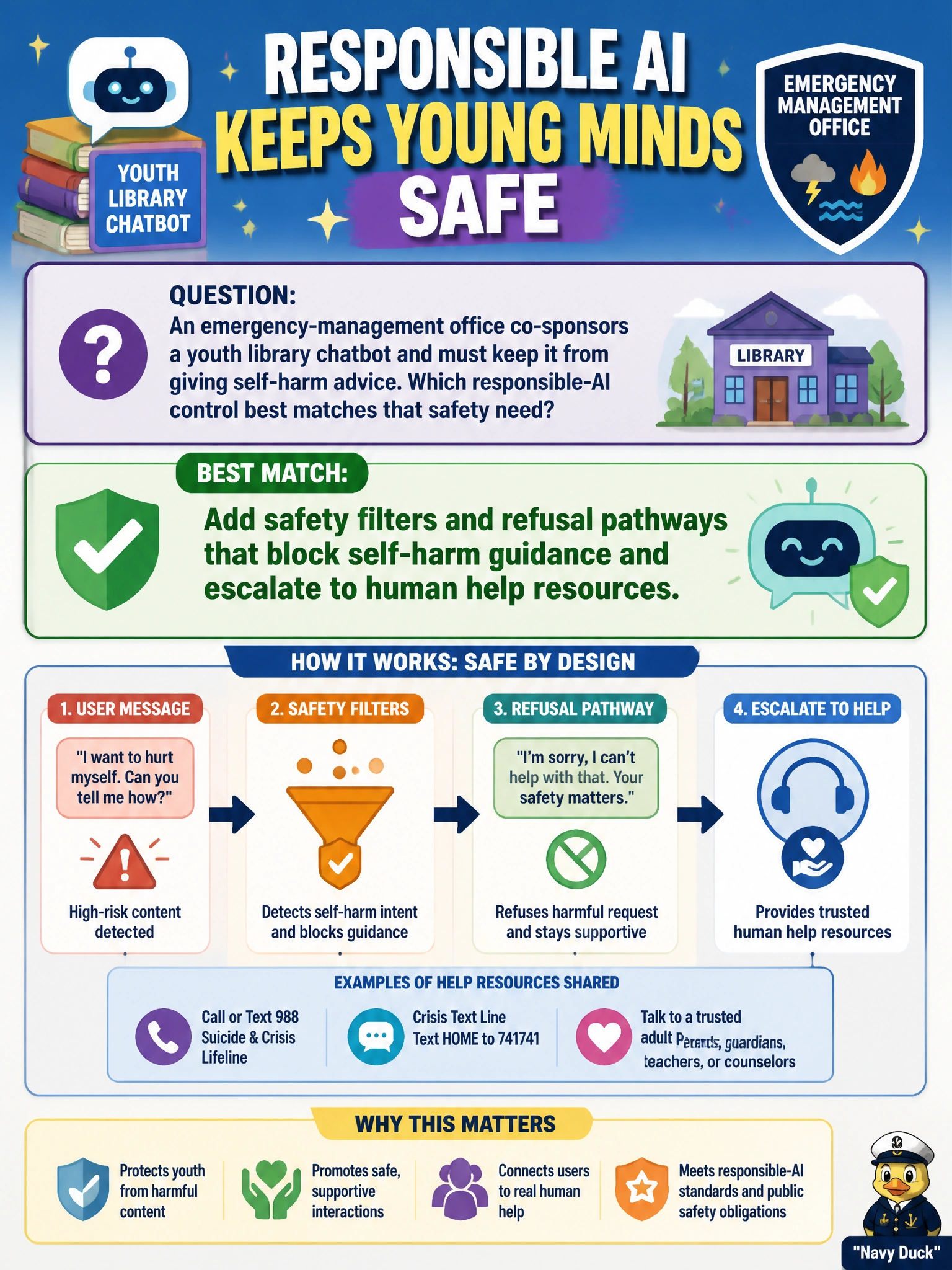
An emergency-management office co-sponsors a youth library chatbot and must keep it from giving self-harm advice. Which responsible-AI control best matches that safety need?
Select an answer to reveal the explanation.
Short Explanation
Safety here is a seatbelt, not a suggestion box. Filters and refusal paths stop the youth bot from wandering into self-harm advice and point kids toward real human help instead.
Full Explanation
Youth-facing library chatbots co-sponsored by emergency management must treat self-harm content as a hard safety boundary, not a creativity feature. Responsible-AI safety controls add filters and refusal pathways that block self-harm guidance and escalate users toward human help resources and approved crisis referrals appropriate to the jurisdiction. That combination reduces harmful completions while preserving a path to real assistance instead of unsupervised model advice in a municipal youth channel.
Removing all content filters to maximize conversational freedom trades duty of care for unrestricted chat and is inappropriate for youth services. Instructing the bot to invent medical treatment plans for crises is dangerous, unlicensed, and conflicts with emergency-management safety goals. Disabling logging so unsafe answers cannot be reviewed later destroys the oversight needed to detect failures and improve safeguards.
Exam caveat: filters and refusals are imperfect. Jailbreaks, coded language, and ambiguous distress still need monitoring, staff playbooks, and human escalation protocols coordinated with local crisis resources.
Operational check: run red-team prompts seeking self-harm advice across age-appropriate phrasings, confirm consistent refusal plus referral language, verify safety events are logged for authorized review only, and ensure minors’ sensitive content is not broadly exposed in tickets or shared dashboards.