
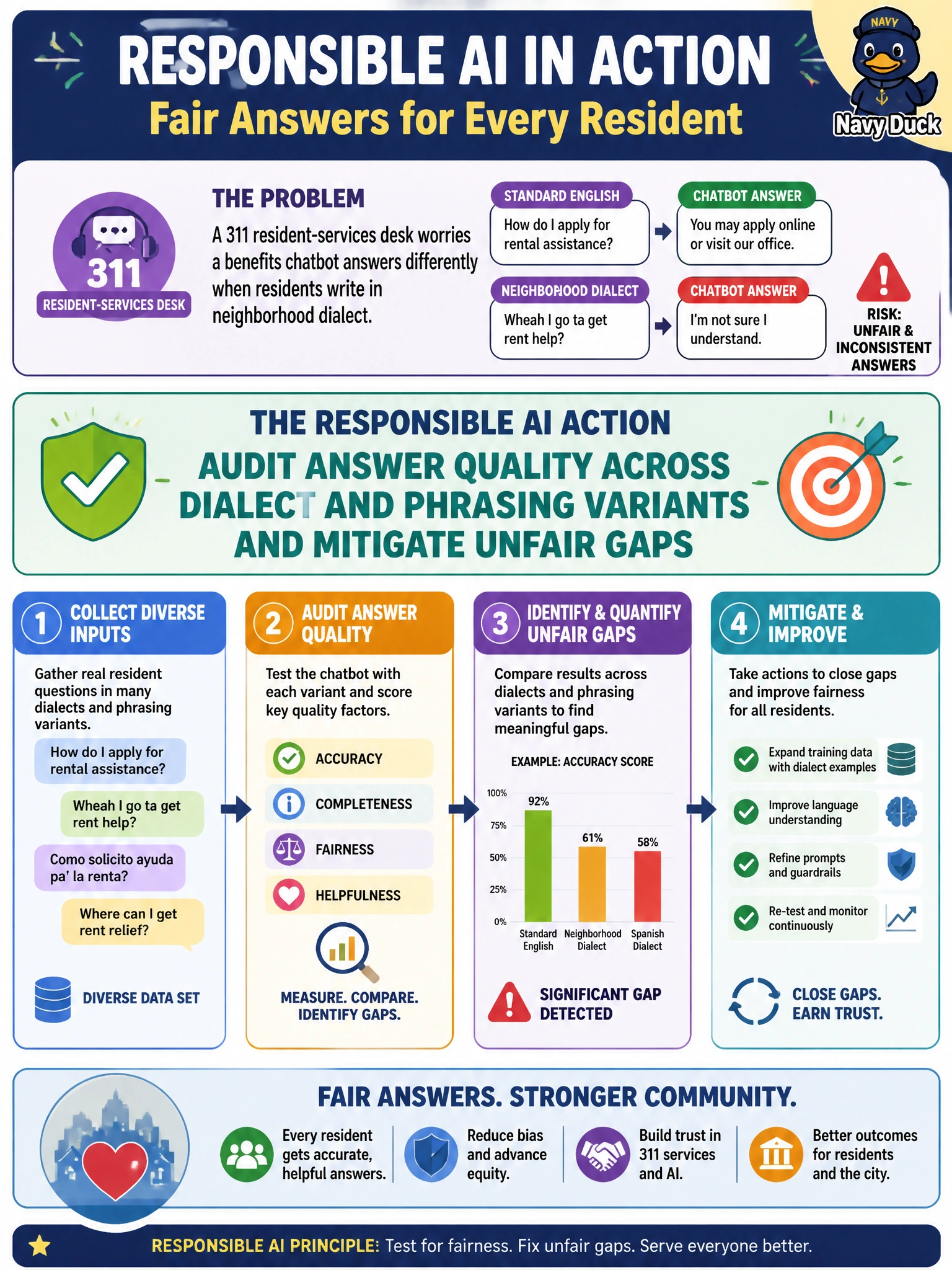
A 311 resident-services desk worries a benefits chatbot answers differently when residents write in neighborhood dialect. Which responsible-AI action best addresses that risk?
Select an answer to reveal the explanation.
Short Explanation
If the bot is kinder to textbook English than to neighborhood dialect, that’s unfair service with a silicon smile. Audit how answers change across phrasing variants, then fix the gaps—fairness is measured, not assumed.
Full Explanation
A 311 benefits chatbot that performs worse on neighborhood dialect than on formal English creates unequal access to municipal information. Responsible-AI practice requires measuring that risk empirically: audit answer quality across dialect and phrasing variants that residents actually use, compare accuracy, completeness, and tone, and mitigate unfair gaps through evaluation data, retrieval coverage, prompt adjustments, or human handoff rules. Fairness here is detected in outcomes—not assumed away because the web form "looks the same" to staff.
Ignoring dialect differences leaves disparate quality unmeasured and unfixed. Training staff to mock nonstandard spelling worsens harm and cultures bias inside the service desk. Routing only speakers of formal English to the chatbot excludes residents who most need clear benefits guidance and institutionalizes inequity under a technical excuse.
Exam caveat: a one-time audit is not continuous assurance. Language patterns, model versions, and corpus updates shift performance, so equity checks belong in regression testing. Also distinguish comprehension failures from retrieval gaps that happen to correlate with how a question is phrased.
Operational check: build a small paired test set of the same benefits questions in formal and dialectal phrasings used locally, score correctness and refusal quality, document gaps with examples, and track remediation until gap metrics meet the city’s equity threshold before wider 311 rollout.